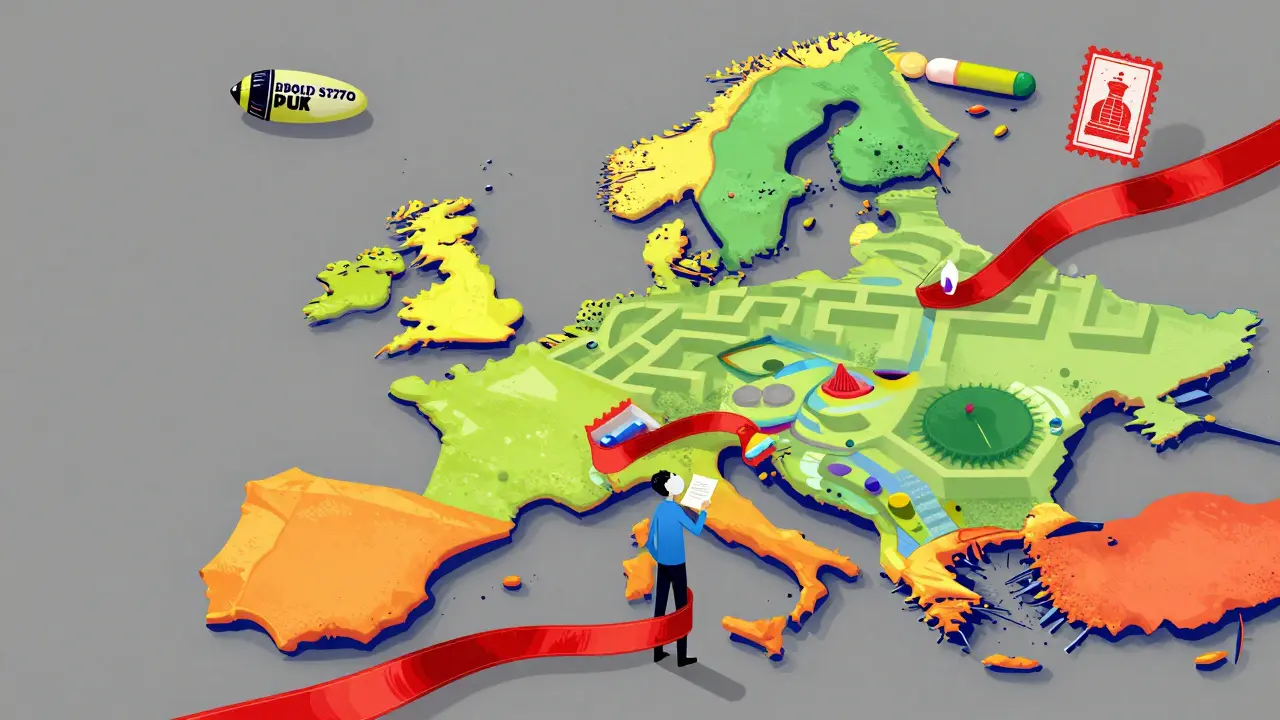
Getting a generic drug onto the European market isn't as simple as filing one piece of paperwork. It is a high-stakes game of timing, strategy, and navigating a multi-layered bureaucracy. For years, companies have dealt with a fragmented system where a drug approved in Germany might still face hurdles in Poland. However, the landscape just shifted. The European generic markets are currently undergoing their biggest overhaul in two decades thanks to the EU Pharma Package reforms finalized in June 2025.
If you are a manufacturer or a strategist, the goal is simple: get your product to patients as quickly as possible while spending the least amount on regulatory overhead. But the path you choose-whether it is a single EU-wide application or a country-by-country approach-can change your launch date by nearly a year and your costs by millions of euros. With the 2025 reforms, the rules on how long original patents protect a drug and when you can start negotiating prices have changed, meaning the old playbooks are officially obsolete.
The Four Pathways to Market Authorization
Depending on your budget and how many countries you want to target, you have four main ways to get a generic approved. Each has its own set of trade-offs regarding speed and cost.
Centralized Procedure (CP) is a single-application route managed by the European Medicines Agency (EMA). This grants a marketing authorization valid across all 27 EU member states. While it is the fastest way to hit the entire market at once, it is expensive. You are looking at roughly €425,000 in fees and up to €1.8 million in consultancy. Because of this, it is usually reserved for high-value generics expecting annual sales over €250 million.
Mutual Recognition Procedure (MRP) works by getting approval in one "Reference Member State" first, then asking other countries to recognize that decision. It is cheaper than the CP (around €180,000 to €220,000), but it creates a domino effect. If one country disagrees with a detail, it can stall your entry into others. For instance, Teva saw their rosuvastatin launch in the Netherlands delayed by over eight months because of pricing disputes in Germany, even though the drug was technically approved.
Decentralized Procedure (DCP) allows you to apply to several countries simultaneously without needing a prior national approval. On paper, it sounds like the best of both worlds, but in reality, it is often a headache. Nearly 37% of these applications face delays of six months or more because different national authorities-especially in Eastern Europe-interpret quality requirements differently.
National Procedure is the simplest but most limited. You apply to one country, and it's only valid there. It's a niche strategy used mostly for specific high-reimbursement markets where a full EU rollout isn't the priority.
| Pathway | Scope | Avg. Cost | Key Advantage | Main Risk |
|---|---|---|---|---|
| Centralized (CP) | EU-wide | €1.6M+ | Fastest total access | High entry cost |
| Mutual Recognition (MRP) | Selected States | €200k | Lower initial cost | Sequential delays |
| Decentralized (DCP) | Selected States | Moderate | Simultaneous filing | Inconsistent interpretations |
| National | Single State | Low | Targeted entry | No scalability |
Breaking Down the 2025 Pharma Package Reforms
The 2025 reforms aren't just minor tweaks; they fundamentally change the math for generic entry. The most critical change is the Bolar Exemption, which is a legal provision allowing generic makers to conduct tests and prepare for launch before a patent expires. Previously, you could only start pricing and reimbursement talks two months before the patent ended. Now, that window has expanded to six months. This is a huge win for generics, potentially shaving four months off the time it takes to hit the shelves.
Then there is the issue of Regulatory Data Protection (RDP). The standard protection has been reduced from 10 years to a "8+1" model (8 years of data protection and 1 year of market protection). While some original innovators can extend this to 10 years by hitting specific public health targets, the general trend is toward faster generic competition. This shift is expected to accelerate the entry of about 78 high-value biologics currently in the pipeline.
However, it's not all smooth sailing. The new "obligation to supply" mechanism aims to stop drug shortages by requiring companies to provide sufficient quantities of essential medicines. While this sounds good for patients, some experts worry that different countries will define "sufficient" differently, creating artificial barriers that make it harder for smaller generic firms to compete in niche markets.

The Technical Hurdle: Bioequivalence and Quality
Regardless of which pathway you choose, you have to prove your drug is essentially the same as the brand-name version. This is where Bioequivalence comes in. You must show that the rate and extent of absorption of your drug are the same as the reference product. Specifically, the 90% confidence intervals for Cmax (peak concentration) and AUC (total exposure) must fall between 80.00% and 125.00%.
But here is the catch: the EMA sets the standard, but national authorities often add their own "flavor." For example, if you are producing complex generics like inhalers, the German BfArM often demands extra pharmacodynamic studies that the EMA doesn't even ask for. Similarly, French authorities (ANSM) have very specific requirements for pediatric formulations. If you don't account for these national quirks during your 15-18 month preparation phase, you will see your approval clock restart every time a national agency raises an objection.
Adding to the technical load, by 2026, all companies must move to Electronic Product Information (ePI) in XML format. This isn't just a software update; it's a significant infrastructure investment, estimated at up to €250,000 per company, to ensure that drug leaflets can be updated digitally and instantly across all languages.
Market Dynamics and Competitive Pressure
The money in the EU generics sector is massive-valued at €42.7 billion in 2024. But the profit margins are shrinking. While generics make up 65% of all prescriptions by volume, they only account for 18% of the total value. This means volume is everything.
We are seeing a major shift in who controls the market. Indian manufacturers are becoming far more aggressive, capturing 38% of EU generic approvals in 2024, up from 29% just four years ago. On the other hand, European giants like Sandoz are using the Centralized Procedure to dominate high-value launches. Sandoz recently used this route for a generic version of Cosentyx, launching across the entire EU 11 months faster than they would have using the MRP route.
Furthermore, the Critical Medicines Act of March 2025 has added another layer of complexity. It mandates stockpiling for 200 essential generics. While this prevents the dreaded "out-of-stock" notices at pharmacies, it introduces new quality verification protocols that can act as a barrier to entry for smaller players who can't afford the storage and testing overhead.
Which approval pathway is best for a mid-sized company?
For mid-sized firms, the Mutual Recognition Procedure (MRP) is usually the most balanced choice. It avoids the massive upfront costs of the Centralized Procedure while allowing for a broader reach than the National Procedure. However, the key is to pick a Reference Member State with a regulatory body that is respected and aligned with your target markets to minimize sequential delays.
How does the 2025 Bolar exemption change the launch timeline?
The expanded Bolar exemption allows generic manufacturers to start pricing and reimbursement negotiations six months before a patent expires, rather than just two. This effectively moves the administrative "start line" back, potentially accelerating the actual market launch by an average of 4.3 months.
What happens if a national authority disagrees with the EMA?
In the DCP or MRP pathways, if a national authority raises an objection, the assessment clock can essentially restart or enter a period of arbitration. This is why many companies are shifting toward the Centralized Procedure for high-value drugs; it removes the risk of individual national authorities blocking a wider EU launch.
What is the new standard for Regulatory Data Protection?
The new standard is an "8+1" model: 8 years of data protection followed by 1 year of market protection. This can be extended to 10 years if the original drug developer meets specific public health targets, but the baseline reduction aims to bring generics to market faster.
Do I need to worry about the Critical Medicines Act?
Yes, if your product is among the 200 essential generics listed. You will face mandatory stockpiling requirements and new quality verification protocols. This increases your operational costs and requires a more robust supply chain strategy to ensure compliance.
Next Steps for Generic Manufacturers
If you're planning a launch for 2026 or beyond, your first move should be a gap analysis of your current documentation against the 2025 Bioequivalence Guidelines. Don't assume your existing studies are enough; the EMA has tightened the requirements for impurity profiling and stability data.
Secondly, audit your IT capabilities. If you aren't ready to submit product information in XML format by 2026, you'll be facing a regulatory wall that no amount of legal maneuvering can fix. Start investing in ePI-compliant infrastructure now.
Finally, decide on your pathway based on the 2025 economics. If your projected sales are high, the Centralized Procedure is no longer just a luxury-it's a competitive necessity to avoid the 11-month average delay seen in fragmented national launches. If you are targeting niche markets, focus on the MRP but choose your Reference Member State with extreme care to avoid the "domino delay" effect.