
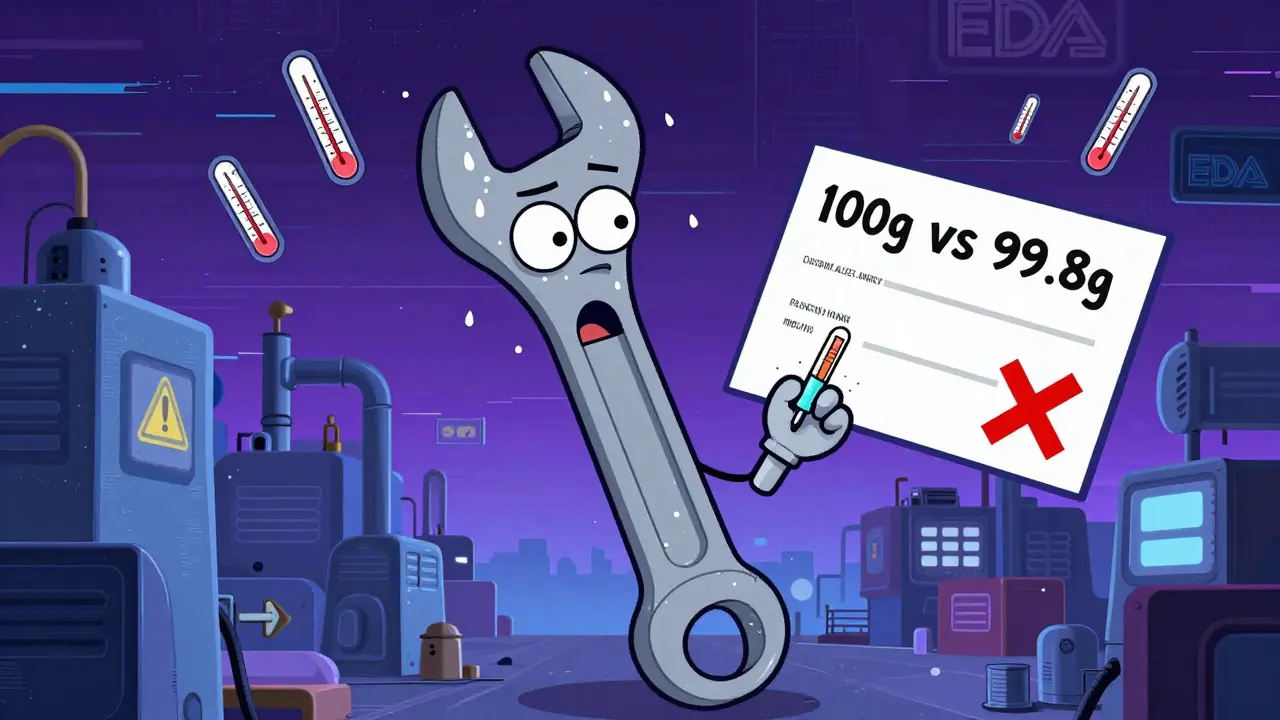
Why Calibration and Validation Aren’t Just Paperwork
If your production line’s scale reads 100 grams when it should read 99.8, is that a big deal? In most factories, maybe not. But in a medical device plant making insulin pumps or cardiac stents, that 0.2% error could mean a patient gets the wrong dose. That’s why equipment calibration and validation aren’t optional checklists-they’re lifelines. They keep your products safe, your audits clean, and your customers alive.
Calibration makes sure your tools tell the truth. Validation makes sure they do the right job. One checks accuracy. The other checks purpose. Mixing them up is like confusing a thermometer with a heart monitor. Both matter, but they don’t do the same thing.
What Calibration Really Means (And What It Doesn’t)
Calibration isn’t just sending a tool to a lab once a year and getting a sticker. It’s a documented process that links your instrument’s reading to a known standard-something traceable back to the International System of Units (SI). That means if you’re measuring temperature, your thermometer must be checked against a reference that’s been calibrated against a national lab like NIST in the U.S. or NML in Australia.
ISO 13485:2016, the gold standard for medical device manufacturers, says calibration must happen at specified intervals or before use. That’s flexible, but not vague. You can’t just pick a number. You have to prove why you chose it. A micrometer used every hour in aerospace might need monthly checks. A simple thermometer in a warehouse storing boxes? Maybe every two years. The key is data. If your equipment hasn’t drifted in 18 months, you can extend the interval-but only if you’ve tracked it.
And here’s the catch: calibration isn’t just about the tool. It’s about the environment. NIST Technical Note 1900 found that 57.8% of out-of-tolerance failures happen when temperature swings more than ±5°C from calibration conditions. If your lab runs hot in summer, your digital calipers drift. That’s not the tool’s fault. It’s your process.
Validation: Making Sure the Tool Does What It’s Supposed To
Calibration says, “This scale reads 100.00 grams correctly.” Validation says, “Will this scale reliably measure the weight of a drug tablet under real production conditions-vibration, dust, humidity, operator pressure?”
Validation is broken into three steps: Installation Qualification (IQ), Operational Qualification (OQ), and Performance Qualification (PQ). IQ checks that the equipment was installed right-wiring, software, environment. OQ tests that it works under all expected conditions-speed, load, temperature range. PQ proves it performs consistently over time with actual product.
For a new automated filling machine in a sterile pharmaceutical plant, this process can take six months and cost $200,000. For a simple label printer? Maybe two days and $5,000. The scope depends on risk. FDA’s 21 CFR Part 820 requires this for any equipment that affects product quality. Skip it, and you’re not just risking a failed audit-you’re risking recalls, lawsuits, and worse.

How Regulations Differ (And Why It Matters)
Not all rules are the same. ISO 13485:2016 demands full traceability to SI units with no exceptions. CLIA, which governs clinical labs in the U.S., lets you skip calibration for some point-of-care devices like glucose meters-as long as you verify them daily with control solutions. That’s a 23.5% reduction in workload for waived tests.
And then there’s the EU. Under MDR 2017/745, you need traceability to BIPM (International Bureau of Weights and Measures). In the U.S., NIST is enough. If you sell globally, you need two sets of records. That’s not just paperwork-it’s double the cost, double the training, double the risk of error.
Even software gets caught in this net. If you’re using an algorithm to calculate dosage based on sensor input, ISO 13485 Amendment 1 (March 2024) now requires you to validate it continuously. Not just at launch. Every time the model updates. That’s new. And it’s not optional.
The Hidden Cost of Poor Calibration
Most companies think calibration is a cost center. It’s not. It’s a risk shield.
Look at FDA warning letters. In 2023, 37.2% cited inadequate calibration procedures. That’s not a typo. It’s the #1 reason for non-compliance notices. One company in Ohio lost a $12 million contract because their torque wrenches weren’t calibrated properly. The client found three out of ten units were over-tightened-causing thread failure in surgical implants.
Small manufacturers pay the most. Companies under 50 employees spend 22.3% more per device on compliance than big ones. Why? They can’t negotiate bulk rates with calibration labs. They don’t have metrology specialists on staff. They’re using spreadsheets instead of software.
And the burden? A 2024 FDA survey found small medical device firms spend 15.2 hours a week just managing calibration records. That’s almost two full workdays. And if you’re audited? You’ve got to produce those records in 48 hours. No digital logs? No second chances.
How to Get It Right (Without Going Broke)
You don’t need to calibrate everything monthly. You need to calibrate what matters, when it matters.
Start with an inventory. List every tool that affects product quality. Classify them by risk: high, medium, low. High-risk tools? Think precision gauges, autoclave sensors, analytical balances. Low-risk? Basic tape measures, non-critical timers.
Use the “Method 5” approach from SAE AS9100D: combine manufacturer recommendations, your own historical data, and risk assessment. If your laser distance meter has stayed within tolerance for 24 months, don’t calibrate it every 6. Extend it. Track it. Prove it.
Invest in software. Tools like GageList or Trescal automate certificate generation, send reminders, store digital records, and integrate with ERP systems. Companies using them cut audit prep time by 63%. That’s 84 hours down to 31 per week.
And don’t ignore the environment. Install temperature and humidity monitors in calibration areas. If it hits 28°C and 70% humidity, flag it. That’s not just uncomfortable-it’s invalidating your measurements.
What’s Changing in 2026 (And What You Need to Do)
Two big shifts are coming.
First, the FDA’s 2024 Calibration Modernization Initiative requires all Class II and III medical device manufacturers to use electronic records by December 31, 2026. Paper logs? Gone. Handwritten signatures? Not enough. You need digital audit trails with user authentication. If you’re still printing certificates, you’re already behind.
Second, AI-driven calibration scheduling is here. Pfizer’s pilot program cut calibration costs by 31.7% by using sensors to trigger calibrations only when drift is detected-not on a calendar. That’s condition-based, not time-based. It’s smarter. It’s cheaper. And it’s the future.
But there’s a catch: 44.2% of automated systems fail to document the chain of custody for reference standards. If your AI says “calibrate now,” but you can’t prove the reference weight was last checked by a certified lab in April 2025, you’re still non-compliant.
And the talent gap? Real. 83.6% of calibration labs report technician shortages. If you’re hiring, look for ASQ Certified Calibration Technicians (CCT). They’re trained in metrology fundamentals and regulatory expectations. They cost more-but they prevent costly mistakes.
Bottom Line: It’s Not About Compliance. It’s About Control.
Calibration and validation aren’t about passing audits. They’re about knowing your equipment behaves exactly as it should-every single time. In manufacturing, especially medical, uncertainty kills. Precision saves.
Start small. Pick one high-risk tool. Document its calibration. Track its performance. Extend the interval if data supports it. Automate the reminders. Train your team. Build from there.
Because in this industry, the difference between a product that works and one that fails isn’t always the design. Sometimes, it’s whether a screwdriver was calibrated last week-or last year.
What’s the difference between calibration and validation?
Calibration checks if a tool gives accurate readings by comparing it to a known standard. Validation checks if the tool performs correctly in its actual use environment-for example, whether a filling machine delivers the exact dose under real production conditions. Calibration is about accuracy. Validation is about functionality.
How often should equipment be calibrated?
There’s no universal answer. ISO 9001 and ISO 13485 require calibration at intervals determined by risk and performance data. High-precision tools like micrometers may need monthly checks. Stable tools like basic thermometers might be calibrated every 18-24 months. The key is using historical data-not just manufacturer recommendations-to justify your schedule.
Can I skip calibration if the equipment seems fine?
No. Even if a tool looks fine, it can drift beyond tolerance without visible signs. In medical device manufacturing, this is a top reason for FDA 483 observations. Calibration isn’t about appearance-it’s about documented, traceable proof of accuracy. Skipping it risks recalls, fines, and patient harm.
What happens if I don’t validate my equipment?
Without validation, you can’t prove your equipment does what it’s supposed to in real-world conditions. This leads to failed audits, regulatory actions, and product recalls. For example, a sterilizer might read 121°C correctly (calibrated), but if it doesn’t maintain that temperature evenly across all trays (not validated), your medical devices could be contaminated.
Do I need software to manage calibration?
Not mandatory, but highly recommended. Manual systems using spreadsheets or paper logs are error-prone and time-consuming. Companies using calibration management software reduce audit prep time by over 60%, eliminate lost records, and automate reminders. For small manufacturers, the return on investment is clear: fewer compliance failures and less staff time wasted.
Is calibration required for all equipment in a manufacturing facility?
No. Only equipment that directly affects product quality, safety, or regulatory compliance needs formal calibration. A floor mop doesn’t need it. A torque wrench that tightens implant screws does. Risk-based classification is key-focus your resources where errors matter most.
What’s the biggest mistake companies make with calibration?
Treating calibration as a calendar event instead of a risk-based process. Many companies calibrate everything on the same schedule-quarterly or annually-regardless of usage, environment, or stability. The result? Wasted money on unnecessary calibrations and missed drift on critical tools. Data-driven intervals reduce costs and improve reliability.
How do I know if my calibration lab is reputable?
Ask for their accreditation (ISO/IEC 17025), traceability documentation (showing chain to NIST or BIPM), and sample calibration certificates. A reputable lab will provide detailed uncertainty values, environmental conditions during calibration, and signed statements of compliance. Avoid labs that just give you a sticker without data.



Reviews
And don't get me started on the EU's BIPM nonsense. NIST is good enough. We invented metrology. Stop copying European bureaucracy.
Also why is everyone so scared of a little drift? We're not launching rockets here. Just stents.
Maybe the real problem is we're training people to chase stamps instead of understanding why the tool matters.
Calibration is the skeleton. Validation is the heartbeat. But what if the system itself is sick? What if we're treating symptoms instead of the disease of overcontrol?
We need to ask: are we protecting patients... or protecting ourselves from liability?
There's a difference between precision and paranoia.
also i used a cheap digital scale for 3 years and it never missed once. maybe the data says we're overdoing it?