
When you're traveling with medications like insulin, vaccines, or biologics, the weather outside your car or suitcase can make all the difference between a safe dose and a useless one. A 2023 survey found that 68% of pharmacists reported at least one temperature-related issue with medications during summer months - and most of those problems happened after the package left the pharmacy. Whether it's a hot car in Perth or a freezing airport tarmac, your meds need protection. This guide shows you exactly how to handle them - no jargon, no theory, just what works.
Know Your Medication's Temperature Needs
Not all medications react the same way to heat or cold. The three main categories are:- Ambient (15°C-25°C): Most pills, capsules, and some liquid antibiotics. These are less sensitive, but still shouldn't be left in a hot car or a freezing garage.
- Refrigerated (2°C-8°C): Insulin, many vaccines, biologics, and some eye drops. These can lose potency fast if they get too warm - or freeze.
- Cryogenic (below -150°C): Very rare for personal use. Mostly hospital or clinical use for specialized treatments.
Check the label. If it says "store in refrigerator," treat it like a perishable food. If it says "keep at room temperature," don't assume that means your sun-baked dashboard is fine. Room temperature doesn't mean "hot car."
Hot Weather: Don't Let Your Meds Cook
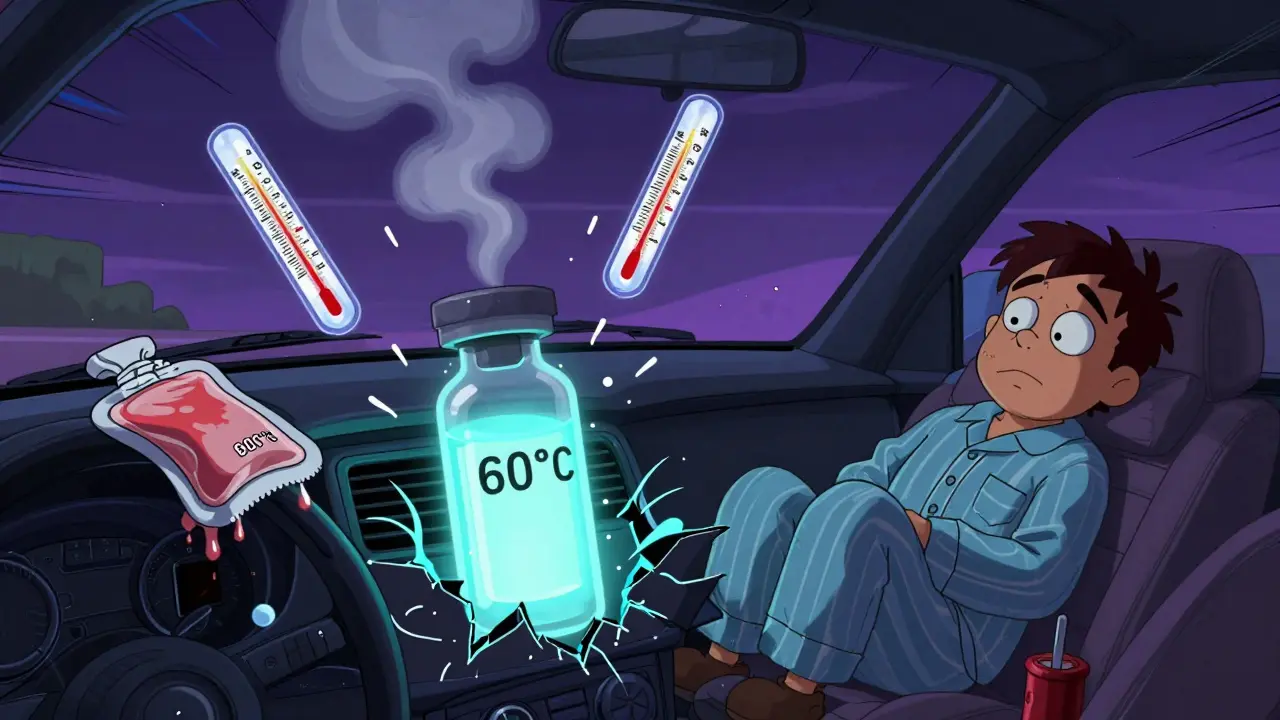
Insulin degrades at a rate of 1.2% per hour above 25°C. Some antibiotics become completely ineffective after just 30 minutes above 40°C. That’s not theoretical - real patients have had cloudy, unusable insulin after leaving it in a car for 45 minutes.Here’s what to do:
- Never leave medication in a parked car, even with the windows cracked. A car can hit 60°C in under an hour.
- Use an insulated cooler or travel case with frozen gel packs. A standard insulated lunch bag with two frozen ice packs can hold 2°C-8°C for up to 8 hours in 90°F weather.
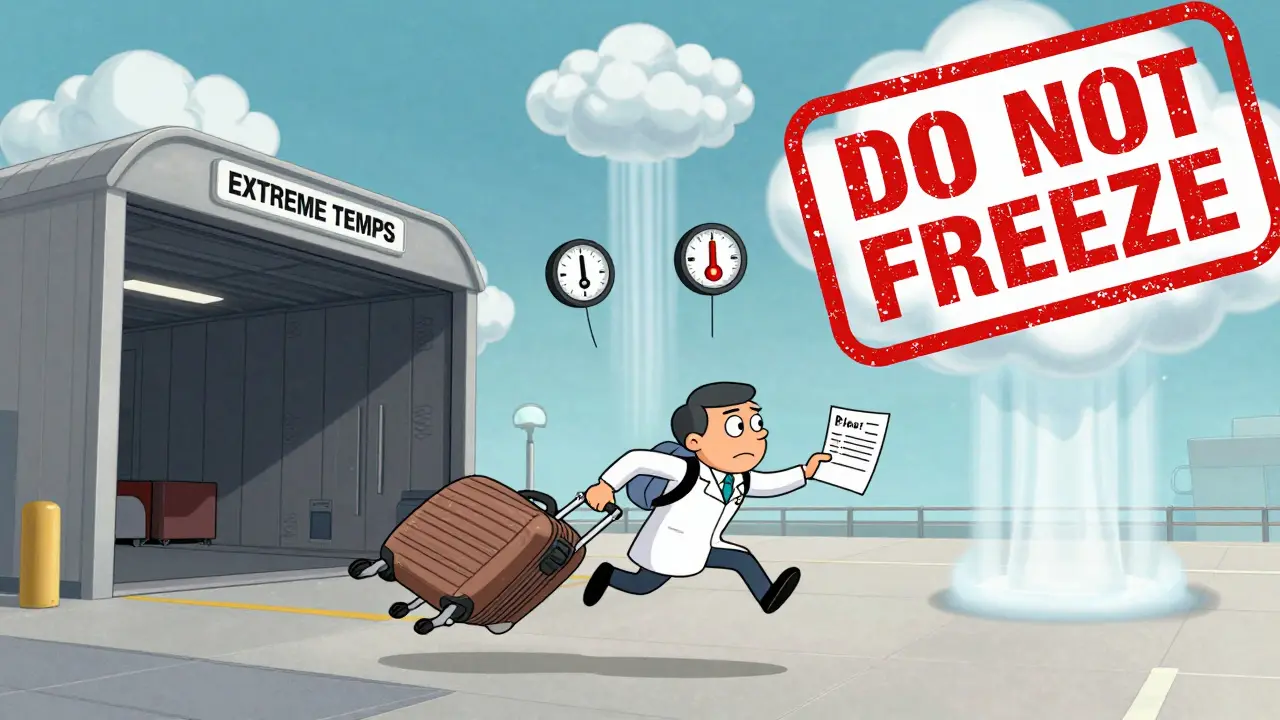
- Keep meds with you, not in checked luggage. Airline cargo holds can drop below freezing or soar above 50°C.
- For long trips, consider a portable temperature-controlled device like the TempAid 2.0, which maintains refrigerated temps for 48 hours. It weighs 3.2 lbs and holds enough for a week - popular with travelers, though not ideal for backpacking.
- If you're flying, carry a doctor’s note and ask to store your meds in the plane’s onboard refrigerator (most airlines will accommodate this).
Cold Weather: Avoid the Freeze
Freezing can damage insulin vials, break glass ampoules, or ruin vaccine formulations. A 2022-2023 winter saw a 17% spike in cold-related transport failures for vaccines and biologics.Here’s how to protect against cold:
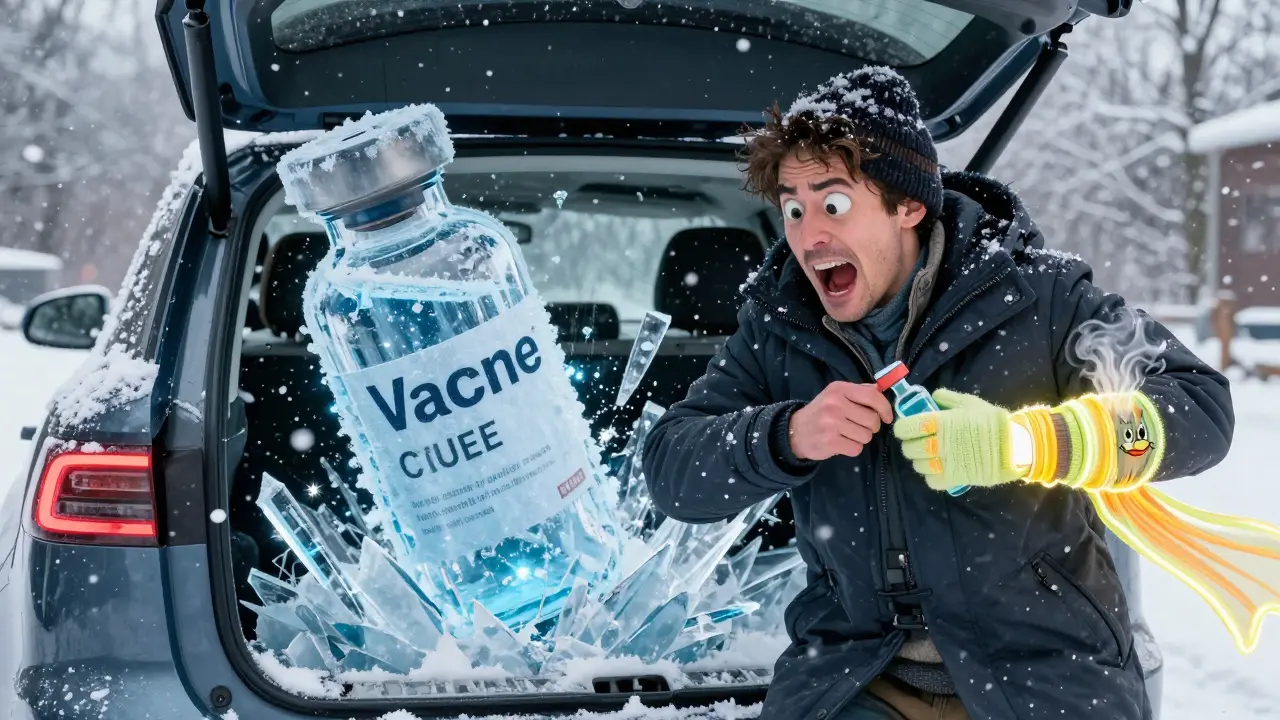
- Don’t let meds sit outside in the cold. Even a porch or unheated garage can drop below 0°C.
- Use insulated packaging - not just foam, but real thermal wraps. IATA guidelines say insulated blankets should be used during transfers in extreme cold to limit exposure to under 5 minutes.
- Keep meds close to your body. A jacket pocket or inner bag is better than a suitcase.
- If you're traveling by car, store meds in the cabin, not the trunk. Trunks get colder than the inside of the car.
- For extended cold exposure (like winter road trips), use a thermal bag with a small hand warmer (not direct contact). Never use a heated blanket or microwave - uneven heat can ruin the product.
Traveling? Pack Smart
Most temperature failures happen during the "last mile" - the final transfer from car to home, or from airport to hotel. That’s where 43% of all excursions occur.Here’s a simple checklist:
- Carry meds in your carry-on - never checked baggage.
- Use a hard-shell insulated case with gel packs (not just a ziplock bag).
- Bring extra ice packs. Freeze them the night before. They’ll last longer than store-bought cold packs.
- Label your bag: "Temperature-Sensitive Medication - Do Not Freeze or Expose to Heat."
- Have a backup plan. If your meds get compromised, know where the nearest pharmacy is. Keep a list of emergency contacts.
One Reddit user shared: "My insulin turned cloudy after being left in a 95°F car for 45 minutes. The pharmacist said it was degraded. I had to get a new prescription on the spot." That’s avoidable.
What About Regular Pills?
If you’re taking common pills like blood pressure meds, antibiotics, or painkillers, they’re more forgiving. But they still shouldn’t be left in direct sun or freezing temps for days. A 2021 FDA guidance says: "Pharmaceutical quality is determined by maximum temperature exposure, not average." So even if your meds were cool for 20 hours but hit 45°C for 30 minutes - that’s enough to risk degradation.Keep them in their original packaging. That foil blister pack? It’s not just for looks - it’s a barrier against moisture and heat. Don’t dump pills into a pill organizer unless you’re using it for immediate use (within a day or two).
Monitoring and Documentation Matter
The pharmaceutical industry spends $2.1 billion a year on temperature monitors because they work. Real-time GPS loggers cut temperature excursions by 92% compared to simple max-min thermometers.For personal use, you don’t need a $500 device. But you should know:
- If you’re using a cooler, check the temperature inside with a small digital thermometer every few hours.
- If your meds look different - cloudy, discolored, crystallized - don’t use them. Call your pharmacist.
- Keep the original packaging and label. It has the storage instructions and lot number - critical if you need to report a problem.
Don’t rely on "I think it was okay." If you’re unsure, ask. Pharmacists see this every day. They’ll tell you if it’s safe.
What’s Changing in 2026?
New tech is coming fast. By 2026, autonomous temperature-controlled delivery vehicles are expected to cut last-mile failures by 65%. Blockchain-based temperature logs will soon be required for international shipments. But for now, the basics still win.Climate change is making extreme weather more common. What used to be a rare heatwave is now a summer norm. That means your routine needs to change too. If you’ve never thought about your meds in the heat before - start now.
Final Rule: When in Doubt, Don’t Use It
There’s no safe way to fix degraded medication. Once it’s been exposed to bad temps, you can’t reverse it. That’s why the WHO says: "Procedures should be qualified to ensure appropriate conditions are maintained under probable extremes."Your job isn’t to be a logistics expert. It’s to be smart about what you carry. If your insulin looks off, throw it out. If your vaccine was left in a hot car, get a new one. It’s cheaper and safer than risking a bad dose.
Can I use a regular cooler to transport insulin?
Yes, but only if it’s insulated and has frozen gel packs. A regular plastic cooler without insulation won’t hold cold long enough. Use a dedicated travel cooler or even a well-insulated lunch bag with two frozen ice packs. Keep the insulin away from direct contact with ice - wrap it in a towel or place it in a sealed plastic bag to prevent freezing.
What if my medication freezes accidentally?
Don’t use it. Freezing can permanently damage the structure of biologics, insulin, and vaccines. Even if it looks normal, the molecules may have broken down. Throw it out and contact your pharmacy or doctor for a replacement. Never try to thaw and reuse it.
Can I carry medications in my pocket during winter?
Yes - and it’s often the best option. Your body heat helps keep meds above freezing. A jacket inner pocket is better than a backpack or purse. Avoid outer coats or exposed areas. If you’re outside for long periods, use a thermal wrap or small insulated pouch.
Do I need a doctor’s note to fly with temperature-sensitive meds?
It’s not always required, but it’s strongly recommended. A short note from your doctor stating the medication name, dosage, and necessity can help avoid delays at security. Some airlines also require it if you’re asking to store meds in their onboard refrigerator.
How long can I keep meds in a cooler without ice packs?
In hot weather (above 30°C), even the best insulated cooler loses effectiveness after 4-6 hours without fresh ice packs. In cooler weather, it might last 8-12 hours. Always check the internal temperature with a thermometer. If it rises above 25°C for refrigerated meds, replace the ice packs immediately.
Are there affordable options for temperature-controlled travel cases?
Yes. Basic insulated travel cases with gel packs cost between $20-$50. Brands like TempAid, MedAngel, and ColdPack offer reliable models. Avoid cheap, non-insulated bags. The difference in protection is huge - and worth the small extra cost.

Reviews
Just wanted to say thank you for this guide. I carry insulin for my daughter, and I’ve been using an insulated lunch bag with two frozen packs since last summer. It’s worked flawlessly. I didn’t realize how common this problem was until I read your stats. Seriously, this should be handed out at every pharmacy.
Also, never leave meds in the trunk. I learned that the hard way after a road trip to Colorado. The car was cold, but the trunk? Freezing. My pens were useless for three days. Never again.
This is one of the most thoughtful, practical guides I’ve seen on medication safety. The emphasis on the "last mile" is spot-on. Most people think once it’s packed, they’re done. But it’s the transfer from car to hotel to airport that kills the efficacy.
I’m a nurse, and I’ve seen patients show up with cloudy insulin and no idea why. The FDA’s stance on maximum exposure-not average-is critical. One hour at 45°C can ruin a vial. That’s not hyperbole. It’s science.
Please share this with every caregiver you know. It could save lives.
lol i cant believe people still dont know this. i mean like come on. if u leave insulin in a hot car ur dumb. its not rocket science. i had a cousin who did this and had to go to er. he was like "but it was just 20 mins" and i was like dude the temp in the car was 110. i swear people need to read the label. its not that hard. also dont use ziplocs. they are useless. get a real cooler. or dont be an idiot.
ps. i use a medangel. its 30 bucks. worth it.
OMG I CRIED READING THIS. I JUST HAD A PANIC ATTACK THINKING ABOUT MY INSULIN IN THE CAR LAST WEEK. I THOUGHT I WAS FINE BECAUSE IT WAS "ONLY A FEW HOURS" AND THEN I SAW THE 1.2% PER HOUR STAT. I’M SO GRATEFUL FOR THIS POST. I JUST ORDERED A TEMPAID 2.0 AND A THERMAL WRAP. I FEEL LIKE I’M GOING TO LIVE NOW. THANK YOU. I’M TELLING EVERYONE.
P.S. MY DOG JUST ATE A GEL PACK. I’M NOT OKAY.
P.P.S. IF YOU’RE NOT USING A THERMOMETER YOU’RE GAMBLING. I’M SCARED.
As a pharmacist based in India, I can confirm that temperature-related degradation is a growing concern, especially with rising ambient temperatures. In urban centers like Mumbai and Delhi, summer temperatures routinely exceed 40°C for weeks. Many patients store medications on windowsills or in unairconditioned rooms, unaware of the risks.
We’ve seen a 30% increase in returned insulin vials since 2022 due to thermal exposure. The advice here is accurate and vital. I especially appreciate the note about blister packs-they’re not decorative. They’re hermetic barriers.
For those in hot climates: consider storing medication in a cool, dark cupboard, away from direct sunlight. A clay pot filled with water can passively cool small containers-a traditional method still effective today.
Let’s be clear: this is not a guide. This is a fear-mongering brochure disguised as medical advice. The 68% statistic? No source cited. The 1.2% degradation rate? Uncited, likely extrapolated from lab conditions. Real-world degradation curves are nonlinear and depend on formulation.
And yet, you’re telling people to throw out vials at the first sign of cloudiness? That’s wasteful and irresponsible. Many cloudy insulins are still bioactive. You’re encouraging panic, not preparedness.
Also, the $2.1 billion figure? That’s total industry spending on temperature monitoring-not losses. You’re conflating cost with failure. That’s misleading.
Don’t confuse caution with alarmism. This post does both.
you guys are all overreacting. i’ve been carrying my insulin in my pocket for 8 years. never had an issue. my buddy does the same thing in his wallet. it’s not that hard. people just need to chill out. if it looks normal and it works, it’s fine. why waste money on fancy boxes? i’ve got a kid to feed.
my mom used to keep her meds in the glovebox. she lived to 92. you’re all too scared to live.
Let me tell you something. In America, we have the best medical system in the world. We don’t need some fancy $50 cooler. We have refrigerators. We have air conditioning. We have doctors. If you can’t afford a proper travel case, maybe you shouldn’t be traveling. This whole thing feels like a scam to sell overpriced gadgets to people who don’t know how to use a basic cooler.
And don’t get me started on the "climate change" part. This isn’t about the weather. It’s about personal responsibility. If you can’t keep your meds safe, maybe you shouldn’t be in charge of them.
Stop blaming the heat. Start blaming the user.
just wanted to say i read this whole thing and it actually helped. i’m a dad with a kid on biologics and i was so stressed about flights. now i know to ask for the fridge on the plane and to carry the meds in my coat. i even printed the checklist. thanks. 🙏
also i bought the $25 medangel case. it’s not perfect but it’s better than nothing. i’m not rich but i’m not stupid either.
I love how this guide doesn’t just say "do this" but explains why. I’m a teacher and I’ve had students ask me about their parents’ meds. I’ve started sharing this with my class. It’s not just about health-it’s about dignity. People shouldn’t have to be logistics experts to stay alive.
Also, the part about the blister pack? I had no idea. I thought it was just for keeping pills neat. Turns out it’s a shield. That’s beautiful engineering.
Thank you for writing this like a human, not a corporate bot.
Oh my god I’m so glad I read this because I left my insulin in the car for 3 hours last week and I didn’t even think twice. I thought it was fine because it was "still cold" when I got back. But now I know. I threw it out. I cried. I called my pharmacist. She said I did the right thing. I’m so relieved. I’m going to buy a cooler today. I’m telling everyone I know. This changed my life. I’m not scared anymore. I’m prepared. Thank you. Thank you. Thank you.