
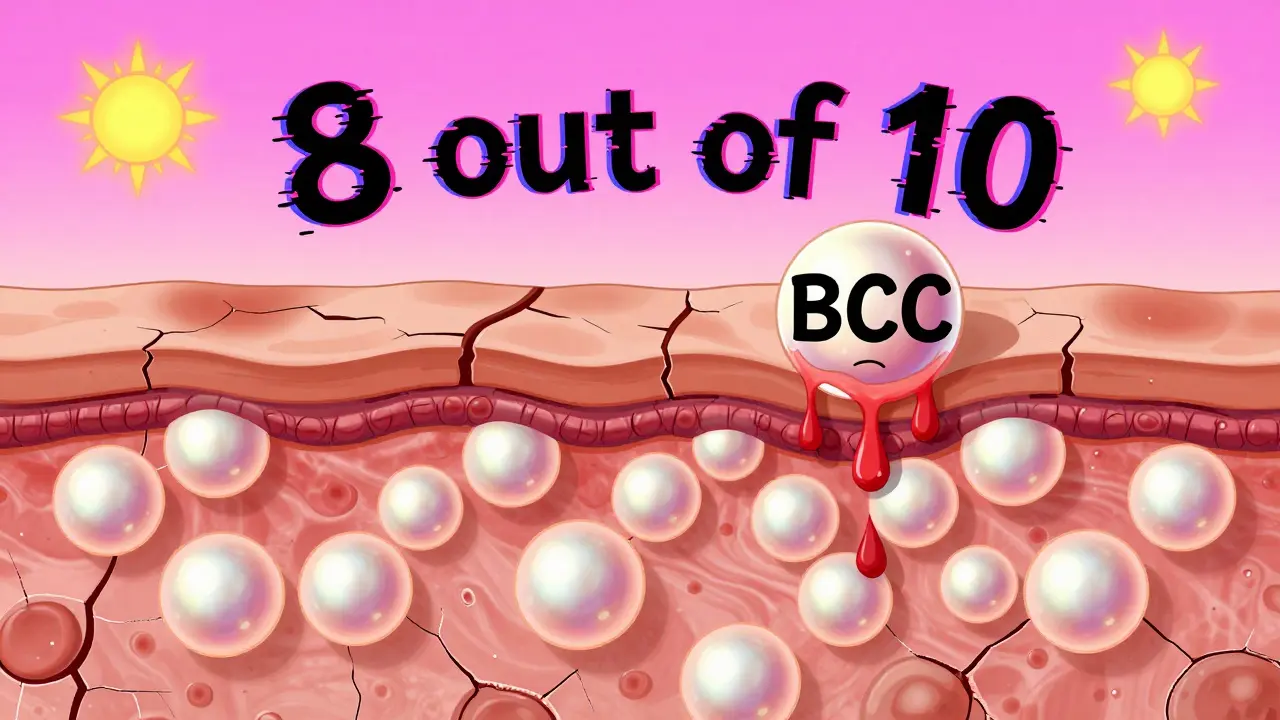
Most people don’t think about skin cancer until they spot a weird bump or patch that won’t go away. But here’s the truth: basal cell carcinoma and squamous cell carcinoma are far more common than melanoma - and far more treatable if caught early. Together, they make up about 95% of all nonmelanoma skin cancers. In the U.S. alone, over 5 million cases are diagnosed every year. That’s more than breast, prostate, lung, and colon cancers combined. Yet many still ignore early signs, thinking it’s just a pimple or a scar. Don’t make that mistake.
Where Do These Cancers Start?
Your skin has layers. The top layer, the epidermis, is made up of flat, scale-like cells called squamous cells. Right beneath them, in the deepest part of the epidermis, are round, basal cells. These basal cells are constantly dividing to replace dead skin cells that flake off. When these cells start growing out of control, they become cancer.
Basal cell carcinoma begins in those basal cells. It’s slow-moving, often appearing as a shiny bump that looks like a pearl, or a sore that bleeds and heals over and over. It rarely spreads beyond the skin, but if left alone for years, it can dig deep into muscle, bone, or nerves - especially on the face.
Squamous cell carcinoma starts in the squamous cells. These cancers tend to look more like a red, scaly patch, a hard lump, or a wart-like growth that crusts or bleeds. They grow faster than basal cell cancers and, while still uncommon, are much more likely to spread to lymph nodes or other organs if ignored.
How Common Are They?
Basal cell carcinoma is the most common cancer in humans. About 8 out of 10 nonmelanoma skin cancers are BCC. In Australia, where sun exposure is intense, nearly 2 in 3 people will develop at least one skin cancer by age 70 - and most of those are BCC.
Squamous cell carcinoma is less common, making up about 20% of cases. But here’s the catch: while it’s less frequent, it’s more dangerous. SCC is about 10 times more likely to spread than BCC. In fact, it’s the second leading cause of skin cancer deaths after melanoma.
Age matters. Eighty-five percent of cases happen in people over 50. The average age for diagnosis is 67 for BCC and 69 for SCC. But younger people aren’t immune - especially those with a history of sunburns, tanning beds, or weakened immune systems.
What Do They Look Like?
It’s not always easy to tell them apart just by looking. But there are patterns.
Basal cell carcinoma often shows up as:
- A pearly or waxy bump, sometimes with visible blood vessels
- A flat, flesh-colored or brown scar-like lesion
- A sore that bleeds, crusts, and doesn’t heal - even after weeks
Squamous cell carcinoma usually looks like:
- A firm, red nodule
- A flat lesion with a scaly, crusted surface
- A wart-like growth that grows quickly
- An open sore that persists and may be painful
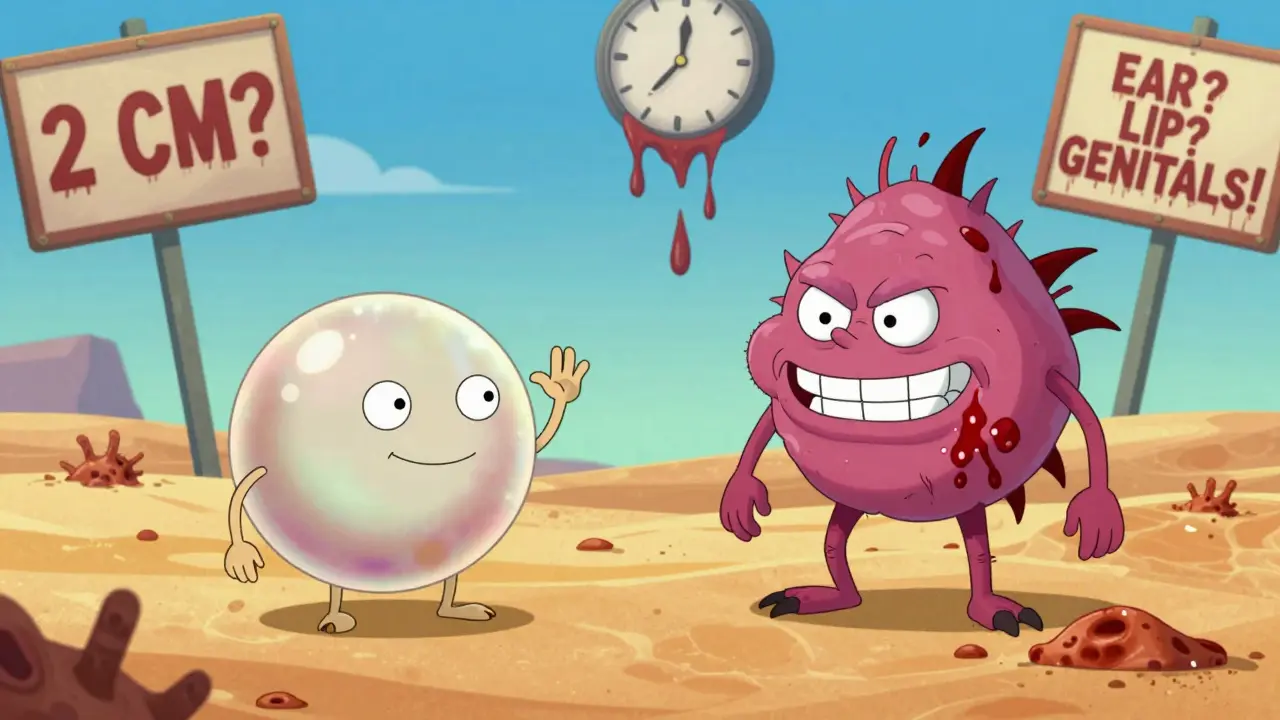
Location matters too. Both cancers love sun-exposed areas - face, ears, neck, scalp, hands. But SCC is more aggressive on the lips, ears, and genital area. In fact, SCC on the lip has a 14% chance of spreading - much higher than SCC on the arm.
Why Is SCC More Dangerous?
BCC almost never spreads. Less than 0.1% of cases metastasize. That’s why doctors often treat it like a local problem - remove it, move on.
SCC is different. About 2-5% of cases spread to lymph nodes or organs. That number jumps to 15% if it’s on the lip, ear, or genital area. Once it spreads, the 5-year survival rate drops from 95% to just 25-45%.
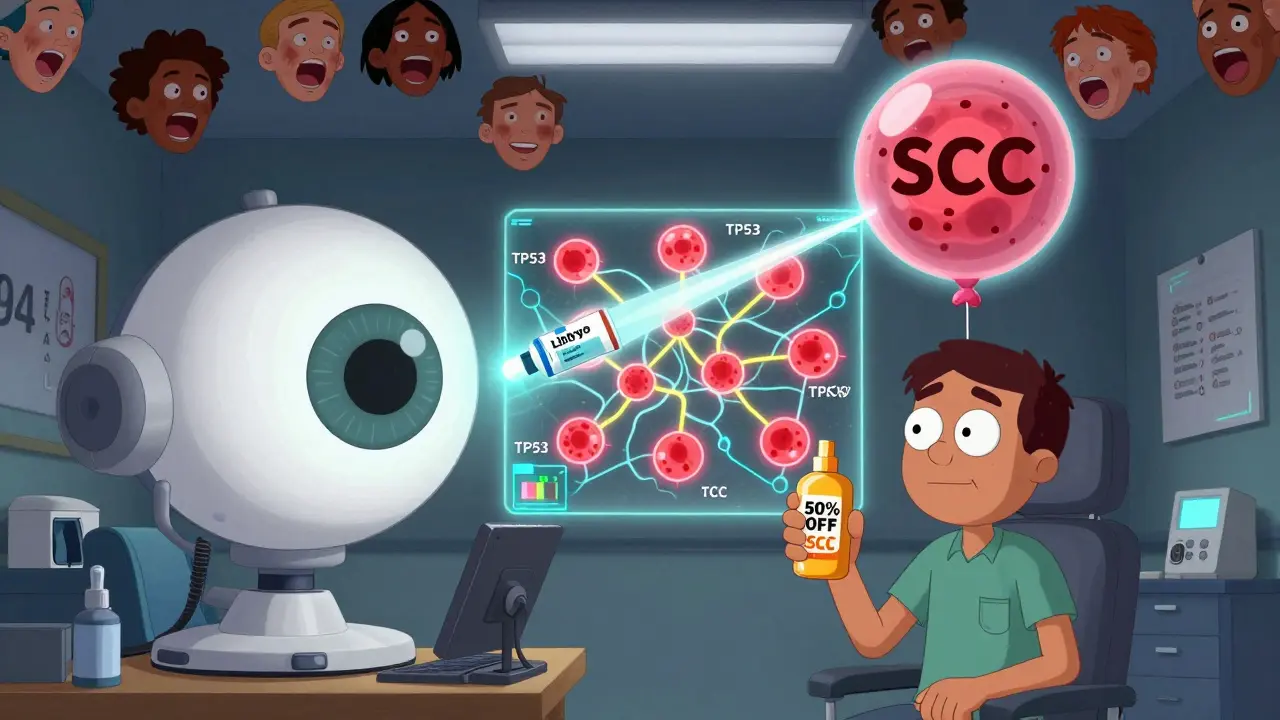
Why? SCC has more aggressive biology. Research shows 90% of SCC tumors carry mutations in the TP53 gene - a key tumor suppressor. BCC only has this mutation in about half of cases. That’s why SCC grows faster, invades deeper, and escapes more easily.
Doctors now use risk factors to decide how aggressive treatment needs to be. High-risk SCC means:
- Larger than 2 cm
- Deeper than 2 mm
- Located on the ear, lip, or genital area
- Occurs in someone with a weakened immune system
These cases need wider surgical margins, sometimes radiation, and close follow-up.
Treatment: What’s Different?
Both cancers are highly curable when caught early - over 95% success rate with surgery.
For small, low-risk BCC, doctors often use topical creams like imiquimod or 5-fluorouracil. These work in 60-70% of cases. For SCC? Only 40-50% effective. That’s because SCC grows deeper faster - creams can’t reach it.
Surgery is the gold standard. Mohs surgery - where the surgeon removes thin layers and checks them under a microscope immediately - has a 99% cure rate for BCC and 97% for SCC. But SCC often needs bigger cuts. The margins (the healthy tissue around the tumor) are wider: 4-10 mm for SCC versus 3-5 mm for BCC.
Immunotherapy is a game-changer for advanced SCC. Drugs like cemiplimab (Libtayo) have helped patients with metastatic SCC live longer - something that wasn’t possible a decade ago. For BCC, there’s vismodegib, which blocks the pathway that makes these tumors grow. But it doesn’t work for SCC.
Recovery? BCC patients usually need just one treatment. SCC patients are more likely to need a second or third procedure. One study found SCC patients had 2.3 times more follow-up visits than BCC patients.
Who’s at Risk?
Anyone with fair skin, light hair, or blue/green eyes is at higher risk. But it’s not just about skin tone.
UV exposure is the biggest factor. BCC is linked to intense, intermittent sunburns - like a bad vacation burn. SCC is tied to long-term, daily exposure - think farmers, construction workers, or people who’ve spent decades outdoors.
Sunscreen helps. Daily use cuts BCC risk by 40% and SCC risk by 50%. That’s because SCC is more directly tied to cumulative sun damage.
People with weakened immune systems are at extreme risk. Organ transplant recipients are 250 times more likely to get SCC than the general population. For BCC? Only 10 times higher. That’s why transplant patients need skin checks every 3-6 months.
Men are more likely to get SCC - 65% of cases. Women get more BCC. Why? Likely because men spend more time outdoors in jobs with sun exposure.
What Happens If You Ignore It?
BCC doesn’t kill you - but it can ruin your face. Left untreated for 2+ years, 70% of advanced BCCs invade deeper tissue. That means disfigurement, nerve damage, or even bone erosion on the nose or eyelid.
SCC can kill. A small, ignored SCC on the ear can spread to lymph nodes in under a year. Once it spreads, treatment becomes harder, more expensive, and less effective. Medicare spends $2.2 billion a year on nonmelanoma skin cancer - 65% of that goes to SCC because of complex surgeries, radiation, and follow-ups.
Real patients report this: BCC patients often say, “I didn’t think it was serious.” SCC patients say, “I was scared it would spread.” That anxiety is real - and justified.
Prevention and Early Detection
You can’t undo past sun damage. But you can stop more.
- Wear broad-spectrum SPF 30+ every day - even in winter
- Seek shade between 10 a.m. and 4 p.m.
- Wear wide-brimmed hats and UV-blocking sunglasses
- Avoid tanning beds - they increase SCC risk by 67%
- Check your skin monthly. Use a mirror for hard-to-see spots
See a dermatologist if you notice:
- A spot that doesn’t heal in 4 weeks
- A mole or bump that changes size, shape, or color
- A sore that bleeds or crusts repeatedly
- A red, scaly patch that itches or hurts
High-risk people - those with a history of skin cancer, organ transplants, or chronic sun exposure - should get checked every 3-6 months. SCC recurs faster than BCC. Most recurrences show up within 12 months.
What’s New in 2026?
Technology is helping. AI tools trained on thousands of skin images can now tell BCC from SCC with 94% accuracy - faster than some dermatologists. Dermatoscopes (special magnifiers) are now standard in clinics.
New genetic tests can spot 12 markers linked to SCC metastasis. That means doctors can now predict which tumors are likely to spread - and treat them more aggressively before it’s too late.
Photodynamic therapy is improving too. For superficial SCC, it clears 92% of cases. For BCC, it’s 85%. It’s less invasive than surgery and leaves less scarring.
The message hasn’t changed: catch it early, treat it fast. Both cancers are preventable. Both are curable. But one - squamous cell carcinoma - demands urgency.
Can basal cell carcinoma turn into squamous cell carcinoma?
No. Basal cell carcinoma and squamous cell carcinoma are two separate types of skin cancer that start in different skin cells. One doesn’t transform into the other. But it’s possible to have both at the same time, especially if you’ve had heavy sun exposure over many years. That’s why regular skin checks are critical - doctors need to look for multiple types of lesions.
Is squamous cell carcinoma more dangerous than melanoma?
No, melanoma is still the deadliest form of skin cancer. But SCC is the second leading cause of skin cancer deaths - and it’s growing faster than BCC. While melanoma spreads early and aggressively, SCC tends to grow slowly at first, which makes it easy to ignore. By the time it spreads, treatment is harder. That’s why SCC is often called the “silent killer” of nonmelanoma skin cancers.
Can I treat these at home with over-the-counter creams?
Only under a doctor’s supervision. Some topical creams like imiquimod or 5-fluorouracil can work for very early, superficial BCC. But they’re unreliable for SCC and can mask deeper cancer. Never self-diagnose or self-treat a skin lesion. What looks like a rash could be cancer. Only a biopsy can confirm it.
How often should I get a skin check?
If you’ve never had skin cancer and have low risk (no sunburns, no family history), once a year is enough. If you’ve had one skin cancer, get checked every 6-12 months. If you’re immunocompromised - like after an organ transplant - every 3-6 months. SCC can return within a year, so don’t wait.
Does sunscreen prevent both types equally?
No. Daily sunscreen use reduces BCC risk by about 40% and SCC risk by 50%. That’s because SCC is more directly linked to long-term, daily UV exposure, while BCC is often tied to occasional intense burns. But sunscreen alone isn’t enough. Combine it with shade, clothing, and avoiding midday sun.
Are there any new treatments for advanced SCC?
Yes. In 2018, the FDA approved cemiplimab (Libtayo), the first immunotherapy for advanced SCC. It works by helping your immune system attack the cancer cells. About 47% of patients with metastatic SCC respond to it - a huge improvement over older chemotherapy, which only worked in about 20%. Research is now focused on combining immunotherapy with targeted drugs for better results.

Reviews
Been using sunscreen daily since my dad got SCC. Not worth the risk. Just do it.
It is imperative to note that squamous cell carcinoma, despite its lower incidence compared to basal cell carcinoma, presents a significantly higher metastatic potential. Early dermatological consultation remains non-negotiable for persistent lesions.
MY MOM JUST HAD MOHS FOR SCC ON HER EAR 😭 THANK YOU FOR THIS POST. I’M GOING TO MAKE THE WHOLE FAMILY DO SKIN CHECKS THIS WEEKEND 🌞💖
I never realized how much more dangerous SCC could be. I’ve got a scaly patch on my nose I’ve been ignoring… guess I’m booking a dermatologist appointment this week.
My grandma had basal cell on her cheek for years. She thought it was just a scar. Took 3 surgeries to get it all. Don’t wait. Seriously.
My brother’s a construction worker and he’s got 3 BCCs already. He thinks he’s invincible because he’s young. This post should be mandatory reading for anyone who works outside. Sunscreen isn’t optional.
94% accuracy with AI dermatology tools? That’s wild. I wonder how many people are getting misdiagnosed by apps like SkinVision. Still, nothing beats a real doc with a dermatoscope.
If we’re talking about cellular mutations and TP53, isn’t it ironic that the same sun that gives us vitamin D also breaks our DNA? We evolved under this star, yet now we fear it. Maybe the real issue isn’t the cancer-it’s how disconnected we’ve become from nature’s rhythms.
bro i used to tan like a maniac in college. now i check my skin every sunday like its my job. one weird spot = doc visit. no excuses. you got this.
Let me be blunt: if you’re still using tanning beds after reading this, you’re not just ignoring science-you’re mocking your own future self. SCC doesn’t wait. It doesn’t ask for permission. It just shows up. And then you’re stuck with a 4cm scar on your lip and a 25% chance of living to see next year. Don’t be the guy who thought "it won’t happen to me".
So… we’re saying BCC is the annoying roommate who never cleans but doesn’t wreck the place, and SCC is the one who steals your stuff and then tries to burn the apartment down? Yeah. That tracks.
Wait-so you’re telling me that the "harmless" one is the one that ruins your face, and the "dangerous" one is the one that kills you? That’s not scary. That’s just… capitalism. We fix the one that’s easy to treat and ignore the one that’s expensive. No wonder people die.