
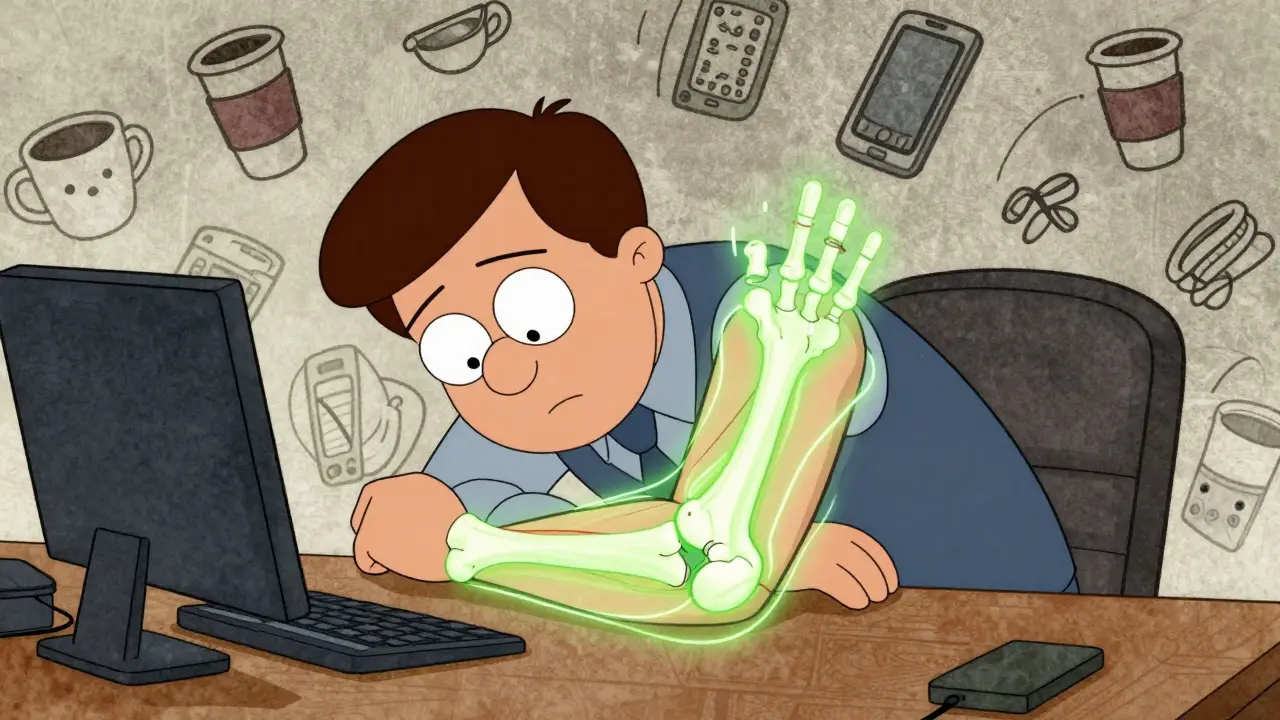
When your ring and little fingers go numb while you're driving, talking on the phone, or sleeping, it's not just a passing tingling. It could be your ulnar nerve being squeezed - a condition called ulnar neuropathy. This isn't rare. In fact, it's the second most common nerve compression issue in the arm, after carpal tunnel syndrome. And if you ignore it, you could end up with permanent weakness, muscle loss in your hand, or even a clawed finger deformity.
What Exactly Is the Ulnar Nerve?
The ulnar nerve runs from your neck down to your hand. It starts at spinal nerves C8 and T1, then travels along the inside of your elbow, through a bony groove called the cubital tunnel, and down into your wrist. It's responsible for sensation in your little finger and the half of your ring finger closest to it. It also controls most of the small muscles in your hand that let you grip things, pinch, and spread your fingers apart.
What makes this nerve so vulnerable? Unlike other nerves wrapped in muscle and fat, the ulnar nerve at the elbow sits right under the skin with almost no padding. That’s why leaning on your elbow for too long - like resting it on a desk or sleeping with your arm bent - can compress it. The same thing happens at the wrist, where the nerve passes through a tight tunnel called Guyon’s canal.
Two Main Places It Gets Trapped
Ulnar nerve entrapment happens in two main spots:
- Cubital tunnel syndrome - at the elbow. This accounts for over 90% of cases. It’s the most common form of ulnar neuropathy.
- Guyon’s canal syndrome - at the wrist. Less common, but still significant. Often caused by a cyst, trauma, or repetitive pressure from handlebars or tools.
At the elbow, the nerve gets pinched as it bends and straightens. Every time you flex your elbow - like when you’re typing, holding a phone, or sleeping - the nerve stretches and rubs against bone. Over time, this causes inflammation and scarring. At the wrist, pressure from a ganglion cyst, fracture, or even a tool handle can crush the nerve.
How Do You Know If It’s Ulnar Neuropathy?
Symptoms don’t show up all at once. They creep in slowly. Here’s how they typically progress:
- Stage 1 (Mild): Occasional tingling or numbness in the ring and little fingers. Often worse at night or after keeping your elbow bent for a while.
- Stage 2 (Moderate): Numbness becomes constant. You might feel a burning sensation. Your grip starts to weaken. You drop things more often. Holding a coffee cup or opening a jar gets harder.
- Stage 3 (Severe): Muscle wasting in your hand. The space between your thumb and index finger starts to look sunken. Your little finger may start to curl inward. This is called a "claw hand." You might also notice the "Froment sign" - when you try to hold a piece of paper between your thumb and finger, your thumb bends at the joint because the muscles aren’t working right.
People often mistake this for carpal tunnel. But carpal tunnel affects the thumb, index, and middle fingers - not the little finger. If your little finger is numb, it’s almost certainly the ulnar nerve.
What Makes It Worse?
Some habits make ulnar neuropathy much worse:
- Sleeping with your elbow bent and your hand under your head
- Leaning on your elbow for hours - like at a desk or while driving
- Repetitive motions: tennis, golf, cycling, weightlifting, or using vibrating tools
- Jobs that require prolonged elbow flexion: plumbers, auto mechanics, or call center workers
Studies show that about 45% of wrist-level entrapments have no clear cause (idiopathic), while 40% are linked to ganglion cysts. At the elbow, it’s mostly mechanical - repeated bending and pressure.

Therapy: Start Conservative, Then Decide
Here’s the good news: most people don’t need surgery. About 50% of all ulnar neuropathy cases improve with non-surgical treatment. And if caught early, up to 90% of mild cases get better without any invasive procedures.
Non-Surgical Options
1. Activity Modification
Stop doing what’s hurting you. Avoid leaning on your elbow. Don’t sleep with your arm bent. Use a headset instead of cradling the phone. Take breaks from repetitive tasks. Simple changes like these can stop progression.
2. Nighttime Bracing
Wearing a soft elbow splint at night is one of the most effective treatments. It keeps your elbow slightly bent - not fully flexed - reducing pressure on the nerve. Studies show this helps over 70% of patients with mild to moderate symptoms. You wear it for 4 to 6 weeks. Some need it longer.
3. NSAIDs
Ibuprofen or naproxen can reduce swelling around the nerve. They’re not a cure, but they help with inflammation, especially in the early stages. Don’t rely on them long-term - talk to your doctor about risks.
4. Physical Therapy
A certified hand therapist can teach you nerve gliding exercises. These aren’t stretches - they’re gentle movements that help the nerve slide smoothly through its tunnel. Do them 3 to 4 times a day. You’ll also work on grip strength, finger coordination, and posture. Progress is slow but steady. Most people see improvement in 6 to 8 weeks.
5. Corticosteroid Injections
If inflammation is the main issue, a shot of cortisone around the nerve can help. It’s not a permanent fix, but it can give you enough relief to make lifestyle changes stick. It’s more common at the wrist than the elbow.
6. Emerging Options
Ultrasound-guided nerve hydrodissection is a newer technique where fluid is injected to gently separate the nerve from surrounding tissue. Early results are promising, especially for people who haven’t responded to bracing or therapy. Platelet-rich plasma (PRP) is being studied too, but there’s not enough solid evidence yet to recommend it widely.
When Surgery Becomes Necessary
If you have muscle wasting, constant numbness, or weakness that doesn’t improve after 3 months of conservative treatment - surgery is likely needed. Waiting too long can lead to permanent damage.
There are three main surgical approaches:
- Simple decompression: The surgeon cuts the ligament over the nerve at the elbow to give it more room. It’s the least invasive. Recovery takes 6 to 12 weeks.
- Anterior transposition: The nerve is moved from behind the elbow to the front. This prevents it from getting stretched when you bend your arm. It’s used when the nerve keeps slipping out of place. Recovery is longer - 3 to 6 months.
- Medial epicondylectomy: A small piece of bone is removed to create more space for the nerve. It’s effective but less commonly done.
Research shows simple decompression and transposition are equally effective for idiopathic cases. But transposition has a higher risk of infection and scarring. Your surgeon will choose based on your anatomy, how long you’ve had symptoms, and whether the nerve is unstable.
Post-surgery, hand therapy starts in 2 to 3 weeks. You’ll work on mobility first, then strength. Full recovery can take up to a year, especially if muscles have atrophied.
What Happens If You Don’t Treat It?
Untreated ulnar neuropathy doesn’t just cause discomfort. It leads to irreversible damage. Once the nerve fibers die, they don’t come back. Muscles shrink and can’t be rebuilt. Claw hand deformity becomes permanent. You’ll lose fine motor control - buttoning shirts, typing, writing - becomes harder. The earlier you act, the better your chance of full recovery.
Who’s Most at Risk?
Men between 35 and 64 are more likely to develop ulnar neuropathy than women. People in manual trades - plumbing, construction, mechanics - are at higher risk. Even office workers who rest their elbows on hard surfaces all day can develop it. It’s not about age alone - it’s about how you use your arms.
How to Track Progress
Doctors now use tools like the QuickDASH questionnaire to measure how ulnar neuropathy affects your daily life. It asks about pain, strength, and ability to do tasks like lifting, writing, or carrying groceries. Tracking this over time helps you and your doctor know if treatment is working.
Costs and Real-World Outcomes
Conservative treatment - splint, therapy, medications - usually costs between $200 and $500. Surgery ranges from $5,000 to $15,000, depending on location and complexity. But the bigger cost is lost function. A study found that 85-90% of patients who get appropriate treatment - whether surgical or not - regain good hand function and avoid permanent disability.
One in eight people who have surgery experience symptoms returning. Why? Often because the root cause wasn’t addressed - like continuing to lean on the elbow or not changing work habits.
Final Takeaway
Ulnar neuropathy isn’t an emergency, but it’s not something to ignore. If you notice numbness in your little finger - especially at night - start making changes now. Adjust your posture. Wear a splint. See a therapist. Don’t wait for weakness or muscle loss to set in. Most cases respond well to simple, non-invasive steps. And if surgery is needed, modern techniques offer strong outcomes. Your hand’s function is worth protecting.



Reviews