
Most prescriptions in the U.S. today are for generic medications-90% of them, to be exact. Yet many clinicians still hesitate to prescribe them confidently, even when they’re the best choice for the patient. Why? Because knowledge gaps persist. Many doctors don’t fully understand how generics are approved, what bioequivalence really means, or how to talk to patients about switching from brand-name drugs. This isn’t just about cost-it’s about trust, adherence, and outcomes.
What Generic Drugs Really Are-and How They’re Approved
A generic drug isn’t a cheaper copy. It’s the exact same medicine as the brand-name version, with the same active ingredient, strength, dosage form, and route of administration. The FDA requires it to work the same way in the body. The approval process isn’t shortcuts-it’s science.
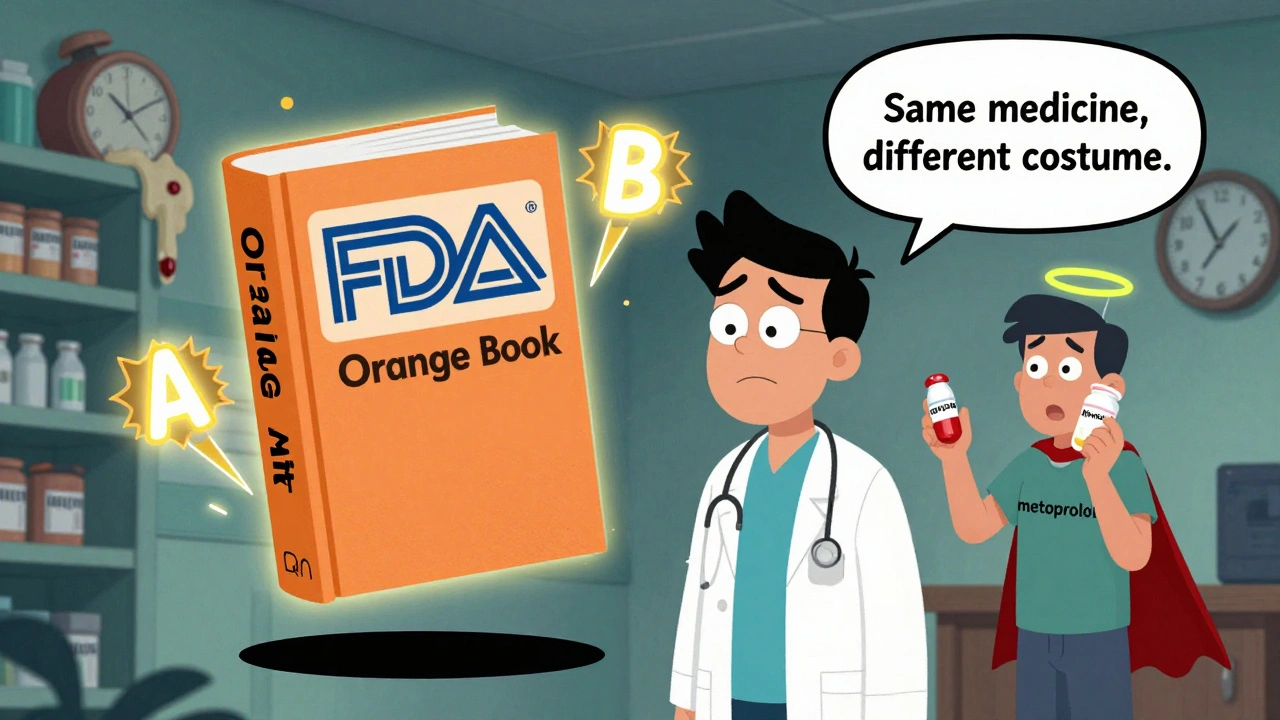
To get approved, a generic must prove bioequivalence. That means its absorption into the bloodstream must fall within 80-125% of the brand-name drug’s levels, measured by AUC and Cmax. This isn’t a rough estimate-it’s a tightly controlled 90% confidence interval. The FDA tests this with hundreds of healthy volunteers. If the generic passes, it’s listed in the Orange Book with an ‘A’ rating, meaning it’s therapeutically equivalent.
What’s different? Only the inactive ingredients-fillers, dyes, preservatives. These can vary, but they can’t affect safety or effectiveness. A 2020 survey found 45% of prescribers wrongly believed generics had to contain the same inactive ingredients as brand-name drugs. That misconception alone leads to unnecessary hesitation.
Why Clinicians Still Doubt Generics
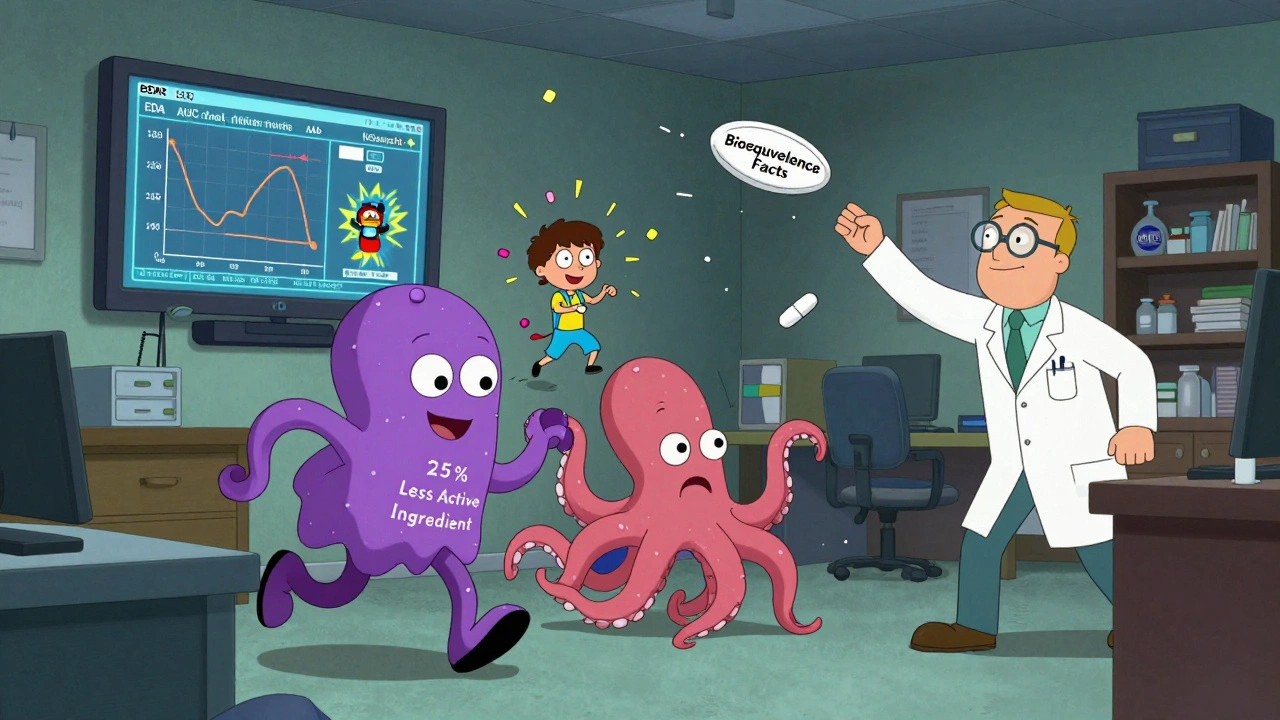
Despite the data, doubts linger. A 2017 review showed 68% of physicians had at least some concern about generic equivalence. Why? Misinformation sticks. Some think manufacturing standards are lower. Others believe generics contain 20-25% less active ingredient. Neither is true.
One major issue is language. Many clinicians still say “Lopressor” instead of “metoprolol.” Medical students learn generic names in school, but when attending physicians use brand names, residents get confused. One Reddit user shared how they almost prescribed double the dose because their attending said “Lopressor twice daily”-not realizing it was the same as the generic they’d already ordered.
Specialties vary too. Family physicians prescribe generics at an 89% rate. Neurologists? Only 67%. Cardiologists and neurologists show the highest resistance-79-82% of substitution hesitations come from provider concerns, not patient requests. Why? Chronic conditions like epilepsy or heart disease make clinicians wary. But the data doesn’t support the fear.
How Education Changes Behavior
Education isn’t about handing out flyers. It’s about changing how clinicians think-and talk-to patients.
A 2021 JAMA Internal Medicine study compared two approaches: static fact sheets vs. interactive, case-based training. The group that engaged with real patient scenarios had 42% higher knowledge retention six months later. That’s the difference between remembering a fact and internalizing a practice.
When providers confidently say, “This generic is just as effective as the brand,” patient adherence jumps by 35%. Harvard Medical School research found that when clinicians explicitly endorse generics, patient-reported side effects drop by 18%. That’s not placebo-it’s nocebo. Patients expect side effects from generics because they’ve been told, implicitly or explicitly, that they’re “less than.”
At UCSF Medical Center, a targeted education program cut brand-name statin prescriptions by 37% in one year. The key? Embedding prompts in the EHR that reminded clinicians to consider generics-and gave them quick access to FDA resources right when they were writing the script.
Barriers to Effective Education
Time is the biggest enemy. In a 2021 AMA survey, 89% of physicians said they don’t have time to learn more about generics. Another 65% said they’ve never even heard of the FDA’s Generic Drug Stakeholder Toolkit.
Even when materials exist, they’re not integrated. A Medicaid program in Tennessee spent $1.2 million on physician education in 2020-and saw only an 8% rise in generic use. Why? The training was a one-time webinar. No follow-up. No EHR integration. No feedback loop.
Successful programs don’t add to the workload-they reduce friction. The FDA’s Generic Drugs and Health Equity handout is free, but only 22% of providers know it exists. Academic detailing-where trained pharmacists or educators visit clinics one-on-one-is more effective than webinars. So are short, monthly CME modules delivered via email or EHR pop-ups.
Spaced learning works. One study found that clinicians who received four 90-minute sessions over six months retained 52% more knowledge than those who sat through a single 6-hour lecture.
What Clinicians Need to Know
You don’t need to be a pharmacologist. But you do need to understand these five things:
- Bioequivalence standards: 80-125% absorption range, 90% confidence interval. Not “close enough”-it’s legally required to be equivalent.
- The Orange Book: Look up ‘A’ vs. ‘B’ ratings. ‘B’ means not equivalent. Rare, but happens with complex formulations.
- State laws: 34 states let pharmacists substitute generics without telling you. 16 require “dispense as written” if you want to block it.
- Communication scripts: “This generic has been tested to work exactly like the brand. It’s safe, effective, and saves you money.”
- Biosimilars are not generics: They’re for biologics-large molecules like insulin or Humira. They’re not interchangeable by default. Only 31% of providers can correctly explain the difference.
Tools That Actually Work
Forget outdated PDFs. The best tools are built into daily practice.
- AI-driven EHR alerts: Medisafe’s system flags when a brand-name drug is prescribed and suggests a generic alternative. In a 2023 pilot, it boosted generic acceptance by 24%.
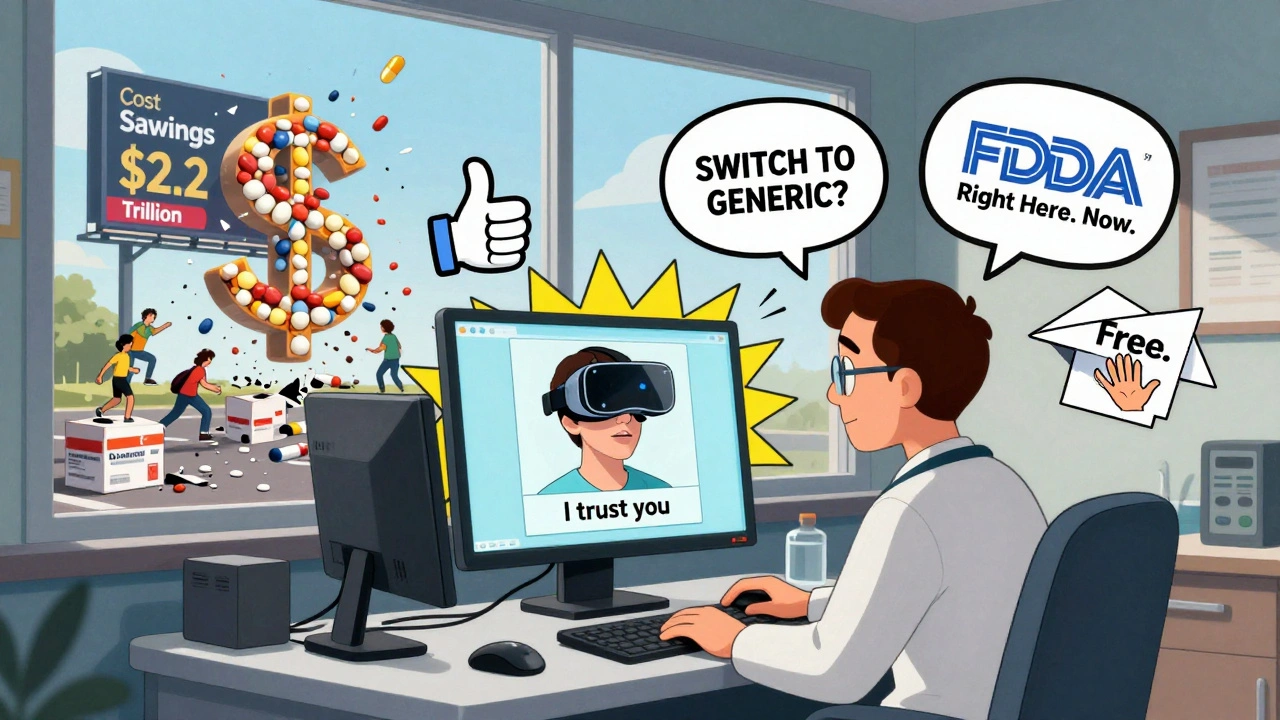
- Virtual reality training: The FDA’s 2023 pilot lets clinicians practice conversations with virtual patients who say, “I don’t trust generics.” Early results show a 41% increase in provider confidence.
- Personalized nudges: UnitedHealthcare’s 2024 pilot uses AI to identify doctors who rarely prescribe generics-and sends them tailored case studies. Result? 28% higher generic prescribing.
Big health systems are catching on. As of 2023, 68 of the 100 largest U.S. health systems require new prescribers to complete generic education before they can write their first script.
The Bigger Picture: Cost, Adherence, and Equity
Generics saved the U.S. healthcare system $2.2 trillion over the past decade. But the real value isn’t just in dollars-it’s in lives.
Patients who can’t afford their meds skip doses. Or stop entirely. Studies show generics improve initiation rates by 35%. For someone with hypertension or diabetes, that’s the difference between control and crisis.
And it’s not just about price. It’s about trust. When a provider says, “This is just as good,” patients believe it. When they don’t, patients assume the worst-even if the science says otherwise.
By 2025, CMS will include generic prescribing rates in its Merit-based Incentive Payment System (MIPS). That’s not punishment-it’s recognition. Prescribing generics isn’t just smart economics. It’s a quality metric.
Where to Start Today
You don’t need a grant or a committee. Start small:
- Download the FDA’s Generic Drug Facts Handout. Keep it on your desk.
- Next time you write a script, say the generic name first. Then add the brand in parentheses if needed.
- Ask one patient: “Have you ever been told a generic wouldn’t work? What did you think?”
- Request a 15-minute CME module from your hospital’s pharmacy department.
- Check the Orange Book once a week for a drug you prescribe often.
Change doesn’t come from mandates. It comes from clinicians who decide, one prescription at a time, to trust the science-and to help their patients trust it too.
Are generic drugs really as effective as brand-name drugs?
Yes. The FDA requires generics to have the same active ingredient, strength, dosage form, and route of administration as the brand-name drug. They must also prove bioequivalence-meaning they deliver the same amount of medicine into the bloodstream at the same rate. The 90% confidence interval for absorption must fall between 80-125% of the brand. This isn’t a suggestion-it’s a legal requirement. Thousands of studies confirm equivalent outcomes across conditions like hypertension, diabetes, and depression.
Why do some doctors still prefer brand-name drugs?
Many doctors were trained during a time when generics were less common, and brand names dominated marketing. Some still believe myths-like generics have lower quality control or different inactive ingredients that affect performance. Others fear patient complaints or blame if something goes wrong, even though the data shows no difference. In specialties like neurology or cardiology, where conditions are complex, caution can turn into overcaution. But education reduces these fears: studies show that after proper training, clinician confidence in generics increases by 40% or more.
Can pharmacists substitute generics without telling me?
Yes, in 34 states, pharmacists can substitute a generic for a brand-name drug without notifying the prescriber-as long as the FDA lists it as therapeutically equivalent (an ‘A’ rating). In 16 states, you must write “dispense as written” on the prescription to prevent substitution. This is why it’s important to know your state’s laws and to clearly communicate your preference to both the patient and the pharmacist. If you don’t want substitution, say so explicitly on the script.
Are biosimilars the same as generics?
No. Biosimilars are not generics. Generics are for small-molecule drugs-like metoprolol or atorvastatin-that are chemically identical to the brand. Biosimilars are for large-molecule biologics-like insulin, Humira, or Enbrel-that are made from living cells. Because they’re complex, biosimilars can’t be exact copies. They must be “highly similar” to the reference product, with no clinically meaningful differences. Only a small percentage of providers (31%) can correctly explain this distinction, which leads to confusion in prescribing. Always check the Orange Book or FDA’s Purple Book for biosimilar status.
How can I learn more about generics without spending hours?
Start with the FDA’s free prescriber toolkit, which includes short fact sheets and talking points. Many hospitals offer 15-minute CME modules on generics through their pharmacy departments. Look for AI-powered EHR tools that suggest generics at the point of prescribing. Join a local pharmacy-led educational session-these are often free and take less than an hour. You don’t need a full course. You need one new habit: always say the generic name first.


Reviews
Generics? Yeah right. I’ve seen people get sick switching to them. Big Pharma’s got the FDA in their pocket. You think they’d let some cheap knockoff pass if it wasn’t rigged? I’ve got a cousin who went into seizures after they switched her epilepsy med. They called it ‘coincidence.’ I call it fraud.
And don’t even get me started on ‘bioequivalence.’ 80-125%? That’s not equivalent-that’s a gamble. You wouldn’t let a mechanic put ‘kinda similar’ parts in your car. Why are you letting them do it to your body?
Isn’t it funny how we trust a pill more than we trust each other? We’ve been conditioned to believe that ‘brand’ means ‘better’-like the label is magic. But the active ingredient? Same molecule. Same science. Same life.
Maybe the real issue isn’t the drug-it’s our fear of letting go of the illusion that more expensive equals more sacred. We don’t trust the system. So we trust the logo.
And yet… we still buy the same brand of toilet paper on sale. Huh.
In India, generics are the only option for most people. We don’t have a choice. But guess what? We don’t die more. We don’t get worse outcomes. We just pay less.
Western doctors act like generics are some kind of dangerous experiment. Meanwhile, my uncle with hypertension has been on the same generic for 12 years. Alive. Stable. No drama.
Maybe your fear isn’t about the medicine. Maybe it’s about losing control.
lol at the FDA. You think they care about you? Nah. They’re just here to make sure Big Pharma doesn’t get sued. Generic approval? It’s a joke. They test on 50 people for 2 weeks and call it science.
I’ve seen docs prescribe generics and then the patient ends up in the ER. Coincidence? I think not. And don’t even get me started on how they spell ‘bioequivalence’ like it’s some fancy Latin spell.
Stick to the brand. It’s not that hard.
WHAT?! You’re telling me the government-THE SAME GOVERNMENT THAT LETS CORPORATE GREED RUN WILD-actually STANDS FOR PATIENT SAFETY?!
THE FDA?! THE SAME AGENCY THAT APPROVED OPIOIDS?!
NO NO NO. I’M NOT BUYING THIS. THIS IS A COVERT BIG PHARMA OPERATION TO SLIP IN WEAK DRUGS UNDER THE RADAR! THEY’RE SABOTAGING AMERICAN HEALTH ONE GENERIC TABLET AT A TIME!
AND WHY IS EVERYONE SO QUIET ABOUT THE INDIAN MANUFACTURING FACTORIES?! WHO’S INSPECTING THEM?!
THEY’RE NOT TESTING ENOUGH! THEY’RE NOT TESTING RIGHT! THEY’RE NOT TESTING AT ALL!
It is, quite frankly, a dereliction of professional duty for any clinician to prescribe a generic medication without first verifying its FDA Orange Book status, reviewing the bioequivalence data, and ensuring that the patient’s comorbidities do not contraindicate substitution. To do otherwise is not merely negligent-it is ethically indefensible.
Furthermore, the notion that patient adherence improves simply because a physician says, ‘This is just as good,’ is a dangerous oversimplification. The placebo effect is not a therapeutic strategy-it is a statistical artifact.
And while cost savings are undeniably attractive, they must never supersede clinical judgment. The patient’s health is not a line item on a spreadsheet.
Ohhhhh so now we’re supposed to trust the FDA? After everything? After the opioid crisis? After the vaccine lies? After the 10-year wait for a generic for my mom’s $1,200/month drug?!
You think I’m gonna just… believe you? After all the lies? After all the corporate greed? After all the empty promises?
And now you want me to trust a pill made in a factory where the workers are paid 50 cents an hour?!
💔 I’m not buying it. Not today. Not ever.
My body is not a budget line.
And if you say ‘it’s the same’ one more time… I swear to God I will cry.
😭
Generics are a socialist plot. You think this is about health? Nah. It’s about control. The government wants you dependent on cheap drugs so you don’t have the money to fight back.
And don’t tell me about ‘bioequivalence.’ That’s just a fancy word for ‘we don’t care.’
I’ve seen people on generics get worse. I’ve seen it. I’ve seen it with my own eyes. And now you wanna tell me it’s all in my head?
Wake up. This isn’t science. It’s propaganda.
AMERICA FIRST. BRANDS FIRST.
NO MORE GENERIC SURRENDER.
My grandma took generics for 20 years. Never missed a dose. Lived to 94. Walked every day. Cooked for the whole family.
She never knew what a brand-name pill was. She just knew it kept her alive.
Maybe the real lesson isn’t in the science.
It’s in the love.
And the fact that she didn’t have to choose between medicine and groceries.