
Statin Rhabdomyolysis Risk Calculator
Risk Assessment Tool
This calculator estimates your relative risk of developing rhabdomyolysis while taking statins. Note: This is an educational tool only - it cannot replace medical advice.
Statins save lives. Millions of people take them every day to lower cholesterol and prevent heart attacks and strokes. But for a very small number of people, these common medications can trigger something far more dangerous: rhabdomyolysis - a rapid breakdown of skeletal muscle that can lead to kidney failure and even death.
What Exactly Is Rhabdomyolysis?
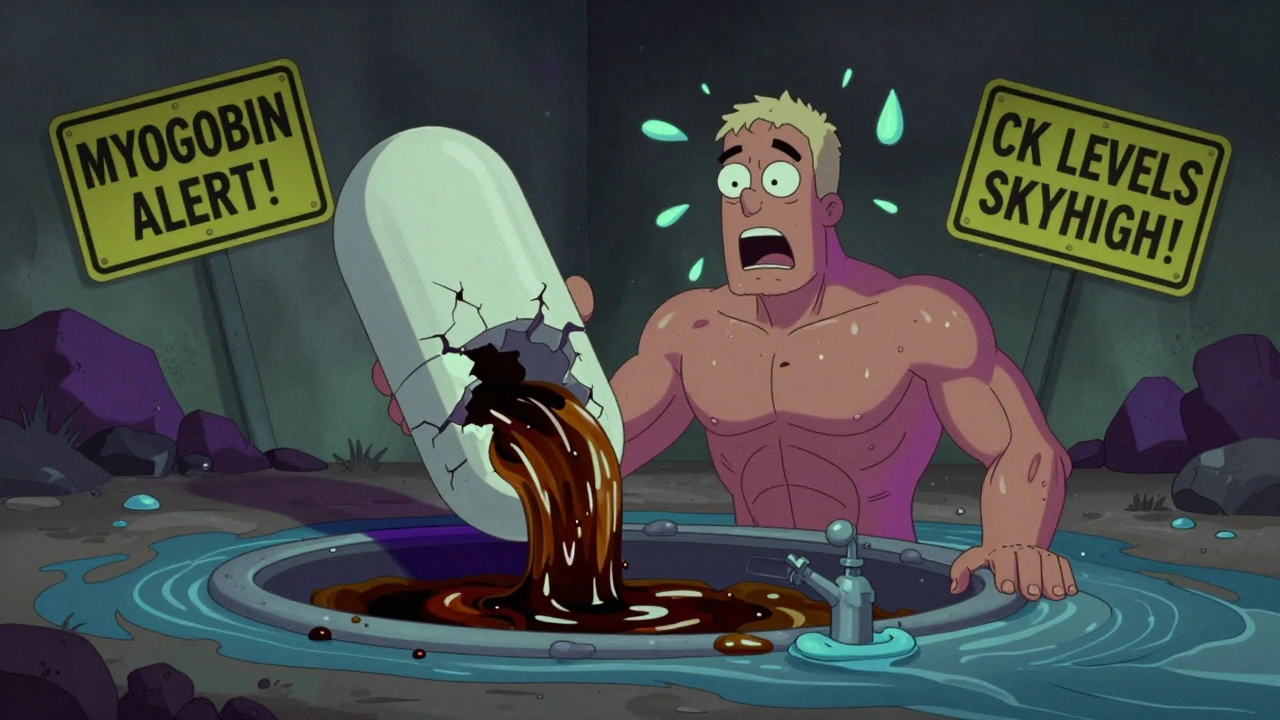
Rhabdomyolysis isn’t just muscle soreness. It’s when muscle cells break down so quickly that they release harmful proteins - like myoglobin - into the bloodstream. Myoglobin clogs the kidneys, which can cause acute kidney injury. In severe cases, it can shut down kidney function entirely. You won’t feel this coming on gently. Symptoms include intense muscle pain, weakness, dark urine (like cola), and extreme fatigue. If you’re on a statin and suddenly can’t climb stairs or feel your legs turning to jelly, don’t ignore it.The good news? This is extremely rare. The FDA estimates only 1.5 to 5 cases per 100,000 people taking statins each year. That’s less than 1 in 20,000. But because statins are so widely used - over 32 million Americans take them - even this tiny risk adds up. And when it happens, it can be life-threatening.
Why Do Statins Cause Muscle Breakdown?
Statins work by blocking an enzyme called HMG-CoA reductase, which your liver uses to make cholesterol. But that same enzyme is also involved in making other important molecules - like coenzyme Q10 (CoQ10) and isoprenoids - that your muscles need to function properly.One theory is that statins reduce CoQ10 levels. CoQ10 helps your muscle cells produce energy. Without enough, muscles tire faster and may start breaking down. Some studies show CoQ10 drops by 40% in people taking high-dose simvastatin. But not all researchers agree this is the main cause.
A more widely accepted mechanism involves the ubiquitin-proteasome system. This is your body’s natural cleanup crew for damaged proteins. Statins seem to turn this system into overdrive, causing muscle cells to break down their own proteins - even healthy ones. Research from 2020 shows this process ramps up significantly in people taking statins, especially at higher doses.
Another theory points to statins inserting themselves into muscle cell membranes, making them unstable. When you exercise - especially downhill walking or lifting weights - the stress on these weakened membranes can trigger a cascade of damage. This explains why many people notice symptoms after physical activity, not while sitting still.
Not All Statins Are Created Equal
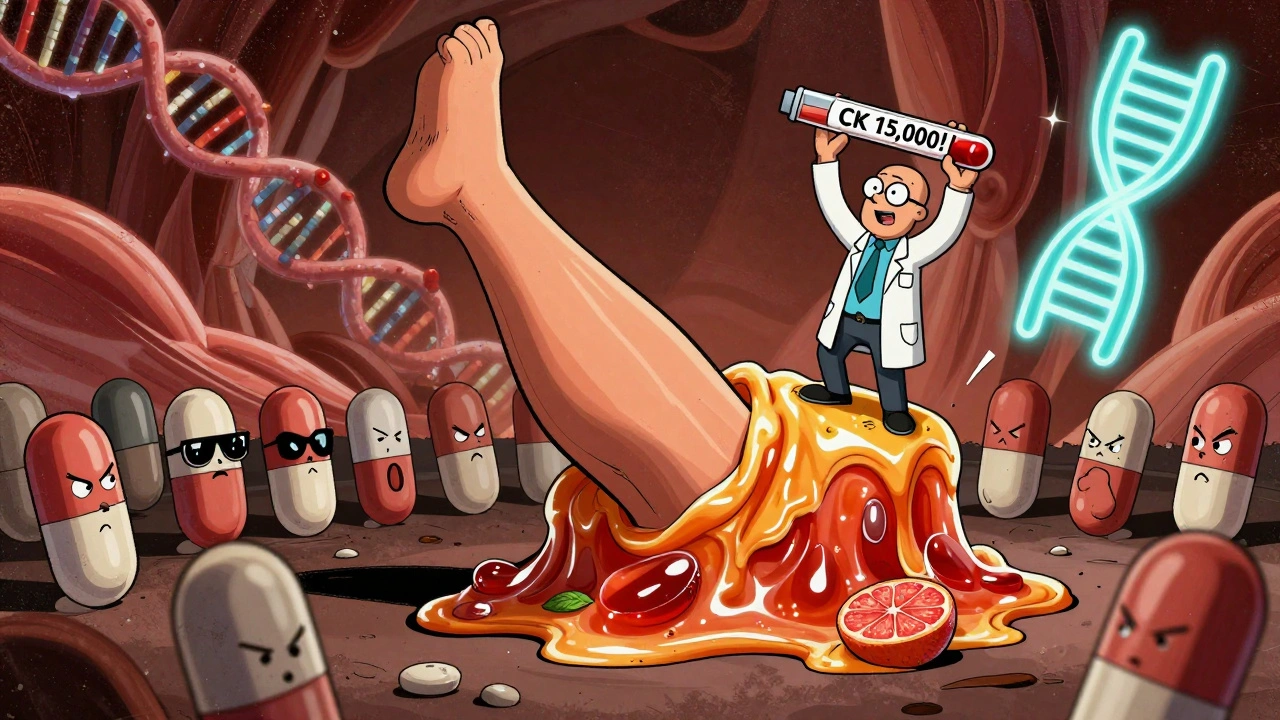
Some statins carry a much higher risk than others. Simvastatin - especially at the 80 mg dose - has the highest association with rhabdomyolysis. In fact, the FDA banned new prescriptions of 80 mg simvastatin in 2011 because the risk was too high. Studies showed the risk of muscle damage was over 10 times greater at that dose compared to 20 mg.Pravastatin and fluvastatin, on the other hand, have much lower muscle toxicity. Why? They’re less lipophilic - meaning they don’t penetrate muscle tissue as easily. Rosuvastatin and atorvastatin fall somewhere in between.
Drug interactions also matter. Statins processed by the CYP3A4 liver enzyme - like simvastatin, lovastatin, and atorvastatin - become much more dangerous when taken with certain antibiotics (like clarithromycin), antifungals, or even grapefruit juice. One case report showed clarithromycin increased simvastatin levels by 10 times. That’s not a coincidence - it’s a recipe for disaster.
Genetics Play a Big Role
Your genes can make you more vulnerable. A specific variation in the SLCO1B1 gene - called c.521T>C - affects how your liver pulls statins out of your blood. If you have two copies of this variant (one from each parent), your body clears statins much slower. This means higher levels build up in your muscles, increasing the risk of damage by nearly five times.This isn’t theoretical. The 2008 SEARCH trial found that people with this genetic variant had a 4.5-fold higher risk of myopathy. Today, genetic tests like OneOme RightMed can screen for this variant. The cost is around $249, and while insurance doesn’t always cover it, it’s worth considering if you’ve had muscle problems before or if your family has a history of statin intolerance.
Who’s Most at Risk?
Certain groups are more likely to experience serious muscle side effects:- People over 65 - aging muscles are more fragile
- Women - 62% of rhabdomyolysis cases in FDA data were female
- Those with kidney or liver disease - their bodies can’t clear statins efficiently
- People taking multiple medications - especially those that interact with statins
- Those who suddenly increase physical activity - especially eccentric exercises like downhill running or heavy weightlifting
On patient forums like PatientsLikeMe and Reddit, hundreds describe the same pattern: they started a statin, felt fine for a few weeks, then after a hike or a gym session, their legs turned to concrete. Pain came on fast. Weakness followed. And when they stopped the statin, everything cleared up.
What Should You Do If You Suspect Rhabdomyolysis?
If you’re on a statin and notice:- Severe muscle pain or weakness you can’t explain
- Dark, tea-colored urine
- Fatigue that doesn’t go away
Stop the statin immediately and call your doctor. Don’t wait. A simple blood test for creatine kinase (CK) can confirm muscle damage. Levels over 10 times the normal upper limit mean you’re in danger. If CK exceeds 10,000 IU/L, you may already be developing kidney injury.
At that point, treatment is urgent: IV fluids to flush out toxins, close monitoring of kidney function, and possibly dialysis. Nephrology involvement is critical. Delaying care can cost you your kidneys - or your life.
Exercise and Statins: Can You Still Be Active?
Yes - but be smart. You don’t need to stop moving. In fact, staying active helps your heart. But avoid sudden, intense, or eccentric workouts. That means no heavy downhill hiking, explosive weightlifting, or marathon training without building up slowly.Physical therapists recommend gentle, consistent activity: walking, swimming, cycling at a steady pace. Listen to your body. If your muscles feel unusually sore or heavy after exercise, it’s a red flag. Rest. Talk to your doctor. Don’t push through it.
What If You Can’t Tolerate Statins?
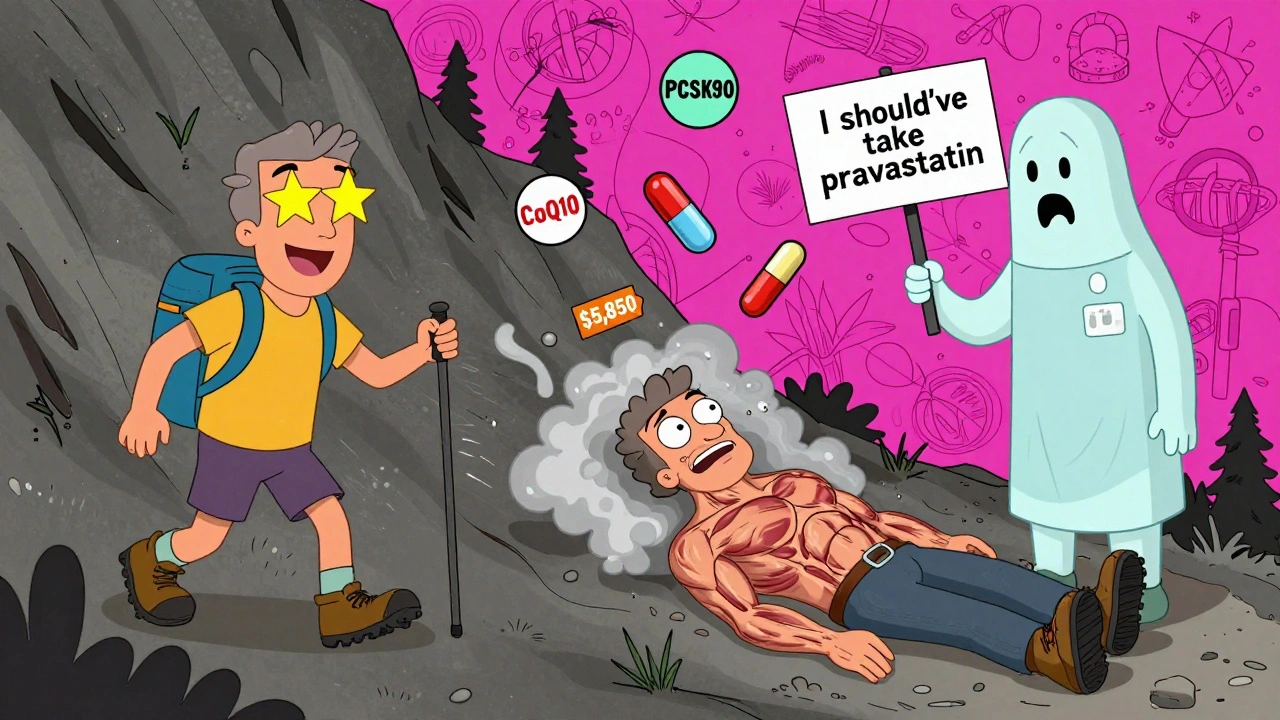
About 75% of people who stop statins do so because of muscle symptoms. But here’s the surprising part: many of them aren’t truly intolerant. A 2023 ACC task force found that 78% of people who believe they can’t take statins can actually restart them with the right approach - lower dose, different statin, or slower titration.If you truly can’t tolerate statins, alternatives exist. PCSK9 inhibitors like alirocumab and evolocumab lower cholesterol dramatically and don’t cause muscle damage. But they cost over $5,850 a year - and most insurance won’t cover them unless you’ve already tried and failed statins.
There’s also emerging hope. In 2023, a study in Nature Communications identified 17 blood proteins that predict statin myopathy with over 85% accuracy. Soon, doctors may be able to test your risk before you even start a statin. And new “muscle-sparing” statins are in early trials - designed to keep lowering cholesterol without hurting muscle tissue.
The Big Picture: Risk vs. Reward
Yes, rhabdomyolysis is terrifying. But let’s put it in perspective. Statins prevent about 500,000 heart attacks and strokes in the U.S. every year. That’s half a million lives saved. The risk of rhabdomyolysis? Less than 1 in 20,000.For someone with a history of heart disease, diabetes, or high LDL, the benefits of statins far outweigh the risks. The American Heart Association and European Atherosclerosis Society both agree: the risk-benefit ratio is overwhelmingly positive.
But for someone with no heart disease, low risk, and mild cholesterol elevation? The decision isn’t so clear. That’s why personalized care matters - genetic testing, careful dose selection, and open communication with your doctor can make all the difference.
Can statins cause muscle pain without rhabdomyolysis?
Yes. Muscle pain, or myalgia, is common - affecting 5% to 29% of statin users. But this is different from rhabdomyolysis. Myalgia means discomfort or soreness without significant muscle breakdown. CK levels stay normal or only slightly elevated. It doesn’t lead to kidney damage. Many people mistake this for statin intolerance, but switching to a different statin or lowering the dose often helps.
Is it safe to take CoQ10 supplements with statins?
Some people take CoQ10 to ease muscle pain, but studies haven’t proven it consistently works. A 2015 review in the Journal of Clinical Lipidology found no major benefit over placebo. Still, CoQ10 is generally safe. If you want to try it, 100-200 mg daily is common. Don’t expect miracles - but if it helps your symptoms, it’s unlikely to hurt.
Should I get genetic testing before starting a statin?
Not routinely - but if you’ve had muscle pain on a statin before, or if you’re starting high-dose simvastatin, it’s worth considering. The SLCO1B1 test can identify people at 4-5 times higher risk. For those with the high-risk variant, guidelines recommend sticking to ≤20 mg of simvastatin or switching to a safer statin like pravastatin or rosuvastatin. Insurance rarely covers it unless you’re at high risk, but out-of-pocket testing is affordable.
Can I restart a statin after rhabdomyolysis?
Almost never. Once you’ve had true rhabdomyolysis, restarting any statin carries a very high risk of recurrence. Doctors will usually avoid statins entirely and switch to non-statin options like PCSK9 inhibitors, ezetimibe, or bile acid sequestrants. Lifestyle changes - diet, exercise, weight loss - become even more critical.
How do I know if my muscle pain is from statins or something else?
Timing matters. Statin-related pain usually starts within the first 3 months. It’s often symmetrical - both legs, both arms - and gets worse with activity. If your pain is localized, only on one side, or accompanied by fever or swelling, it’s likely not statin-related. A blood test for creatine kinase (CK) is the best way to tell. Normal CK? Probably not statins. High CK? Stop the statin and get help.

Reviews
Statins are basically chemical betrayal. I was on simvastatin for six months, felt fine until I tried hiking - then my legs turned to wet cement. Dark urine? Yeah, I thought I was dehydrated. Turned out my CK was through the roof. Docs just shrugged. Thanks for the heads-up - this needs to be screamed from rooftops.
Man, this post is a quiet masterpiece. The way it breaks down the science without drowning you in jargon? Chef’s kiss. I’ve seen too many people panic and quit statins cold turkey, then wonder why their LDL’s in the stratosphere. The key is nuance - not fear, not faith, just smart choices. And yeah, grapefruit juice? That’s just asking for trouble. 🤦♂️
It is imperative to underscore that the risk-benefit calculus underlying statin therapy remains overwhelmingly favorable when evaluated through the lens of evidence-based medicine. The incidence of rhabdomyolysis, while clinically significant, is statistically negligible in the context of population-wide cardiovascular mortality reduction. To prioritize anecdotal experience over epidemiological data constitutes a logical fallacy of the highest order.
Okay but like… have you ever just… felt it? Like your body screaming at you? I was on atorvastatin and my thighs felt like they were wrapped in concrete after yoga. I cried. I called my mom. I Googled until my eyes burned. And then I stopped. And guess what? I felt like myself again. Who cares if the numbers are ‘rare’? If it ruins your life, it’s not rare to you. I’m not a statistic. I’m a person. And I’m still mad.
One must contemplate the metaphysical implications of pharmaceutical intervention: we outsource our biological autonomy to molecular entities designed by corporate laboratories. Statins are not merely drugs - they are silent architects of cellular decay, disguised as salvation. The SLCO1B1 variant? A poetic irony - your genes betray you before you even know their name. The tragedy is not the disease, but the illusion of control.
CoQ10 supplements? Meh. I tried it. Felt nothing. But switching from simvastatin to pravastatin? Game changer. No more muscle zombies. Also avoid grapefruit like it’s the devil’s juice. And if you’re over 65? Start low. Go slow. Don’t be a hero. Your quads will thank you.
Let me say this plainly: statins aren’t the enemy. Ignorance is. If you’re on one and you’re active - walk, swim, bike - but avoid sudden heavy lifting or downhill trails. Your muscles need time to adapt. And if you’ve had muscle pain before? Don’t assume it’s ‘just statins.’ Get tested. SLCO1B1 isn’t magic, but it’s a map. And if your doctor won’t order it? Find one who will. Your heart deserves better than guesswork.
Everyone’s acting like rhabdomyolysis is some secret conspiracy. Newsflash: it’s been documented since the 80s. If you’re taking 80mg simvastatin and drinking grapefruit juice while lifting weights? You’re not a patient. You’re a walking clinical trial gone wrong. Also CoQ10? That’s just placebo with a price tag. And no, genetic testing isn’t ‘expensive’ - it’s cheaper than dialysis. Stop being lazy and get informed.
Just got my SLCO1B1 results back - yep, I’m homozygous for the bad variant. Switched to rosuvastatin 10mg. No pain. No drama. Life’s good. 🙌 If you’re on statins and have unexplained muscle pain? Don’t wait. Get tested. It’s like a car checkup but for your muscles. Don’t be that guy who ignores the engine light until the whole thing explodes.
Statins are overprescribed. I’m 42, healthy, LDL is 130, I jog twice a week. Why am I on a pill that makes my legs feel like lead? My grandma had a heart attack at 72 and never took one. She lived to 91. Maybe we’re all just scared of death and taking pills to feel safe. 🤷♂️
Dark urine = bad. Stop statin. Call doctor. That’s it.