
Isotretinoin Mood Risk Assessment Tool
Personal Risk Assessment
This tool helps you understand your personal risk of mood changes while taking isotretinoin. Based on your responses, we'll calculate a risk score and provide personalized monitoring recommendations.
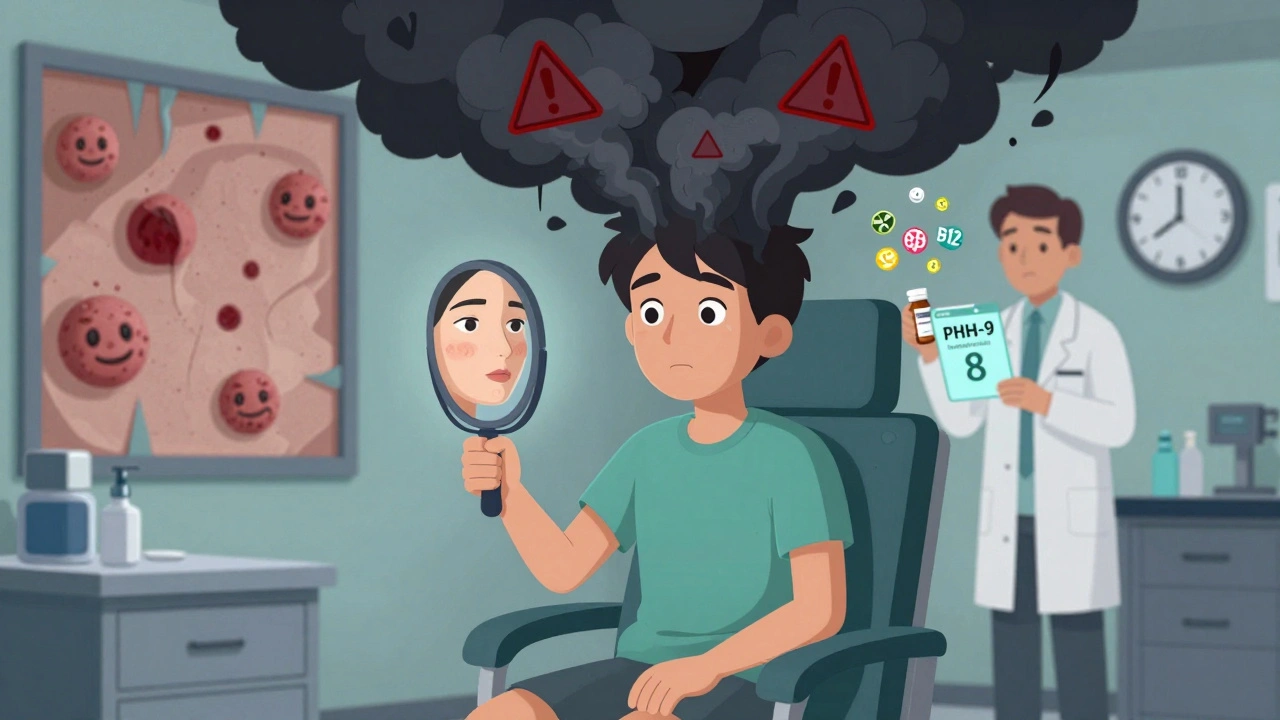
When you're dealing with severe acne, isotretinoin can feel like a lifeline. It clears up skin that hasn't responded to anything else-hundreds of thousands of people see real results. But for some, the cost isn't just dry lips or sun sensitivity. There’s a quiet, heavier risk: changes in mood, anxiety, or even depression. And while the science is mixed, the real-world stories and clinical guidelines tell a clear story: isotretinoin demands careful mental health monitoring.
Why Isotretinoin Raises Concerns
Isotretinoin isn’t just another acne pill. It’s a powerful retinoid that shrinks oil glands, cuts sebum production by up to 90%, and can lead to clear skin in 85% of people after one course. But because it’s so potent, it affects more than just your skin. It crosses the blood-brain barrier. That’s why doctors and researchers have watched for mood changes since the 1980s. The FDA added a black box warning in the 1990s-not because they knew for sure it caused depression, but because enough people reported it to raise a red flag. Today, reports still come in. In the U.S., the FDA’s adverse event database recorded over 19,000 psychiatric cases linked to isotretinoin between 2004 and 2024. Depression was the most common, followed by suicidal thoughts and anxiety. The numbers sound alarming. But here’s the catch: those numbers don’t tell you how often it actually happens. Reporting systems like FAERS don’t prove cause-they show what people report after taking a drug. That’s why big studies look at real populations, not just reports. A 2023 meta-analysis in JAMA Dermatology followed nearly 1.6 million people. It found no higher risk of suicide or depression in isotretinoin users compared to the general population. The 1-year risk of depression was 3.83%, almost identical to the 3.3-5.72% rate seen in teens without acne. That’s reassuring. But it doesn’t mean you’re safe if you’re already struggling.Who’s at Higher Risk?
The biggest risk factor isn’t the drug itself-it’s your history. If you’ve had depression, anxiety, bipolar disorder, or a family member who’s struggled with mental illness, your chance of having issues on isotretinoin goes up. Studies show patients with prior psychiatric conditions are far more likely to report worsening symptoms. Age and gender matter too. Older patients tend to have lower rates of depression on the drug. Men are more likely to report completed suicide incidents-consistent with general suicide patterns, where men are less likely to seek help but more likely to act on suicidal thoughts. Even your dose might play a role. Surprisingly, higher cumulative doses were linked to a lower risk of suicide attempts in one major study. That doesn’t mean more is better. It might mean people who take higher doses are more closely monitored, or that those with severe acne (who often need higher doses) see such a big improvement in self-esteem that it offsets any biological risk.What the Experts Say
The American Academy of Dermatology doesn’t say isotretinoin causes depression. But they do say: monitor anyway. Their 2022 guidelines recommend a baseline psychiatric screen before starting treatment. That means asking about past depression, anxiety, suicidal thoughts, and family history. No judgment. Just facts. The iPLEDGE program in the U.S.-the strict system you must go through to get isotretinoin-now requires monthly PHQ-9 screenings. That’s a simple 9-question test that measures depression severity. If your score hits 10 or higher, you’re required to see a mental health professional before continuing. In Australia, the TGA updated its safety warnings in March 2024. They now require doctors to document any persistent mood changes and rule out other causes-like vitamin B12 deficiency, which affects nearly 1 in 5 isotretinoin users. Low B12 can mimic depression: fatigue, brain fog, low mood. Fix that first. The European Medicines Agency says the same: if you’ve had mental health issues before, you need extra care. They’ve even added a differential diagnosis protocol. That means your doctor should check your B12, thyroid, and sleep patterns before assuming isotretinoin is to blame.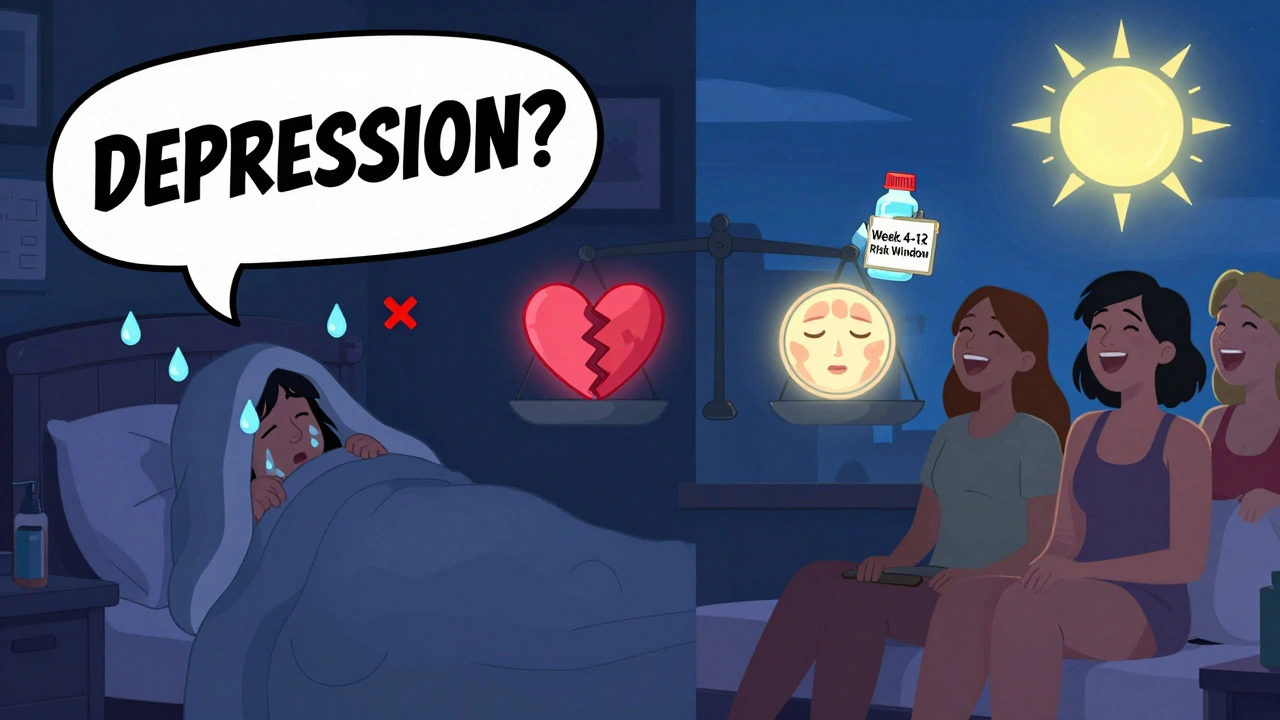
When to Watch Closely
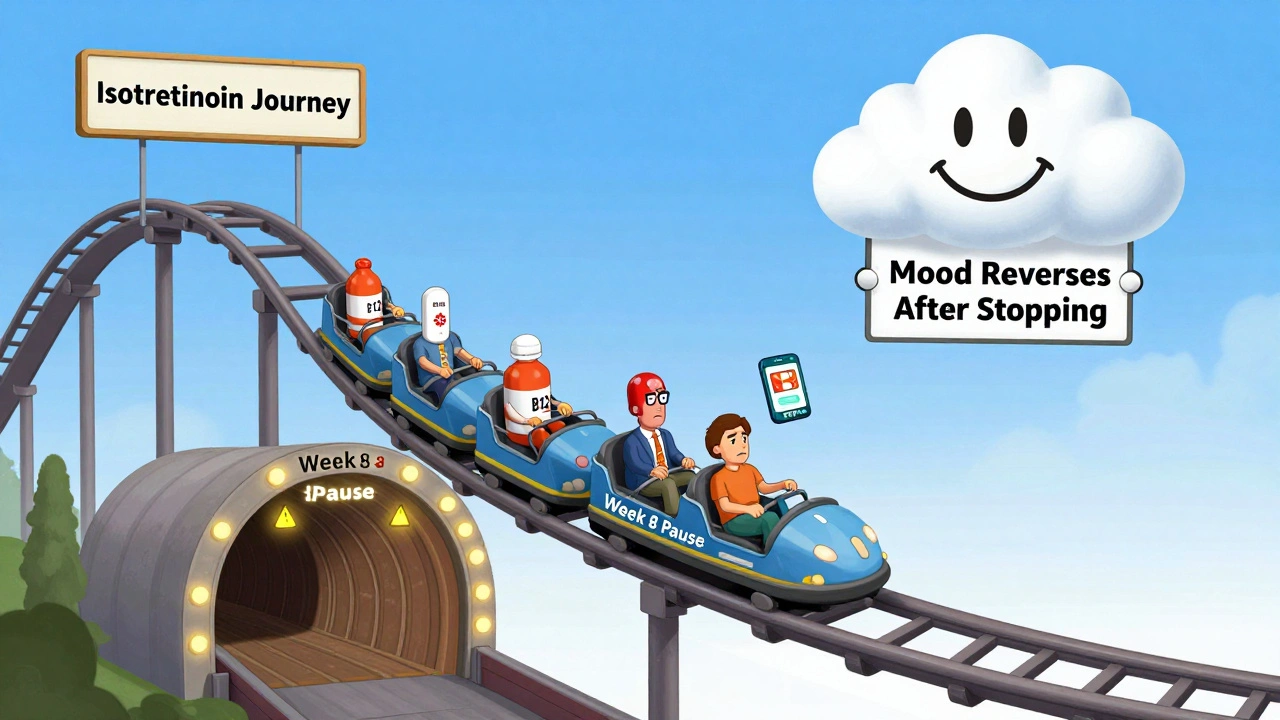
It’s not random. Most psychiatric symptoms appear between weeks 4 and 12. The median time to onset? Eighty days. That’s why the smartest clinics now have a “mental health pause” at week 8. Here’s what a real monitoring schedule looks like:- Week 1-4: Weekly check-ins. Are you sleeping? Eating? Still enjoying things you used to?
- Week 5-8: Biweekly. Use the PHQ-9. If your score jumps from 2 to 8 in two weeks, that’s a signal.
- Week 9-16: Monthly. Still important. Mood changes can creep in slowly.
- After week 16: Monthly, but less urgent unless symptoms appear.
Red Flags: When to Stop
Not every low mood means you need to quit. But some signs are non-negotiable:- Any suicidal thoughts-no matter how fleeting
- Severe anxiety that doesn’t improve with therapy or medication
- Sudden emotional numbness or loss of joy in everything
- Unexplained irritability, aggression, or rage
- Psychotic symptoms: hallucinations, paranoia, delusions
What About Other Acne Treatments?
Isotretinoin isn’t the only acne drug with mental health risks. Minocycline, a common antibiotic, has been linked to depression in 1.7% of users. Doxycycline? Less so. Topical retinoids? Rarely. But none come close to the number of reports seen with isotretinoin. That doesn’t mean isotretinoin is the worst. It means it’s the most studied, the most powerful, and the one that triggers the most attention. If you’re worried, talk to your doctor about alternatives. But if your acne is severe, nodular, scarring, and unresponsive to everything else, isotretinoin might still be the best option-just with eyes wide open.What You Can Do
You’re not powerless. Here’s how to protect yourself:- Get screened before starting. Ask for a PHQ-9 or Beck Depression Inventory. Don’t just say “I’m fine.”
- Track your mood. Use a journal or app. Note sleep, energy, irritability, crying spells.
- Tell someone. Let a friend or family member know you’re on isotretinoin. Ask them to check in.
- Check your B12. Get a blood test before and during treatment. Low levels are common and fixable.
- Don’t hide symptoms. If you feel off, say something. Your doctor isn’t there to judge-they’re there to help.
- Know it’s reversible. If you stop, most mood changes fade within weeks.
What’s Next?
Science is catching up. A 2024 study in the Journal of Clinical Psychiatry found a genetic marker-BDNF Val66Met-that may predict who’s more likely to develop depression on isotretinoin. With 68% sensitivity, it’s not perfect yet, but it’s a step toward personalized medicine. The American Psychiatric Association’s new 2025 guidelines will recommend tailored monitoring based on risk-not one-size-fits-all. That’s the future: not fear, but smart, individualized care. Isotretinoin isn’t dangerous for most people. But for some, it can be a trigger. The goal isn’t to scare you off-it’s to make sure you’re prepared. Your skin matters. So does your mind. You don’t have to choose one over the other.Does isotretinoin cause depression?
The evidence is mixed. Large population studies show no increased overall risk of depression compared to the general population. But reports of mood changes are common, especially in people with a history of mental health issues. Isotretinoin doesn’t cause depression in most people, but it can trigger it in those who are vulnerable. Monitoring is key.
How often should I be checked for depression while on isotretinoin?
Most guidelines recommend monthly screenings using the PHQ-9. But because symptoms often appear between weeks 4 and 12, many clinics now do weekly check-ins for the first 8 weeks, then biweekly until week 16, and monthly after that. The critical window is weeks 6-10.
Can I still take isotretinoin if I’ve had depression before?
Yes-but with extra care. If you’ve had depression, anxiety, or suicidal thoughts in the past, your doctor should screen you more thoroughly, monitor you more often, and possibly coordinate with a mental health professional. Many people with past depression take isotretinoin safely with proper support.
What are the signs that isotretinoin is affecting my mood?
Watch for persistent sadness, loss of interest in hobbies, trouble sleeping, increased irritability, emotional numbness, or sudden crying spells. If you feel detached from people you care about, or have thoughts of self-harm, stop the medication and contact your doctor immediately.
Will my mood improve after I stop isotretinoin?
For most people who experience mood changes, symptoms improve within 2 to 6 weeks after stopping the drug. This suggests the effect is reversible and not permanent. If symptoms persist, it may indicate an underlying condition that needs separate treatment.
Is there a blood test to check if isotretinoin is affecting my brain?
No direct test exists yet. But doctors may check vitamin B12 and thyroid levels, since low B12 (common with isotretinoin) can mimic depression. Research is ongoing into genetic markers like BDNF Val66Met, which may one day help predict who’s at higher risk.
Are there alternatives to isotretinoin for severe acne?
Yes-long-term antibiotics like doxycycline, hormonal therapies (for women), spironolactone, or photodynamic therapy. But none are as effective as isotretinoin for severe, scarring nodular acne. If other treatments have failed, isotretinoin remains the gold standard-even with its risks.



Reviews
Just started isotretinoin last week and already feeling way more confident-my skin isn’t perfect yet, but the shame is fading. If you’re scared, talk to someone. You’re not alone.
Let’s be real: the FDA’s database is a garbage fire of self-reported anecdotes-people blame every mood swing on isotretinoin because it’s ‘the scary drug.’ Meanwhile, the JAMA meta-analysis? That’s science. The real risk? Not taking it when you need it.
And yes, B12 deficiency mimics depression-duh. But that’s not the drug’s fault; it’s lazy diagnostics. Doctors should check B12 before prescribing *anything* these days.
Also, the ‘mental health pause’ at week 8? Genius. Why wait for a crisis? Proactive monitoring isn’t overcaution-it’s standard of care.
And don’t get me started on the iPLEDGE forms-they’re bureaucratic theater, but the PHQ-9? That’s actual medicine.
People who say ‘it caused my depression’ are often the same ones who didn’t disclose prior anxiety. The drug doesn’t create mental illness-it reveals it.
And yes, I’ve seen patients get worse. And I’ve seen patients get their lives back. It’s not the drug. It’s the context.
Stop treating this like a horror story. It’s a tool. Use it wisely.
As a dermatologist who’s prescribed this to over 300 patients, I’ve seen exactly three cases where mood changes were clearly drug-induced. All had prior depression. The rest? Acne was the root cause. Clear skin = better mental health. Period.
The real issue isn’t isotretinoin-it’s that we don’t screen for mental health before treating acne. We fix the skin first, then wonder why they’re sad.
Check B12. Check thyroid. Check sleep. Check family history. Then decide. Don’t let fear stop someone from getting their life back.
My cousin took isotretinoin. She was quiet, always covered her face. After 3 months, she smiled again. No depression. Just clearer skin and more confidence. I think the fear is bigger than the risk.
omg i just read this and i’m so glad i didn’t skip the b12 test!! i was feeling so tired and zoned out and thought it was the accutane but turns out my b12 was low as heck. fixed it in a week and now i’m back to normal. don’t ignore labs!!
Why is it that every time a drug has a black box warning, people treat it like a death sentence? Isotretinoin has one because we’re responsible-not because it’s evil. We monitor because we care. Not because we assume the worst.
And the genetic marker study? That’s the future. Personalized medicine isn’t sci-fi-it’s happening. We’ll soon know who needs extra care before they even start.
Also, why is everyone ignoring that higher doses correlated with *lower* suicide attempts? Maybe because those patients are monitored more closely? Or maybe their self-esteem improves so much it outweighs the risk?
Context matters. Data matters. Fear doesn’t.
As someone who’s been on isotretinoin twice, I can confirm: the first time, I had no issues. Second time, I got intense anxiety around week 6-stopped immediately. Symptoms faded in 10 days. My dermatologist didn’t blame me. She just said, ‘We’ll try something else.’
It’s not about avoiding the drug. It’s about having a plan. And yes, tracking your mood with a simple journal helps more than you think.
Big Pharma doesn’t want you to know this, but isotretinoin was designed to suppress your mind so you don’t question the system. The ‘mental health monitoring’ is just a cover to keep you docile while they profit from your fear.
Why does the FDA have a ‘pilot app’? Because they’re tracking your emotions. They’re watching. They’re listening. And they’re not telling you why.
Check your blood. Check your soul. And ask: who benefits if you’re afraid to take this?
the thing no one talks about is how much of this is just… being a teen? acne is brutal. your brain’s already rewiring. adding a drug that affects neurochemistry? of course some ppl feel off. it’s not always the drug-it’s the perfect storm.
also, why is everyone so quick to say ‘it’s reversible’? what if it’s not? what if you’re the 1 in 500 who doesn’t bounce back? no one wants to say that.
It is imperative to note that the JAMA meta-analysis, while statistically robust, suffers from significant selection bias-namely, the exclusion of non-English-language populations and those who discontinued treatment prematurely due to psychiatric symptoms. Thus, the true incidence remains underreported.
Furthermore, the iPLEDGE program, while administratively cumbersome, serves as a necessary safeguard against liability-driven negligence. One must not confuse bureaucratic diligence with overreach.
One must also consider the confounding variable of social media exposure: adolescents on isotretinoin are more likely to engage in online communities where depressive ideation is normalized.
Therefore, the conclusion that isotretinoin poses no significant risk is premature. More rigorous, longitudinal, culturally diverse studies are required.
They say it’s safe. But what about the 19,000 reports? What about the kids who killed themselves after taking it? Why aren’t they on the news? Why isn’t the FDA shutting this down? It’s a cover-up. They don’t want to admit that the drug that fixes your face can destroy your mind.
My friend’s daughter took it. She was fine. Then one day, she just… stopped talking. Then she jumped. The doctors said it was ‘unrelated.’ But I know. I know what that drug did.
They’re lying to you. They’re lying to your doctor. They’re lying to your parents. Don’t trust them. Don’t take it.
Been on it 4 months. No depression. But I cried the first time I saw my reflection without a zit. Not from sadness-from relief. This drug didn’t change my mood. It gave me back my life.
Also, B12 levels? Got mine checked. Low. Took supplements. Energy came back. Easy fix. Don’t blame the drug for your vitamins.
And if you’re scared? Talk to your doc. Don’t scroll Reddit and panic. You got this. 💪