
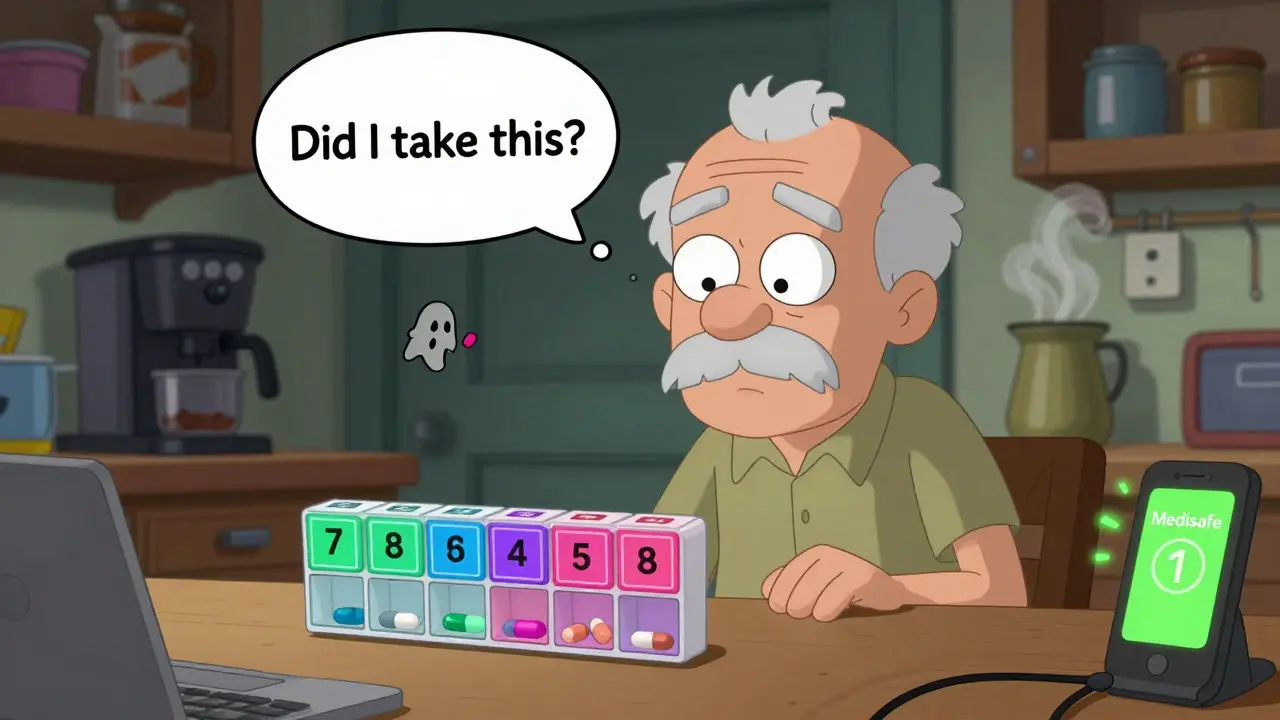
Every year, thousands of people accidentally take two doses of the same medication in one day. It’s not because they’re careless-it’s because they forgot, got confused, or someone else gave them another pill without knowing they already took it. For older adults juggling five or more prescriptions, or parents giving liquid medicine to a sick child, this kind of mistake can lead to serious harm-or even death. The double-dosing prevention isn’t about being perfect. It’s about building simple, reliable systems that work even when you’re tired, stressed, or distracted.
Why Double-Dosing Happens More Than You Think
Most people assume they’d never accidentally take two pills. But the truth is, it’s easier than you’d expect. A 2023 survey by WesleyLife found that nearly 3 out of 10 seniors admitted to double-dosing at least once in the past year. Why? Because they couldn’t remember if they’d already taken their morning pill. Or because their spouse gave them another dose after they said they felt worse. Or because the medicine bottle looked empty and they thought it was time to refill-only to realize they’d already taken it. Children are just as vulnerable. In 41% of pediatric double-dosing cases tracked by Children’s Healthcare of Atlanta in 2023, a child refused medicine the first time, then accepted it later from another parent or grandparent who didn’t know the first dose had been given. Kitchen spoons were used instead of proper measuring tools, leading to accidental overdoses. One teaspoon can hold anywhere from 2.5 to 7.3 milliliters-enough to turn a safe dose into a dangerous one. And it’s not just prescriptions. Over-the-counter meds like acetaminophen, ibuprofen, or cold syrups often contain the same active ingredients as prescription drugs. People don’t realize they’re doubling up until it’s too late. EssexCare Pharmacy reported that 32% of double-dosing incidents they saw in 2023 involved hidden duplicates-like taking a prescription painkiller and a store-brand cold tablet that both contained acetaminophen.Use a Pill Organizer-But Choose the Right One
The simplest, most proven tool for preventing double-dosing is a pill organizer. Not just any organizer-look for one with separate compartments for each time of day: morning, noon, evening, bedtime. A standard 7-day organizer with four slots per day is the most common and effective. According to WesleyLife’s 2023 survey, 68% of seniors use this type, and it reduces double-dosing errors by 35% on its own. Here’s how to make it work:- Fill it once a week, ideally on the same day-Sunday works well for most people.
- Keep it in a visible spot: on the kitchen counter, next to the coffee maker, or beside the toothbrush.
- After taking your pills, look at the compartment. If it’s empty, you’re good. If it still has pills, don’t take more.
Set Digital Reminders That Actually Work
Smartphone apps like Medisafe have changed the game. In a 2022 study published in the Journal of Medical Internet Research, users who used Medisafe saw an 87% improvement in adherence. These apps don’t just buzz at the right time-they track what you’ve taken, alert family members if you miss a dose, and even warn you if you’re about to take a duplicate medication. But setup matters. Don’t just download an app and expect it to work. Spend 20-30 minutes setting it up properly:- Enter every medication-prescription, OTC, vitamins, supplements.
- Set the exact time and frequency (e.g., “Take 10 mg at 8 a.m. and 8 p.m.”).
- Enable notifications with a unique sound for each medication.
- Invite one family member to get alerts too-they’ll get a notification if you don’t mark a dose as taken.
Keep a Written Medication List-And Update It
You’d be surprised how many people don’t know exactly what they’re taking. A medication list isn’t just for doctors-it’s your personal safety net. Write down:- Drug name (brand and generic, if different)
- Dose (e.g., 5 mg, 10 mL)
- Time of day to take it
- Reason for taking it (e.g., “for high blood pressure”)
- Prescribing doctor’s name
Never Use Kitchen Spoons to Measure Liquid Medicines
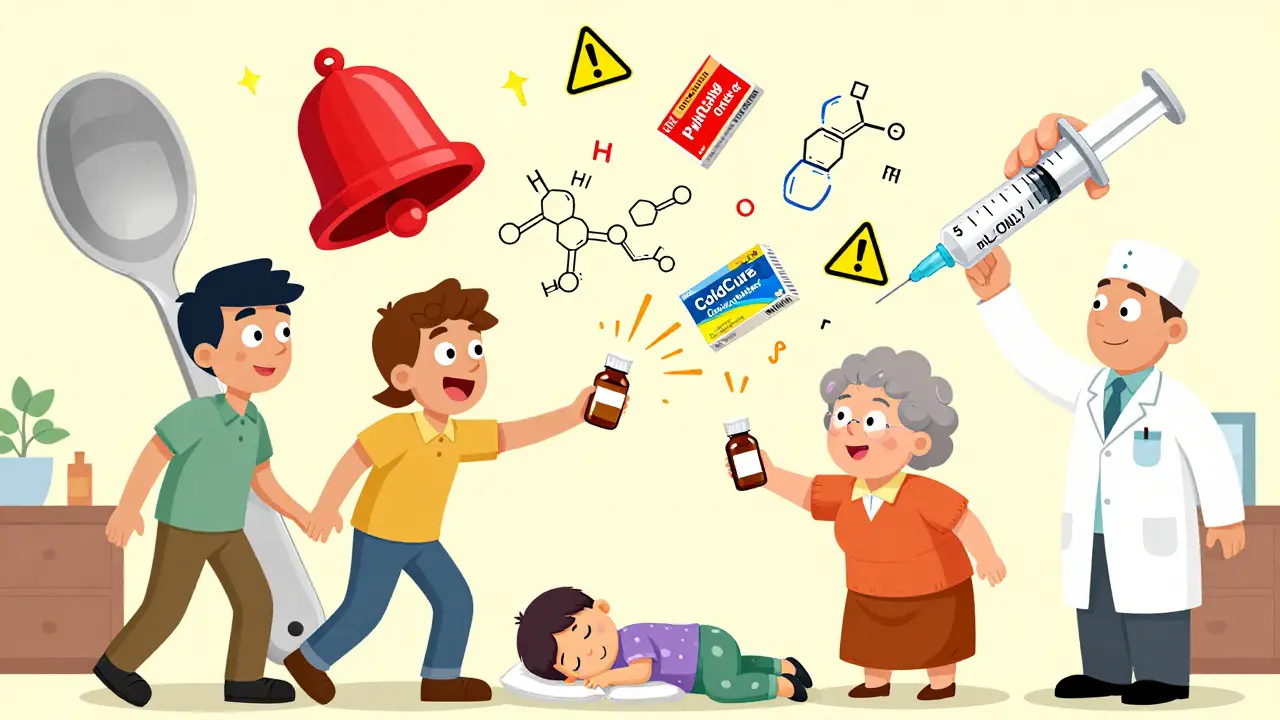
This is one of the most dangerous myths. A teaspoon is not a teaspoon. Children’s Healthcare of Atlanta tested common kitchen spoons and found they varied by 20% to 65% in volume. That means if you’re giving a child 5 mL of medicine with a kitchen spoon, you might be giving them 3 mL-or 8 mL. That’s not just inaccurate-it’s risky. Always use the measuring tool that came with the medicine: a syringe, dosing cup, or oral dropper. If you lost it, ask your pharmacist for a replacement. They’ll give you one for free. And never guess. If the label says “5 mL,” use the tool that measures in mL-not tablespoons or teaspoons.Designate One Person to Handle Medications
In households with multiple caregivers-especially with children or elderly parents-double-dosing spikes. St. Louis Children’s Hospital found that assigning one person to give all medications cuts errors by 47%. That doesn’t mean others can’t help. But only one person should be responsible for giving the dose and checking the pill organizer or app. For families, this works best with a simple rule: “Only Alex gives the morning meds.” Everyone else knows to ask Alex before offering anything. For seniors living with a spouse or adult child, the same applies. If Mom takes her pills at 8 a.m., Dad should be the one who hands them to her-not a visiting grandkid who thinks she “looks like she needs it.”Store Medications Out of Reach-and Out of Sight
A 2023 report from Children’s Healthcare of Atlanta found that 86% of emergency visits for medicine poisoning in kids involved medications taken from a family member’s purse, drawer, or nightstand. Kids are curious. They see a colorful bottle and think it’s candy. Lock up all medicines-even OTC ones-in a cabinet with a childproof latch. Keep them away from countertops, bedside tables, and bathroom vanities. Don’t leave pills in a purse or coat pocket where a child can grab them. If you’re traveling, use a small locked container.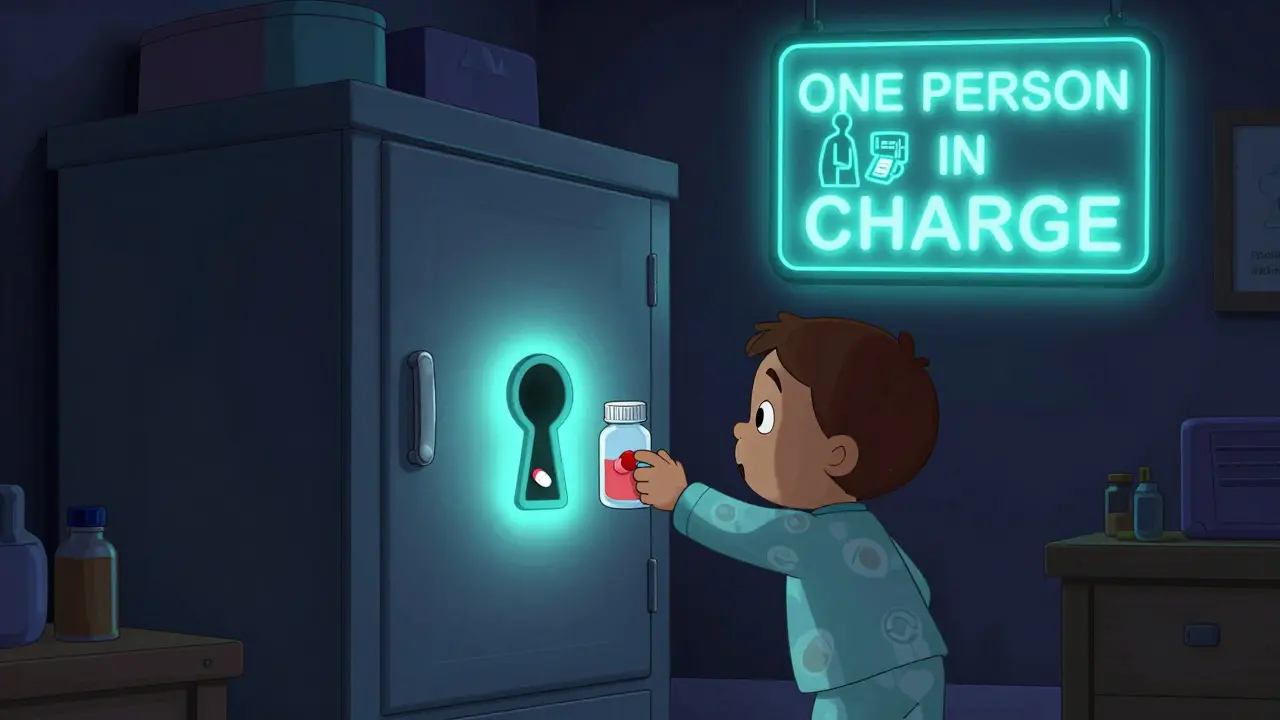
Know What to Do If You Accidentally Double-Dose
Even with all the best systems, mistakes happen. If you or someone you care for takes two doses by accident, don’t wait. Don’t panic. Don’t Google it. Call 1-800-222-1222 immediately. That’s the National Poison Control Center. They’re staffed 24/7 by toxicology experts who know exactly what to do. They’ll ask you:- What medication was taken?
- How much?
- When?
- How old is the person?
What Works Best Together
No single method is perfect. But when you combine tools, you slash your risk dramatically. - A pill organizer + digital reminders = 62% reduction in double-dosing (WesleyLife, 2023)- A written list + pharmacist review = 40% fewer duplicate medications (EssexCare Pharmacy, 2023)
- One designated caregiver + locked storage = 70% fewer pediatric overdoses (Children’s Healthcare of Atlanta, 2023)
The most successful users don’t rely on memory. They rely on systems. They check the organizer. They listen to the app. They ask, “Did I already take this?” before reaching for the bottle.
Future Tools Are Coming-But Simplicity Still Wins
Smart pill dispensers that lock after each dose are now available. Johns Hopkins found they reduce double-dosing by 76%. AI systems that learn your routine and warn you when you’re off track are on the horizon. But for now, the best tools are still the simplest: a plastic box with compartments, a phone alarm, a written list, and one person who knows the plan. The goal isn’t to make medication management complicated. It’s to make it foolproof. Even on bad days. Even when you’re tired. Even when someone else is helping. You don’t need to be perfect. You just need to be prepared.What’s the most common cause of accidental double-dosing in seniors?
The most common cause is forgetting whether a dose was already taken, especially when taking multiple medications at different times of day. Anxiety about missed doses leads people to take extra pills “just in case.” Using a pill organizer with visual compartments and setting digital reminders significantly reduces this risk.
Can over-the-counter medicines cause double-dosing?
Yes. Many OTC cold, flu, and pain relievers contain the same active ingredients as prescription drugs-like acetaminophen, ibuprofen, or diphenhydramine. Taking a prescription painkiller and a store-brand cold syrup together can lead to dangerous overdose. Always check the “Active Ingredients” label on every bottle and compare them to your prescription list.
Is it safe to use a kitchen spoon to measure liquid medicine?
No. Kitchen spoons vary in size by up to 65%, which can result in underdosing or overdosing. Always use the dosing syringe, cup, or dropper that came with the medication. If you lost it, ask your pharmacist for a free replacement.
What should I do if I accidentally give my child two doses of medicine?
Call the National Poison Control Center at 1-800-222-1222 immediately. Do not wait for symptoms to appear. Have the medicine bottle handy so you can tell them the name, dose, and time it was taken. They’ll guide you on whether to monitor at home or go to the ER.
How can I help an elderly parent avoid double-dosing?
Set up a weekly pill organizer with AM/PM slots, sync a medication app like Medisafe with your phone so you get alerts, and designate one person as the primary medication manager. Review their medication list with their pharmacist every 3 months to catch hidden duplicates. Keep all meds locked away and out of sight.
Are smart pill dispensers worth the cost?
For people with complex regimens, memory issues, or a history of double-dosing, yes. A 2023 Johns Hopkins study showed they reduce errors by 76%. While they cost $100-$300, many insurance plans or Medicare Advantage programs cover them if prescribed by a doctor. For simpler routines, a basic pill organizer and phone reminders are just as effective.



Reviews
Man, this post hit home. I’ve been helping my dad manage his meds for years-five different bottles, three times a day, and he still forgets if he took his blood pressure pill. The pill organizer thing? Total game changer. We got one with AM/PM slots, filled it every Sunday, and now he just looks at it like it’s a to-do list. No more ‘Did I take it?’ panic. Also, the app reminder with the weird sound? Genius. He says it’s like a little robot yelling at him to take his pills. I laugh, but it works.
And don’t even get me started on kitchen spoons. My mom once gave my niece 10 mL of cough syrup with a soup spoon because ‘it looked right.’ Turned out it was closer to 18 mL. We ended up at the ER at 2 a.m. Now we keep the syringes taped to the bottle with duct tape. Simple. Stupid. Effective.
why do u need all this fancy stuff? just write it on ur hand with a marker. i do it all the time. easy. free. no app needed. also dont trust those pharmacy people they just wanna sell u more shit.
Let’s be real-most of these ‘solutions’ are for people who can’t handle basic responsibility. If you’re forgetting to take your meds, maybe you shouldn’t be managing them. Or maybe your doctor needs to cut your regimen down. I’ve seen people on 17 pills. That’s not medicine, that’s a pharmaceutical buffet.
And don’t even get me started on ‘designating one person.’ That’s just code for ‘I’m too lazy to teach my family to be responsible.’
Also, using a syringe? Please. I’ve been giving my kid liquid medicine since 2012 with a regular spoon. Nothing’s happened. Maybe your kid just needs to learn to take medicine like a human.
I cried reading this. My grandma passed last year because of a double dose of her heart med. She took it because she thought she missed it, and the bottle looked empty-so she grabbed another. We found the bottle half-full. She was so proud of how organized she was. She had a pill organizer… but she didn’t trust it. She thought the pills would disappear if she didn’t see them.
This post? It’s the kind of thing I wish someone had handed me before it was too late. The written list, the locked cabinet, the one person in charge-those aren’t just tips. They’re lifelines.
If you’re reading this and you’re caring for someone? Do it. Don’t wait until it’s a crisis. Just… do it. For them. For you.
I’m still crying. But I’m also setting up my mom’s organizer tonight.
While the recommendations provided are indeed practical, they are fundamentally reactive rather than preventative in nature. The underlying issue lies in a societal failure to prioritize health literacy, particularly among aging populations. Why are we allowing individuals to manage complex pharmacological regimens without formal training? Why are pharmacies not mandated to provide in-person medication reconciliation sessions? Why is the burden placed entirely on the patient and their family, rather than on the healthcare infrastructure?
Furthermore, the normalization of ‘simple’ solutions like pill organizers ignores the cognitive decline that often accompanies polypharmacy. A plastic box does not compensate for dementia. A phone alarm does not address executive dysfunction. We are treating symptoms while ignoring the disease: a healthcare system that abdicates responsibility to the most vulnerable.
Perhaps we should be advocating for mandatory pharmacist-led medication audits for seniors on five or more drugs-not just a ‘written list’ they may never update.
USA is the only country where you need an app to take your pills. In China they just use a calendar. In Germany they have nurses come to the house. Here we got apps and syringes and designated people. We are so overcomplicated. All you need is discipline. And stop buying so much junk medicine.
lol the whole post is just a big ad for medisafe. also why is everyone so scared of pills? my grandpa took 12 pills a day for 30 years and never messed up once. he just remembered. maybe people are just lazy now. also i used a kitchen spoon for tylenol and nothing happened. maybe your kid is just weak.
The entire framework presented here is a neoliberal fantasy of individual responsibility masquerading as public health. You don’t solve systemic failures-like the overprescription of polypharmacy, the commodification of health tools, the erosion of elder care infrastructure-by handing someone a plastic box and a smartphone app.
This is the same logic that tells you to ‘just eat better’ when you live in a food desert, or ‘just exercise’ when you work three jobs. The real solution is not a pill organizer. It’s universal healthcare with mandatory geriatric pharmacology reviews. It’s a national medication reconciliation program. It’s paying home health aides to actually administer doses.
Instead, we turn elderly people into their own pharmacists and call it ‘empowerment.’
It’s not a system. It’s a failure dressed in pastel compartments.
i like this post a lot. my sister in law is a nurse and she said the same thing about the kitchen spoons. i never knew they were so off. also the one person rule makes sense. we had a mess at thanksgiving when my uncle gave my aunt her blood pressure pill twice because he thought she looked pale. now we just say ‘only linda touches the meds’ and everyone respects it. no drama. no yelling. just quiet order. also the poison control number is something everyone should have saved. like 911 but for medicine stuff.
you think this is bad wait till you find out the government is putting tracking chips in pill bottles. they’re using the ‘accidental overdoses’ as an excuse to monitor seniors. i saw a video on Gab where a guy showed his pill organizer had a tiny antenna. they want to know when you take your meds so they can deny you care if you ‘don’t comply.’ also medisafe is owned by big pharma. they want you addicted to apps so you keep buying pills. don’t trust any of this. burn your organizer. throw away your syringes. trust your gut.
man i used to be the guy who gave my mom two doses because i felt bad she looked tired. then she ended up in the hospital with liver failure from too much tylenol. i still feel like shit about it. now i have a checklist on my phone that says ‘did she take it? check. did she say she took it? check. is the pill organizer empty? check.’ i even took a picture of the bottle after she takes it. yeah it’s extra. yeah it’s weird. but i’d rather be weird than bury my mom because i thought she ‘seemed fine.’
also the poison control number? saved it in my phone as ‘POISON’ so i don’t have to think when it’s 3 a.m. and my heart is in my throat.
While the recommendations provided are commendable in their practicality, I must emphasize the critical importance of maintaining a standardized, digitally encrypted, and HIPAA-compliant medication registry accessible via secure patient portals. The handwritten list, while well-intentioned, is vulnerable to loss, illegibility, and temporal obsolescence. Furthermore, the reliance on consumer-grade smartphone applications introduces significant data privacy risks, particularly when family members are granted access without explicit consent protocols.
I strongly urge all caregivers to consult with their primary care provider to initiate enrollment in a certified Medication Therapy Management (MTM) program, which offers pharmacist-led reconciliation, real-time interaction alerts, and regulatory-compliant documentation-far superior to the ad hoc systems described herein.
Additionally, the use of ‘childproof’ cabinets is insufficient; the Consumer Product Safety Commission mandates that all medication storage containers meet ASTM F963-21 standards for child resistance, which many retail organizers fail to achieve.
you people are so dramatic. i gave my dad his pills every day for 5 years. i never used an app. never used a syringe. never wrote anything down. i just knew. i looked him in the eye and said ‘you good?’ and he said yes. that’s all you need. love. trust. human connection. not plastic boxes and phone alarms. you’ve turned medicine into a corporate ritual. stop it. just be there.
Wow, I didn’t think anyone else would get the syringe thing. I just got one from the pharmacy last week after my cousin almost gave her kid 15 mL of amoxicillin with a tablespoon. The pharmacist looked at me like I was from another planet. Said, ‘You’re the third person this week.’
And Shiv? You’re right about love and trust. But trust doesn’t stop a kid from grabbing a bottle. Love doesn’t stop someone from forgetting. Systems aren’t the opposite of care. They’re the structure that lets care survive when we’re exhausted.
My dad still says ‘you good?’ before I hand him his pills. Then I check the organizer. We do both. It’s not either/or. It’s both.