
What Makes a Generic Drug Approved by the FDA?
When you pick up a generic pill at the pharmacy, you expect it to work just like the brand-name version. That’s not luck. It’s the result of one of the most tightly regulated processes in medicine. The FDA doesn’t just accept that a generic drug has the same ingredients-it demands proof that it performs the same way in your body. This isn’t about cutting corners. It’s about ensuring safety, quality, and strength match the original drug down to the last milligram.
The Core Requirements: Same Active Ingredient, Same Effect
Every FDA-approved generic drug must contain the same active pharmaceutical ingredient as the brand-name drug. That means if the brand is 10 mg of lisinopril, the generic must be 10 mg of lisinopril-no more, no less. It must also come in the same form: tablet, capsule, injection, etc. Same strength. Same route-oral, topical, inhaled. That’s the baseline.
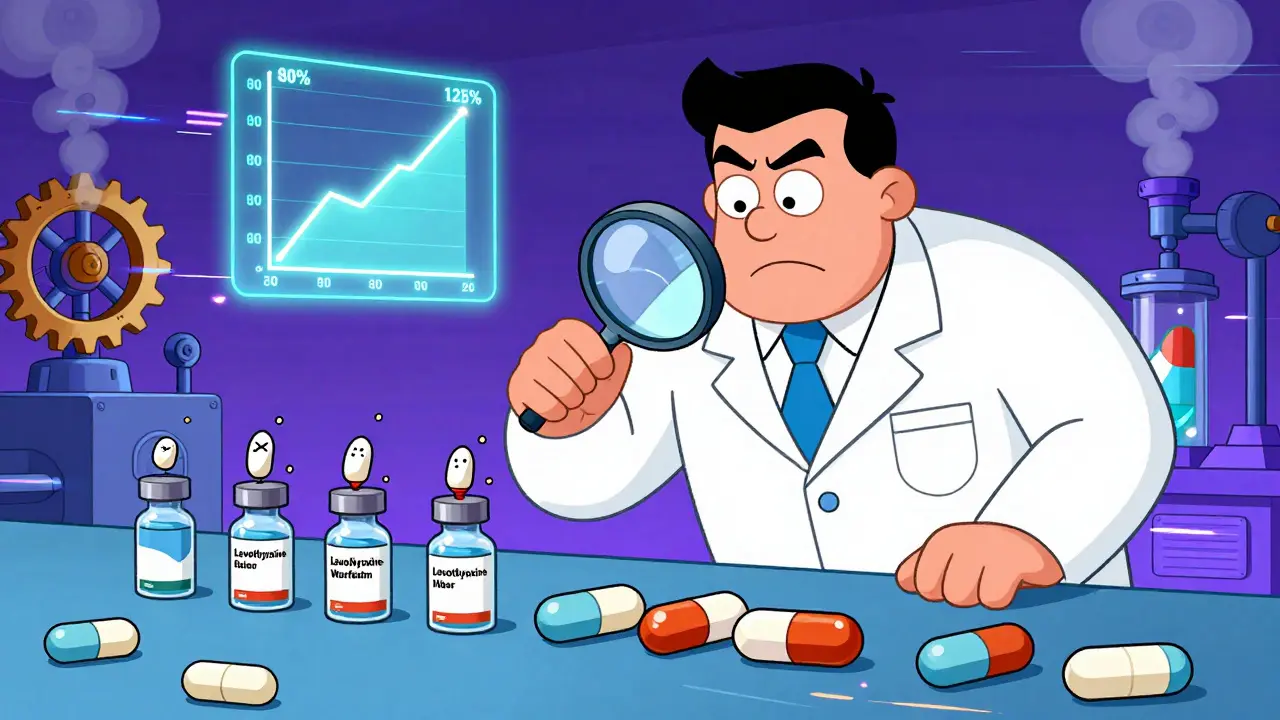
But that’s not enough. A pill with the right chemical doesn’t mean it’ll work the same in your bloodstream. That’s where bioequivalence comes in. The FDA requires generic manufacturers to prove their product is absorbed into your body at the same rate and to the same extent as the brand. This is measured using blood tests in healthy volunteers. The standard? The generic’s absorption must fall within 80% to 125% of the brand’s. For most drugs, that’s a wide enough range to ensure safety. But for drugs with a narrow therapeutic index-like warfarin or levothyroxine-the FDA tightens the rules. For levothyroxine, the range is 95% to 105%. One percent off can mean your thyroid isn’t properly controlled.
Manufacturing Isn’t Optional-It’s Scrutinized
Even if a drug performs correctly in a lab, it can fail in the real world if the manufacturing process is sloppy. That’s why the FDA inspects every factory making generics. These aren’t random checks. They’re pre-approval inspections (PAIs) that look at every step: raw material sourcing, mixing, tablet compression, coating, packaging. The rules? Current Good Manufacturing Practices (cGMP), written into federal law (21 CFR Parts 210 and 211).
Manufacturers must prove consistency. The FDA doesn’t accept one good batch. They need data from three consecutive commercial-scale batches showing every tablet has the same hardness, dissolution rate, and purity. In 2021, Hetero Labs got a Complete Response Letter for its generic version of Jardiance because tablet hardness varied too much across batches. That’s not a minor issue-it means some pills might dissolve too fast, others too slow. That’s dangerous.
And the inspections are frequent. The FDA conducts about 1,200 PAIs every year. If a facility has a history of violations, they come back. Often. And if problems aren’t fixed, approval is delayed-sometimes for years.
Why Do So Many Generic Applications Get Rejected?
You’d think with fewer clinical trials needed, approval would be easier. But the opposite is true. Less than 10% of generic applications get approved on the first try. Why? Because the paperwork is massive. A typical ANDA (Abbreviated New Drug Application) runs 5,000 to 10,000 pages. It includes chemistry data, stability studies, bioequivalence results, and detailed manufacturing controls.
Complex drugs are the hardest. Inhalers, injectables, topical creams, and extended-release tablets are much harder to copy than a simple pill. For example, between 2015 and 2020, the FDA approved only 3 out of 27 applications for a generic EpiPen. Why? The auto-injector device itself is part of the drug. Getting the needle depth, force, and delivery timing right is as hard as making the drug.
Even when the science is solid, delays happen. A 2023 survey of generic manufacturers found that 68% said designing bioequivalence studies was the toughest part. And 45% struggled with cGMP compliance during inspections. The average time to approval? 32.7 months. For complex generics? Nearly 4 years.
The Real-World Impact: Safety, Cost, and Access
Despite the hurdles, the system works. As of 2023, 90% of all prescriptions filled in the U.S. are generics. Yet they make up only 23% of total drug spending. That’s over $370 billion saved in a single year. These savings don’t just help patients-they keep insurance premiums lower and public health programs like Medicare solvent.
And the safety record? Strong. A 2021 report by the American Medical Association reviewed 15 years of post-market data and found that 98.7% of therapeutic categories showed no meaningful difference in outcomes between generics and brand-name drugs. For most people, switching to a generic is safe and effective.
But the system isn’t perfect. Some experts warn that the 80%-125% bioequivalence range might be too loose for drugs where small changes matter. The FDA has responded by creating stricter rules for narrow therapeutic index drugs. That’s the system adapting-responding to evidence, not ignoring it.
What’s Changing in 2026?
The FDA is pushing to approve more complex generics faster. Right now, only 28% of complex generic applications get approved within two review cycles. The goal by 2027? 50%. That means more options for drugs like insulin pens, inhalers, and long-acting injectables that have been stuck with only one brand-name option for years.
In late 2023, the first generic version of Humira (adalimumab) finally hit the market after years of patent battles. That was a milestone. Now, the FDA is working on similar pathways for other biologic drugs-though those fall under a different approval system (biosimilars, not generics). And in August 2023, the first generic of Vivitrol (naltrexone extended-release injection) was approved, a major step for opioid addiction treatment.
But the biggest challenge isn’t science-it’s patents. Even after the FDA approves a generic, brand-name companies can use legal tactics to delay market entry. The FTC found that, on average, generics face a 2.4-year delay between approval and being sold to patients. That’s not a regulatory failure. It’s a legal one.
What Patients Should Know
If your doctor prescribes a brand-name drug, ask if there’s a generic. In most cases, there is-and it’s just as safe. The FDA doesn’t approve generics that are weaker, slower, or less reliable. The only exceptions are for drugs with very narrow therapeutic windows, where your doctor might prefer to stick with the brand. But even then, many generics are now approved for those drugs under tighter standards.
Don’t assume a generic is inferior because it’s cheaper. It’s not. It’s the same drug, made to the same standard, tested to the same standard, inspected to the same standard. The only difference? The price tag-and that’s a good thing.
Are generic drugs as safe as brand-name drugs?
Yes. The FDA requires generic drugs to meet the same safety, strength, quality, and performance standards as brand-name drugs. Every approved generic contains the same active ingredient and delivers it the same way. Post-market surveillance over 15 years shows no meaningful difference in outcomes for 98.7% of therapeutic categories.
Why do some generics cost more than others?
Cost differences between generics come from manufacturing complexity, market competition, and supply chain factors-not quality. A simple tablet made by multiple companies will be cheaper than a complex extended-release formulation made by only one. The FDA doesn’t regulate pricing, but competition usually drives prices down. If one generic is significantly more expensive, ask your pharmacist if another version is available.
Can I switch between different generic brands?
Yes, for most drugs. All FDA-approved generics meet the same bioequivalence standards. But for drugs with a narrow therapeutic index-like warfarin, levothyroxine, or seizure medications-your doctor may prefer you stick with one brand to avoid even small variations in absorption. Always check with your provider before switching.
Do generic drugs take longer to work?
No. The FDA requires generics to have the same rate and extent of absorption as the brand-name drug. If the brand works in 30 minutes, the generic must too. For extended-release versions, the release pattern must match exactly-whether it’s over 8, 12, or 24 hours. Bioequivalence studies prove this before approval.
What if my generic looks different from the brand?
That’s normal. Generic manufacturers aren’t required to copy the color, shape, or packaging of the brand-name drug. Only the active ingredient and performance matter. The inactive ingredients (fillers, dyes, coatings) can differ, which is why generics may look different. But these don’t affect how the drug works in your body.
Are all generics made in the U.S.?
No. Over half of all generic drugs sold in the U.S. are made overseas, mostly in India and China. But every facility-whether in the U.S., India, or Germany-must pass the same FDA inspections. The FDA has offices in India and China to conduct on-site inspections. If a factory fails an inspection, its products are blocked from entering the U.S. market.
Final Thoughts
The generic drug system isn’t perfect, but it’s one of the most effective public health tools we have. It brings down costs without sacrificing safety. It’s built on science, not speculation. And it’s held together by thousands of inspections, millions of pages of data, and a regulatory framework that doesn’t cut corners. For patients, it means access. For the system, it means sustainability. And for the future, it means more people getting the medicines they need-without paying a fortune for them.


Reviews
The FDA's rigor with generics is something most people don't appreciate until they need a life-saving drug that costs 90% less. It's not just about saving money-it's about ensuring that the person on the other side of the pharmacy counter gets the same outcome, no matter their income. The data backs this up, and the inspections aren't theater. They're necessary.
bioequivalence thresholds of 80-125% are essentially a statistical loophole dressed up as science. When you're dealing with pharmacokinetics, that’s a 45% window for divergence-how is that not a regulatory failure masked as pragmatism? The system is built on assumptions, not absolutes.
Oh, so now we’re impressed that a system designed to prevent corporate greed from killing patients is somehow ‘remarkable’? Let’s not forget that this is the same FDA that approved OxyContin with a straight face. Maybe we should start calling this ‘minimum viable regulation’ instead of ‘gold standard.’
in india, we make half the world’s generics and still get called ‘unsafe’ by people who’ve never seen a cGMP facility. the FDA inspects our plants like they’re inspecting a bomb lab-because they are. if your pill dissolves wrong, people die. we take that seriously. you think your $200 brand-name drug is pure? check the fillers. they’re cheaper than ours.
sooo many people think generic = bad. but the truth? if you're on a med like levothyroxine, the difference between brands is smaller than the difference between your morning coffee and your afternoon tea. just trust the science. and save your cash for something fun.
the fact that the FDA approves generics at all is a joke. real medicine is made in switzerland, not some factory in hyderabad with a 3-star rating on google maps. if you're gonna take a pill, at least make it look expensive. and yes, i know that's elitist. good.
the 98.7% therapeutic equivalence statistic is the most important number here. it’s not opinion. it’s data. and it’s why generics are the backbone of public health. the rest is noise.
did you know that the FDA has been compromised by Big Pharma lobbying? the 80-125% range was pushed through by manufacturers who wanted to cut corners. the real reason generics are approved so slowly isn’t because of inspections-it’s because the system is rigged to protect patents, not patients. the FDA isn’t watching you. they’re watching the stock prices.