
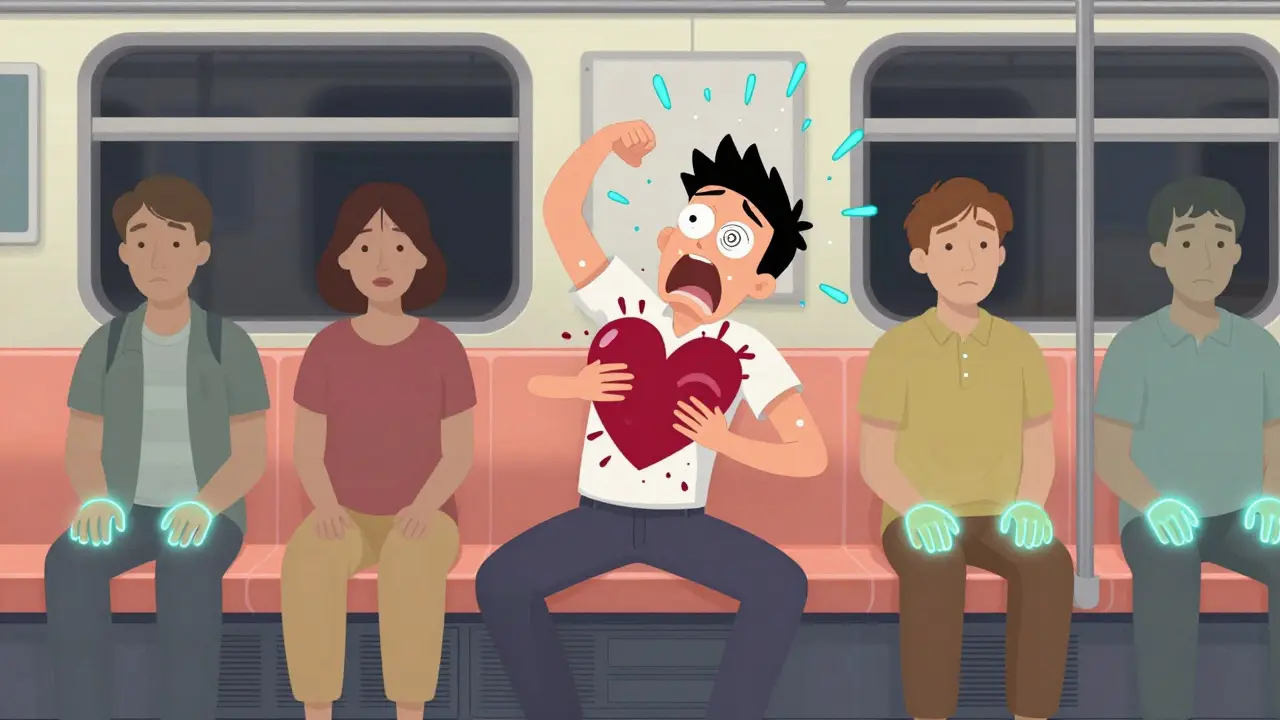
When your heart pounds like it’s trying to escape your chest, your breath vanishes, and you’re sure you’re having a heart attack - but you’re not sick - you’re not crazy, and you’re not alone. This is a panic attack. And if they keep happening without warning, you might be dealing with panic disorder.
What Exactly Is a Panic Attack?
A panic attack isn’t just feeling nervous. It’s a sudden, overwhelming surge of fear that hits like a wave, peaking within minutes. You might feel your heart racing, sweat pouring, hands trembling, or your throat closing up. Some people feel like they’re dying, losing control, or going crazy. These aren’t just thoughts - they’re real physical reactions. In fact, during a panic attack, your heart rate can jump to over 120 beats per minute, even if you’re sitting still. According to clinical data, nearly everyone who has panic attacks reports palpitations (98%), and 80% fear they’re going to die. That’s not exaggeration - it’s how the brain misfires under extreme anxiety. These attacks usually last 5 to 20 minutes, but the fear of the next one can linger for days, weeks, even years.Panic Disorder: More Than Just Attacks
Having one or two panic attacks doesn’t mean you have panic disorder. The diagnosis kicks in when you start living in fear of the next one. You begin obsessing: “What if it happens while I’m driving?” “What if I pass out in public?” “What if no one helps me?” That constant worry - plus changing your behavior to avoid triggers - is what turns occasional attacks into panic disorder. The DSM-5-TR requires two things for diagnosis: recurrent unexpected panic attacks, and at least one month of persistent fear or behavioral changes because of them. Most people don’t realize they have it for years. The Anxiety and Depression Association of America found that 68% of people wait an average of 7.2 years before getting a correct diagnosis. Many end up in emergency rooms thinking they’re having a heart attack - and they’re not wrong to worry. The symptoms are identical.Agoraphobia: The Invisible Prison
One in every two people with panic disorder develops agoraphobia. That doesn’t mean you’re scared of open spaces - it means you’re scared of being trapped, helpless, or far from safety if a panic attack hits. It’s not about the place. It’s about the feeling of being unable to escape or get help. Common avoided situations include:- Public transportation (62% avoid buses or trains)
- Being outside the home alone (72%)
- Crowds like malls or concerts (59%)
- Enclosed spaces like elevators or movie theaters (48%)
- Open areas like parking lots or bridges (55%)
Why Does This Happen?
No single cause explains panic disorder. It’s a mix of biology, psychology, and life events. Your brain’s alarm system - the amygdala - is overly sensitive. Brain scans show people with panic disorder have 25% more activity in this fear center when faced with threats. The locus coeruleus, which controls norepinephrine (your body’s natural adrenaline), is also overactive. That’s why you feel your heart racing even when nothing’s wrong. Genetics play a role too. If a close family member has panic disorder, your risk goes up by 30-48%. Trauma, major life stress, or even a history of childhood anxiety can trigger it. But the biggest psychological factor is anxiety sensitivity - the fear of your own physical sensations. People who think “my racing heart means I’m having a heart attack” are 4.7 times more likely to develop full-blown panic disorder.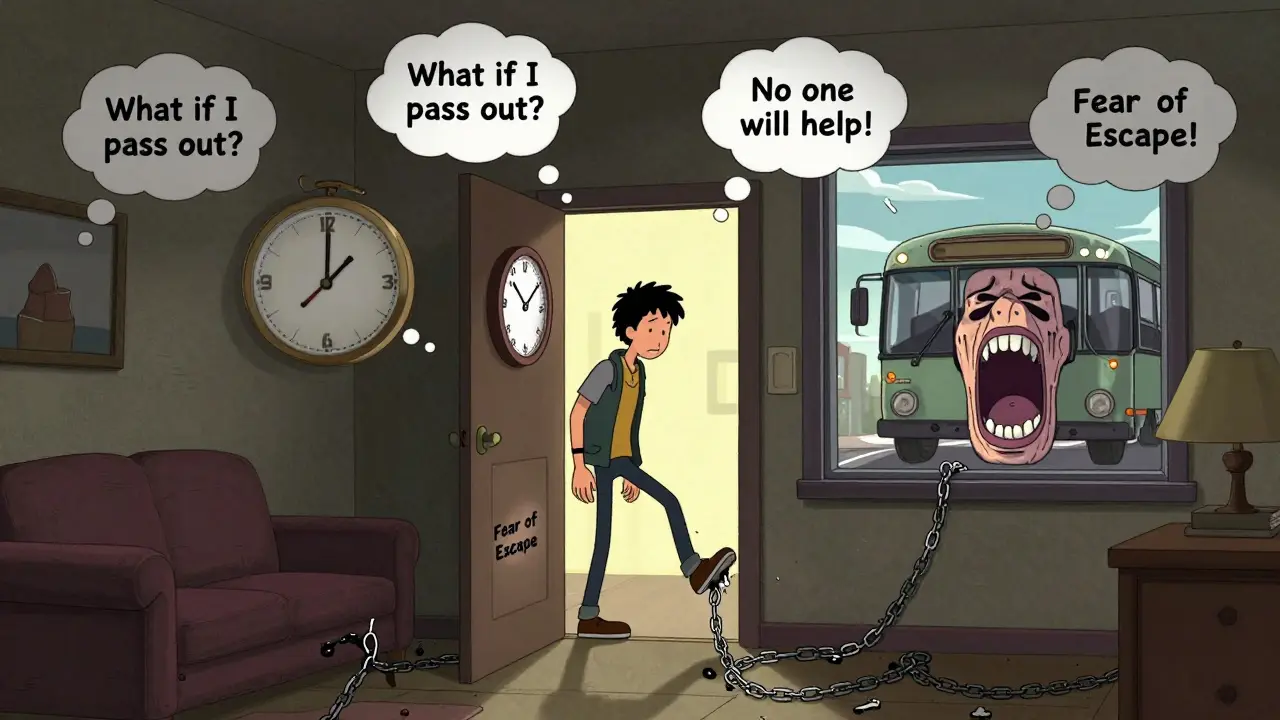
Treatment That Actually Works
The good news? Panic disorder is one of the most treatable anxiety conditions. You don’t have to live like this forever. The gold standard is cognitive behavioral therapy (CBT). Studies show 70-80% of people see major improvement after 12-15 weekly sessions. CBT doesn’t just calm you down - it rewires how you think about panic. Here’s how it works:- Psychoeducation: You learn what’s really happening in your body during a panic attack. It’s not a heart attack. It’s not a stroke. It’s your nervous system overreacting. Understanding this reduces fear.
- Cognitive restructuring: You challenge catastrophic thoughts. Instead of “I’m dying,” you learn to say, “This is panic. It’s scary, but it won’t kill me.”
- Interoceptive exposure: You deliberately bring on panic-like sensations - spinning in a chair to feel dizzy, breathing fast to get lightheaded, holding your breath to feel short of breath. You learn these sensations are harmless. You stop fearing them.
- In vivo exposure: You slowly face avoided situations. Start with standing near a bus stop. Then sit on a bench. Then ride one stop. Then go to a quiet store. Then a crowded one. Each step builds confidence.
Medication: Helpful, But Not a Cure
Medications can help, especially when panic is severe or CBT feels too hard to start. SSRIs like sertraline (Zoloft) or paroxetine (Paxil) are first-line. They take 4-8 weeks to work, but they’re not addictive and help with both panic and depression. About 60-75% of people respond well. Side effects? Nausea, weight gain, emotional numbness - reported by 40% of users. One person wrote: “Paroxetine stopped my panic attacks, but I feel like a zombie. My psychiatrist says this is common.” Benzodiazepines like alprazolam (Xanax) work fast - within 30 minutes. But they’re risky. Up to 40% of long-term users become dependent. They’re meant for short-term use, not daily living. Newer options are emerging. d-cycloserine, a drug taken before CBT sessions, boosts learning during exposure therapy. A 2022 trial showed it improved outcomes by 28%.Combining Therapy and Medication
The most effective approach? Combining CBT with an SSRI. Research from UC San Diego shows remission rates jump to 85% with both - compared to 65-70% with just one. But here’s the catch: if you rely only on medication and skip therapy, relapse rates hit 60% within six months of stopping. Why? Because meds quiet the symptoms - but they don’t fix the fear of fear. CBT teaches you how to live with uncertainty. That’s the real cure.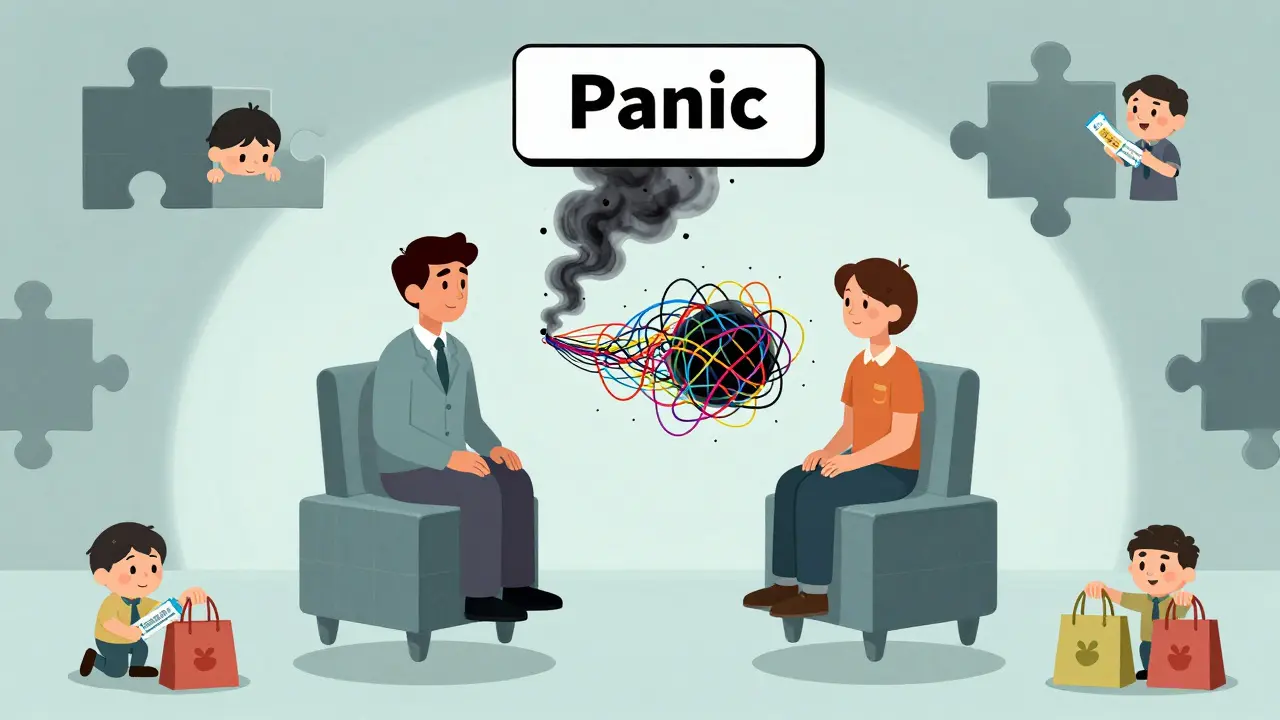


Reviews
Panic attacks are just your body’s fight-or-flight stuck on overdrive. No magic, no mystery. CBT works because it retrains the brain-not meds.
I used to think I was losing my mind until I learned the science behind it. Knowing it’s not a heart attack, just a false alarm, changed everything. You’re not broken-you’re just wired too sensitively. And that’s okay.
You got this. One step at a time. Even standing at the bus stop counts. I’ve been there. You’re not alone.
CBT? Really? You’re telling me the entire psychiatric establishment has been wrong for decades, and now we’re just supposed to ‘rethink’ our panic? What about the pharmaceutical-industrial complex? The FDA-approved apps? Please. They’re just selling you a new kind of placebo-with a subscription fee.
Let’s be clear: panic disorder isn’t ‘just anxiety.’ It’s a biochemical malfunction masked as a character flaw. People who say ‘just breathe’ or ‘calm down’ have no idea what they’re saying. You don’t choose to panic. Your amygdala does. And if you’re not using CBT, you’re not treating it-you’re just masking it with pills that make you numb.
And don’t get me started on benzodiazepines. They’re not ‘helpful’-they’re chemical handcuffs. I’ve seen patients become dependent after three weeks. Three weeks. And then they wonder why they can’t function without Xanax. It’s not treatment. It’s addiction with a prescription.
Yes, SSRIs help some. But they don’t rewire anything. They just dampen the noise. Meanwhile, interoceptive exposure? That’s the real work. You sit with the dizziness. You breathe fast until you’re lightheaded. You let your heart race. And you learn-through direct experience-that you won’t die. That’s not therapy. That’s courage.
And digital tools? Fine, if you’re too lazy to leave the house. But don’t confuse convenience with cure. Nothing replaces the discipline of facing your fear in real time. Apps can guide you. But only you can walk into the store. Only you can get on the bus. Only you can choose to stop running.
And yes, genetics matter. But so does agency. You can’t blame your DNA for avoiding elevators for seven years. You can’t blame your childhood trauma for refusing to go to your sister’s wedding. You can acknowledge it. You can forgive yourself. But you still have to act. And that’s not easy. But it’s possible.
And if you’re reading this and you’re still afraid? Good. That means you’re still fighting. Keep going.
ok but what if the panic attacks are caused by the government putting fluoride in the water to make people anxious so they buy more meds? i read this on a forum and the guy had like 50k upvotes and he said the amygdala is actually a microchip implanted at birth. also my cousin’s neighbor’s dog got panic attacks after the 5g rollout so…
I’ve seen this in my village back home. People think it’s jinn or bad luck. No one talks about it. But the symptoms? Same. The fear? Same. Maybe the science is different, but the suffering? Universal. Thank you for writing this.
While it is true that cognitive behavioral therapy demonstrates statistically significant efficacy in controlled clinical environments, one must interrogate the epistemological foundations of Western psychiatric paradigms. The DSM-5-TR, as a product of neoliberal medical hegemony, pathologizes normal human affective responses. The amygdala, as a neuroanatomical construct, is a reductionist fiction designed to commodify distress. One cannot treat a metaphor with exposure therapy. One must, instead, confront the ontological insecurity of late capitalism that renders the human body a site of perpetual surveillance and dread.
Furthermore, the normalization of digital CBT platforms betokens a deeper alienation: the privatization of healing. One’s internal landscape is no longer sacred-it is data to be optimized. The app does not care if you weep. It logs your heart rate and charges you $19.99/month.
And yet-I acknowledge the pragmatic utility of these interventions. For the individual drowning, the lifebuoy is not less valuable because it was manufactured in a factory. One must act within the system to transcend it.
Why do we even treat this? Like, isn’t panic just nature’s way of saying ‘you’re living wrong’? Maybe we should all just move to the woods and stop scrolling. Problem solved.
Let me tell you something about panic disorder that no therapist will admit. It's not about the amygdala. It's about the collapse of spiritual order in modern society. In ancient India, panic was called 'vata imbalance'-a disruption of life energy. In China, it was 'heart shen disturbance.' But here? We call it a chemical imbalance and hand you a pill. We've forgotten that the soul needs stillness, not serotonin. We've replaced meditation with mindfulness apps. We've turned healing into a product. And now we wonder why everyone is falling apart. The real treatment? Silence. Solitude. Breath. Not exposure therapy. Not apps. Not SSRIs. Just you. Alone. With your breath. And no screens. That's the cure they don't want you to know.
It is profoundly encouraging to observe the empirical validation of cognitive behavioral interventions in the treatment of panic disorder. The longitudinal outcomes, particularly in conjunction with pharmacotherapy, reflect a paradigmatic shift in the management of anxiety-related pathologies. One must, however, exercise caution in the enthusiastic adoption of digital therapeutics, as adherence rates and long-term efficacy remain subject to significant variability across demographic strata. The human element-the therapeutic alliance-remains irreplaceable, even in an age of algorithmic intervention.
so like… why do people even bother with all this therapy stuff? just take xanax and chill. i did. it worked. now i’m fine. problem solved. why make it hard? 🤷♀️
So we’ve turned human suffering into a checklist. Panic attack? Check. DSM-5-TR criteria? Check. CBT module 3.2? Check. Now you’re ‘recovered.’ But what about the silence after the breathing exercises? The emptiness when the app stops reminding you to be calm? We treat the symptom like it’s the disease. We don’t ask why the alarm is going off. We just turn it off. And then we wonder why it comes back louder.
Maybe panic isn’t a disorder. Maybe it’s a message. And we’ve spent a century screaming over it with pills and apps and exposure drills. But no one’s listening to what it’s trying to say.
Thank you for this comprehensive and culturally sensitive overview. In my work across multiple continents, I have observed that while the biological mechanisms are universal, the stigma and interpretation of panic attacks vary dramatically. In some cultures, it is seen as spiritual affliction; in others, as moral weakness. This post bridges that gap with clarity and compassion. A rare and necessary contribution.