
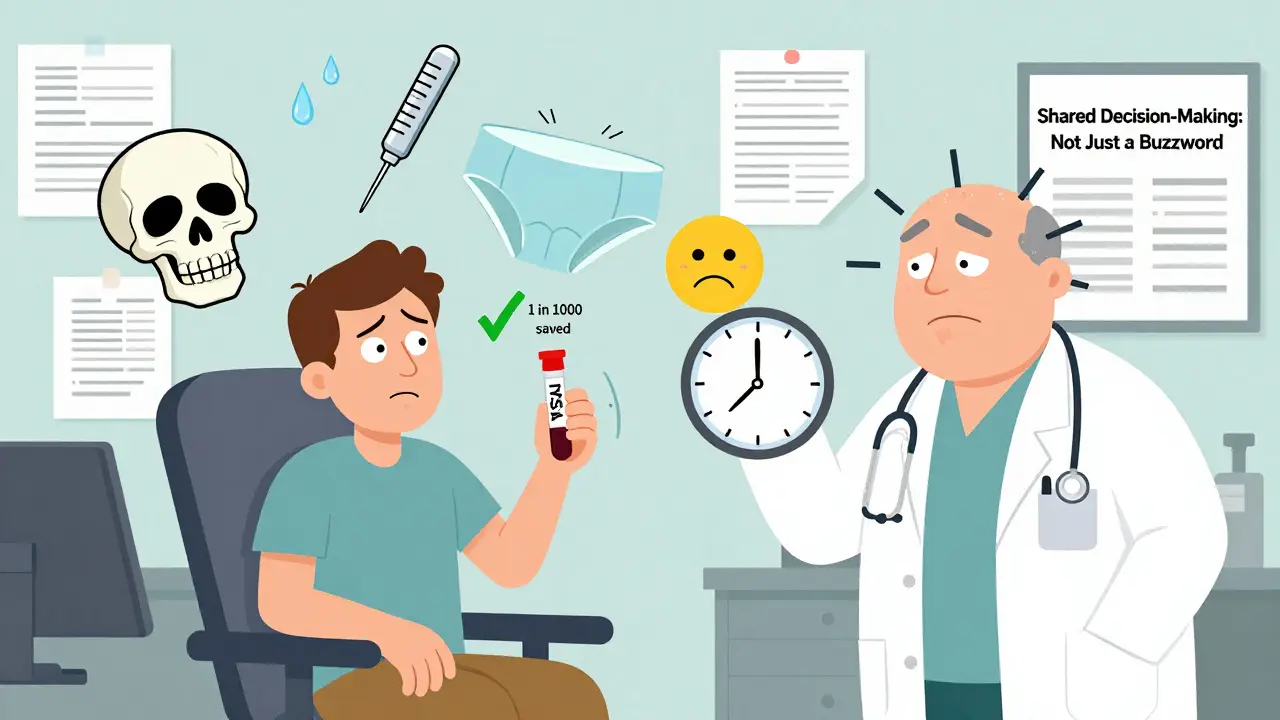
Every year, millions of men get a simple blood test called PSA screening, hoping it will catch prostate cancer early. But here’s the problem: for every life it saves, it can trigger a chain reaction of unnecessary biopsies, anxiety, and treatments that leave men with incontinence or impotence. And many don’t even know that.
The PSA Test Isn’t What You Think
The PSA test measures a protein made by the prostate gland. It sounds straightforward - high level, maybe cancer. But it’s not that simple. About 75% of men with a PSA between 4.0 and 10.0 ng/mL don’t have cancer at all. Their levels rise because of an enlarged prostate, a recent bike ride, or even a urinary infection. Meanwhile, 15% of men with aggressive prostate cancer have PSA levels below 4.0 - the very number doctors used to call a red flag for decades.That’s why the U.S. Preventive Services Task Force flipped its stance. In 2012, they said don’t screen at all. By 2018, they changed to: only screen if you’ve talked it through with your doctor. That’s not a recommendation to test. It’s a warning: this test has real downsides.
What Does Screening Actually Do?
Let’s break it down with numbers. For every 1,000 men aged 55 to 69 screened every year for 10 years:- 1 to 2 prostate cancer deaths are prevented
- 100 to 120 men get false positives - meaning they get biopsies they didn’t need
- 80 to 100 men are diagnosed with cancers that would never have hurt them
That last part is the real controversy. Many prostate cancers grow so slowly they’ll never cause symptoms. But once you know you have it - thanks to PSA - you’re pressured to treat it. Surgery or radiation can mean permanent side effects. And for what? A tiny chance of avoiding a death you might never have faced anyway.
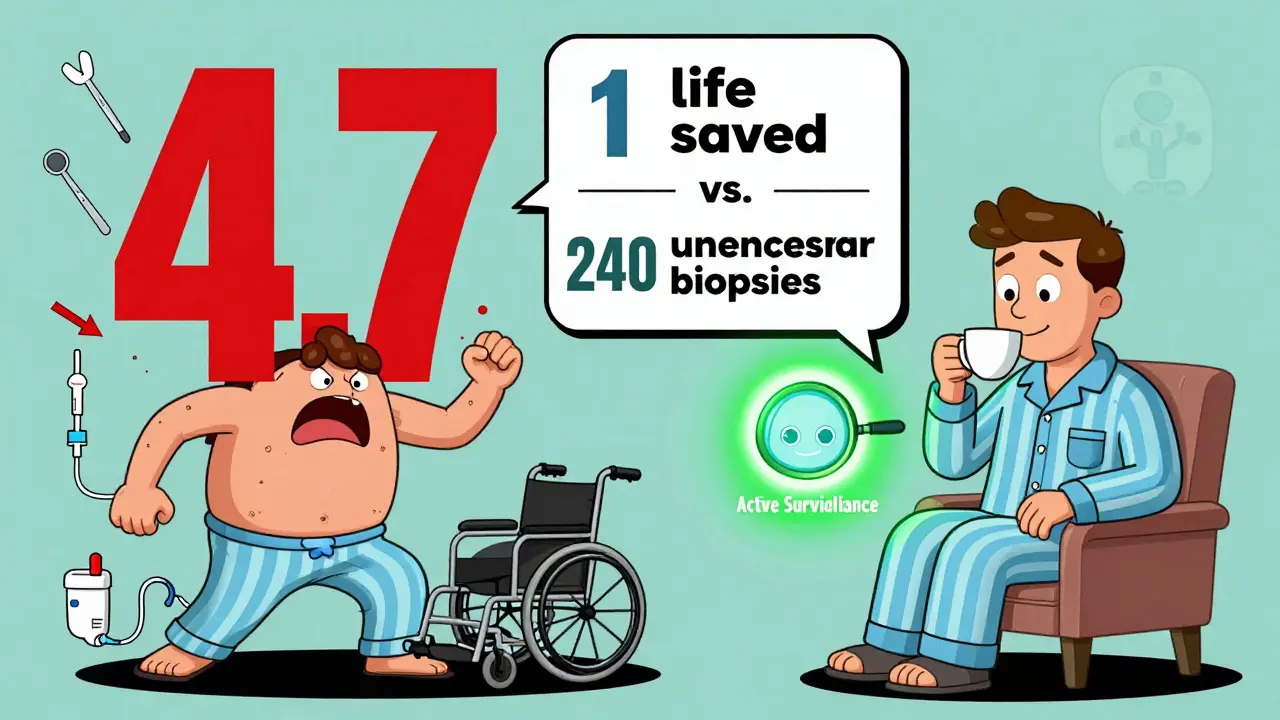
Studies like the ProtecT trial show that after 10 years, survival rates are nearly identical between men who had surgery, radiation, or just watched and waited. That’s called active surveillance. It’s not doing nothing. It’s choosing to monitor closely - and only act if the cancer starts to change.
Why Shared Decision-Making Isn’t Just a Buzzword
Shared decision-making isn’t about handing a patient a brochure and saying, “You decide.” It’s a conversation. A real one. It means your doctor says: “Here’s what we know. Here’s what we don’t. Here’s what could go wrong. Here’s what might save your life. And then - what do you want?”But here’s the truth: most men aren’t getting that conversation. A 2017 survey found only 60% of men who got a PSA test were even told about the risks. On Reddit, men say their doctors only talked about benefits. One man, 62, had his prostate removed after a PSA of 4.7. He later learned his cancer was low-risk. He now lives with urinary incontinence. He didn’t know that was a possibility.
Decision aids - like the Mayo Clinic’s tool that shows visual charts - help. One study showed they cut decision stress by 35%. Tools like the Ottawa Personal Decision Guide let men see side-by-side: “If 1,000 men get screened, 1 will avoid death. 240 will get unnecessary biopsies.” That’s not scary. That’s clear.
What’s Replacing PSA? (And Why It’s Still Not Perfect)
Newer tests are coming. The 4Kscore looks at four different proteins in your blood and gives a risk score. It’s 95% accurate at ruling out aggressive cancer. The PCA3 urine test checks for a gene linked to prostate cancer. Multiparametric MRI can scan the prostate before a biopsy - and in one trial, it cut unnecessary biopsies by 27%.But here’s the catch: these cost hundreds or even thousands of dollars. PSA costs $20 to $50. Most insurance covers it. The newer tests? Often don’t. And even the best ones still can’t tell you for sure if a cancer will kill you.
Genomic tests like Oncotype DX GPS can tell you how aggressive your cancer is after diagnosis - but only if you’ve already been diagnosed. That’s too late to avoid the whole mess.
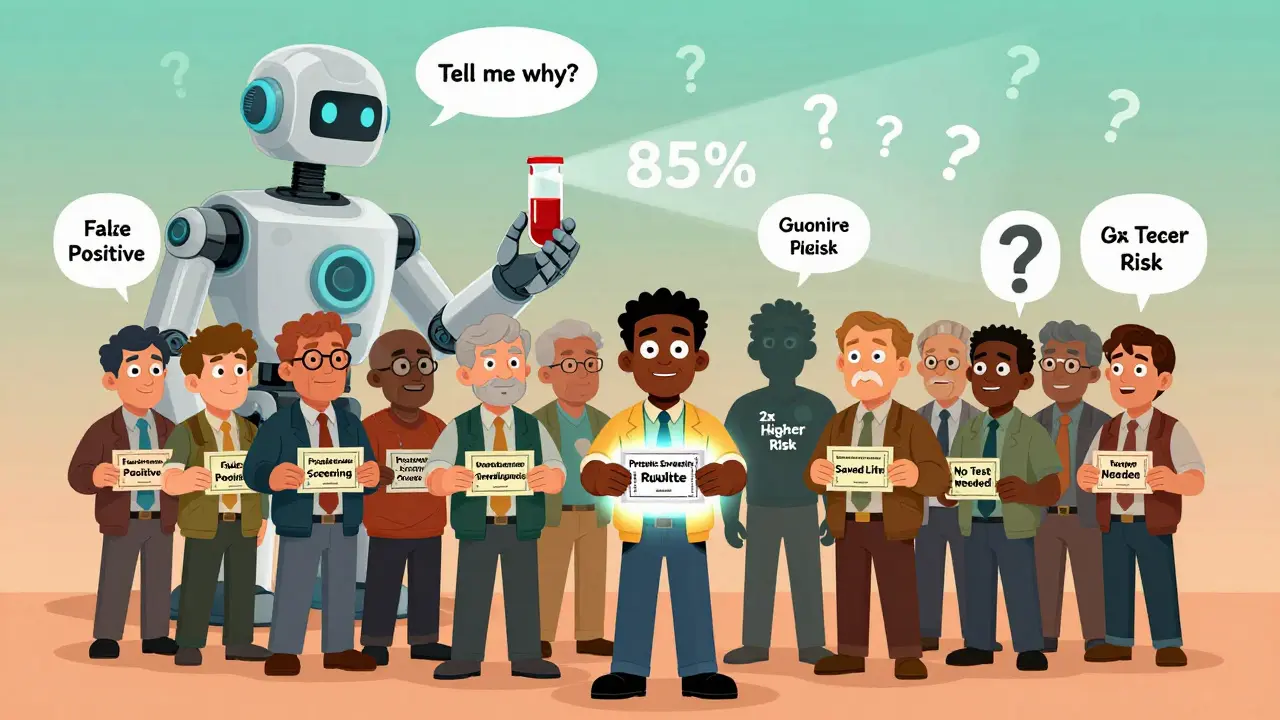
And now, AI is stepping in. MIT researchers built an algorithm that predicts prostate cancer risk just from routine blood tests - no PSA needed. It’s 85% accurate. If this scales, it could mean fewer men get screened at all - only those truly at risk.
Who’s Most at Risk - and Who’s Being Left Behind
African American men are more than twice as likely to die from prostate cancer than white men. They’re also 23% less likely to have a real conversation about screening. That’s not just a gap. It’s a crisis.Men with a family history - a father or brother with prostate cancer - are at higher risk too. And if your PSA is under 1.0 at age 45 to 50, your risk of aggressive cancer later is very low. Some experts say you might not need another test for 10 years.
But most men don’t know this. They hear “PSA test” and think, “I need this.” They don’t know their risk profile. They don’t know their options. And their doctors - pressed for time - often don’t either.
Why Doctors Struggle to Have the Talk
The average doctor spends 3.7 minutes on PSA screening during a yearly visit. The American College of Physicians says you need 15 to 20. That’s not a mistake. That’s a system failure.Only 38% of U.S. clinics have a standard checklist for shared decision-making. Kaiser Permanente does. They use a 14-point discussion guide. Their patients understand the risks 47% better. But most clinics? They just hand out a form and move on.
Training helps. The American Urological Association has certified over 2,000 urologists in shared decision-making. But only 29% of primary care doctors feel confident doing it. And they’re the ones most men see first.
What Should You Do?
If you’re a man between 55 and 69, here’s what you need to do before you get a PSA test:- Ask your doctor: “What are the chances this test will save my life?”
- Ask: “What are the chances it will lead to a biopsy or treatment I don’t need?”
- Ask: “What happens if I wait and get tested later?”
- Ask: “Do I have any risk factors - race, family history, baseline PSA?”
- Ask: “Can I see a decision aid?”
If you’re under 55 or over 70, the answer is usually: don’t get screened unless you have symptoms or a strong family history. Screening doesn’t help older men - the risks outweigh the tiny benefit.
If your PSA is low and you’re healthy, you might not need another test for years. If it’s high, don’t panic. Ask for an MRI first. Or a 4Kscore. Don’t jump to biopsy.
It’s Not About Avoiding the Test - It’s About Choosing Wisely
Some men credit PSA screening with saving their lives. The Prostate Cancer Foundation has over 1,200 stories of men diagnosed early, treated successfully, and still alive today. That’s real. That matters.But for every one of those men, there are five others who went through hell for a cancer that never would’ve hurt them. That’s the cost of screening without understanding.
PSA screening isn’t good or bad. It’s complicated. And the only way to navigate that complexity is to have a real conversation - with your doctor, with your family, and with yourself.
The goal isn’t to stop testing. It’s to stop guessing. It’s to stop letting fear drive decisions. It’s to make sure the next time you hear “PSA test,” you don’t just say yes - you say, “Tell me why.”
Is PSA screening still recommended?
Yes - but only for men aged 55 to 69, and only after a shared decision-making conversation with a doctor. The U.S. Preventive Services Task Force gives it a Grade C recommendation, meaning the benefit is small and personal values should guide the choice. Screening is not recommended for men under 55 or over 70 unless they have high-risk factors like family history or African ancestry.
What are the biggest risks of PSA screening?
The biggest risks are false positives, unnecessary biopsies, and overdiagnosis. About 75% of men with a PSA between 4.0 and 10.0 don’t have cancer. Biopsies can cause infection, bleeding, and pain. Overdiagnosis means men are treated for cancers that would never cause harm - leading to side effects like urinary incontinence and erectile dysfunction from surgery or radiation.
What’s the difference between PSA and newer tests like 4Kscore or MRI?
PSA is a single blood measure that can’t distinguish between cancer and benign conditions. Newer tests like the 4Kscore combine multiple biomarkers and clinical data to better predict aggressive cancer risk. Multiparametric MRI scans the prostate visually and can identify suspicious areas before a biopsy. These are more accurate and reduce unnecessary procedures, but they’re more expensive and not always covered by insurance.
Should I get screened if I’m African American?
Yes - but only after a detailed discussion with your doctor. African American men have a 70% higher chance of getting prostate cancer and more than double the death rate. Guidelines still recommend shared decision-making, but many experts suggest starting the conversation earlier, around age 45, due to higher risk. Make sure your doctor considers your race and family history when advising you.
Can I avoid PSA screening entirely and still be safe?
For many men, yes. If you have no symptoms, no family history, and a very low PSA (under 1.0) at age 45-50, your risk of aggressive cancer is very low. Some experts say you may not need another test for 10 years. Active surveillance is also a valid option if you’re diagnosed with low-risk cancer. The key is not avoiding testing altogether - it’s avoiding testing without understanding the trade-offs.
What if my doctor pushes me to get a PSA test?
Ask for evidence. Say: “I’ve read that screening has risks. Can you explain why you think it’s right for me specifically?” A good doctor will welcome that. If they dismiss your concerns or don’t mention the downsides, consider getting a second opinion or asking for a decision aid. You have the right to make an informed choice - not just a quick one.
Prostate cancer screening is no longer a simple yes-or-no question. It’s a personal decision shaped by your health, your values, and the information you’re given. Don’t let silence or pressure make it for you.


Reviews
So let me get this straight - we’re spending billions on a test that gives false alarms 75% of the time and then we cut off people’s ability to pee or have sex because someone didn’t read the fine print? Brilliant. Just brilliant. I’m sure the urologists are thrilled with their new yachts.
This is why medicine is broken. You don’t get to tell men they’re too scared to make a decision. You get to give them data - not a pamphlet with a smiley face. If you want to avoid overtreating cancer, stop calling it cancer when it’s just a cellular hiccup. Stop the euphemisms. Call it what it is: a biological glitch that doesn’t need fixing.
PSA is a scam. Biopsies are torture. Incontinence is forever. Doctors don’t care. They get paid either way.
The United States Preventive Services Task Force’s Grade C recommendation is not a suggestion - it is a clinical standard grounded in evidence-based medicine. Any deviation from shared decision-making constitutes a breach of ethical duty. Patients are not consumers. They are persons entitled to informed consent, not marketing.
This post made me cry 😭 I had no idea. My dad went through all of this and never told me. I’m going to print this out and give it to my uncle. He’s 61 and just got his PSA results. He’s terrified. He deserves to know the truth. Thank you for writing this.
The entire paradigm of early detection is a neoliberal fantasy predicated on the commodification of health anxiety. PSA screening is not medicine - it’s a surveillance mechanism disguised as prevention. The real pathology isn’t the prostate - it’s the medical-industrial complex that profits from iatrogenic trauma. You’re not fighting cancer. You’re fighting capitalism’s need to pathologize the human body.
my doc just said ‘its a good idea’ and handed me a form. i didn’t know there was even a choice. i’m 58. i got screened. now i’m scared. i didn’t even know what a biopsy was. sorry for the typos. this is hard to type.
There is a deeper question here: why do we equate intervention with care? If a tree falls in the forest and no one is there to hear it, does it make a sound? If a slow-growing tumor never causes pain, does it deserve to be named a disease? Perhaps we are not treating cancer - we are treating our fear of death. And that fear is not medical. It is human.
Big thanks for laying this out so clearly. I’m 63 and got screened last year. My PSA was 5.2. I asked for an MRI first - turned out it was just BPH. No biopsy. No drama. Just a chill conversation with my doc. This stuff matters. Seriously. 🙏
Men who don’t get screened are cowards. You think cancer waits for you to be ‘ready’? It doesn’t. It kills. My brother died at 59 because he listened to this ‘shared decision’ nonsense. He didn’t want to ‘be a burden.’ Now he’s gone. Don’t be him.
Let’s talk about the elephant in the room - the profit motive. PSA is cheap. MRI is expensive. Pharma makes billions off surgeries. Insurance won’t cover 4Kscore unless you beg. So who really benefits? Not the patient. Not even the doctor. The system. And the system doesn’t care if you live or die - only if you bill.
Hey, if you’re reading this and you’re 45–50 and your PSA is under 1.0 - breathe. You’re golden. Don’t panic. Don’t rush. Get tested again in 10 years unless something changes. And if you’re Black? Talk to your doc. Ask about family history. You’re not being paranoid - you’re being smart.
It’s fascinating how the public conflates ‘medical advice’ with ‘moral obligation.’ The fact that you’re even asking whether to screen reveals a deeper epistemological crisis: we’ve outsourced autonomy to institutions that are structurally incapable of honoring it. The PSA test is not a diagnostic tool - it’s a ritual of surrender to technocratic authority.
I’ve been thinking about this for weeks. My dad died of prostate cancer at 67. He had a PSA of 12. They did the biopsy, the surgery, the radiation. He lost his bladder control. He couldn’t sleep. He cried every night. He said, ‘I wish I’d never known.’ But then again - what if he’d waited? What if he’d died suddenly, in his sleep, and we never knew why? Is ignorance better? I don’t know. I just miss him. And now I’m 54. I’m scared. I don’t know what to do. I’ve read all this. I still don’t know.