
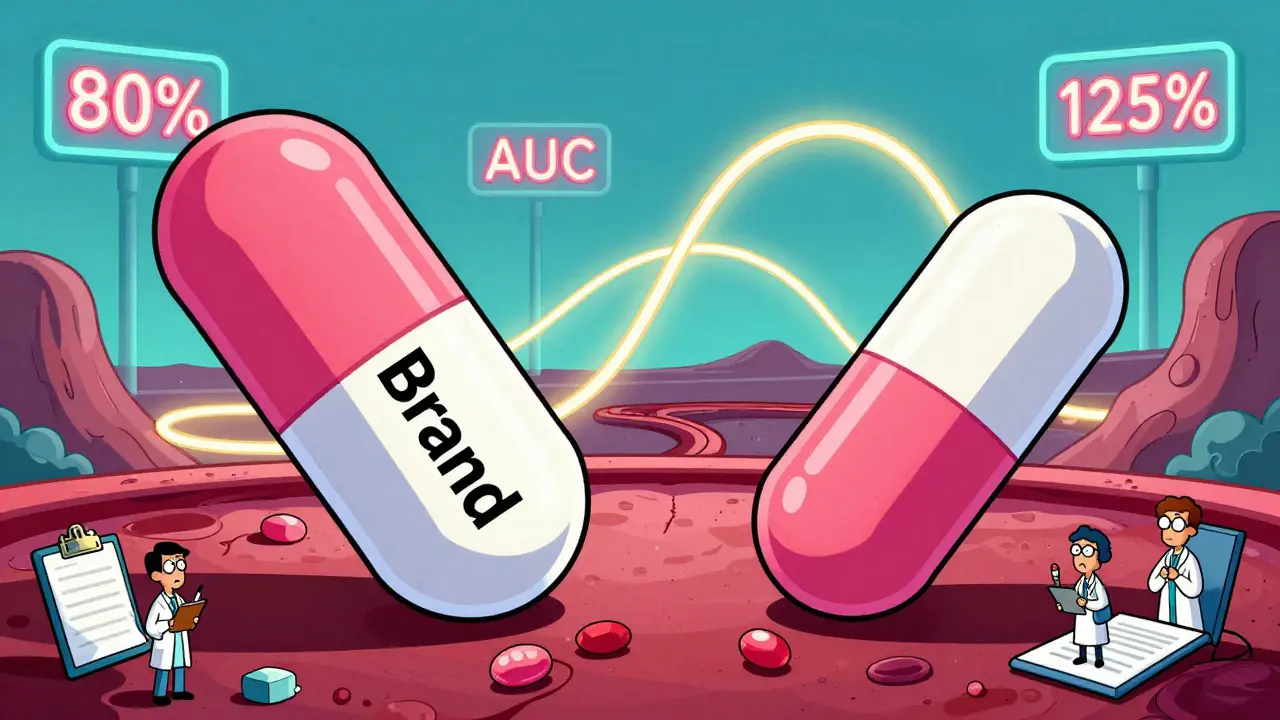
When you pick up a prescription and see a generic version instead of the brand-name drug, it’s natural to wonder: Is it the same? Many people think the 80-125% rule means generic drugs can have up to 25% less or 25% more active ingredient than the brand. That’s not true. And that misunderstanding causes real anxiety - especially for people managing conditions like epilepsy, heart disease, or thyroid disorders. The truth is more precise, more scientific, and actually more reassuring.
What the 80-125% Rule Actually Measures
The 80-125% range isn’t about how much active ingredient is in the pill. It’s about how much of that ingredient your body actually absorbs and how fast it gets into your bloodstream. This is called bioavailability. The rule applies to two key measurements: AUC (area under the curve), which tells you the total amount of drug absorbed over time, and Cmax (peak concentration), which shows how quickly it reaches its highest level in your blood.
The FDA requires that the 90% confidence interval of the ratio between the generic and brand drug for both AUC and Cmax must fall entirely within 80% to 125%. That means if the brand drug delivers an AUC of 100 units, the generic’s AUC must be between 80 and 125 units - but only if the entire range of likely values (the confidence interval) stays within those bounds. It’s not enough for the average to be 90%. The data has to be consistent across all tested individuals.
Why 80-125%? It comes from math. Pharmacokinetic data - how drugs move through the body - is usually log-normally distributed. When you take the natural logarithm of the ratios, the acceptable range becomes symmetric around zero. Log(0.80) is about -0.223, and log(1.25) is +0.223. So the 80-125% range is really a ±20% variation on a log scale. This makes the math work with real-world biological variability.
How Strict Is This Rule Really?
It’s stricter than it looks. The 90% confidence interval requirement means the generic drug’s true average bioavailability must be very close to the brand. A 2012 FDA analysis of over 2,000 bioequivalence studies found that 98% of approved generics had point estimates between 95% and 105% of the brand drug. In other words, most generics are nearly identical in absorption.
Think of it this way: if a brand drug gives you an AUC of 100, a generic with a mean of 90 and a standard deviation of 10 might have a 90% confidence interval of 83-97 - that’s fine. But if the mean is 85 with the same variation, the interval could be 78-92. That fails because 78 is below 80. So the system doesn’t just check if the average is close - it checks if the entire range of possible outcomes is safe.
Real-World Evidence: Do Generics Work?
Over 30 years of data say yes. A 2016 study in JAMA Internal Medicine looked at 2 million patient records and found no difference in clinical outcomes between brand and generic versions of cardiovascular drugs. The FDA’s Sentinel Initiative tracked adverse events across 200 million patient records from 2015 to 2020. For 94% of drug products, there was no significant difference in safety between brand and generic.
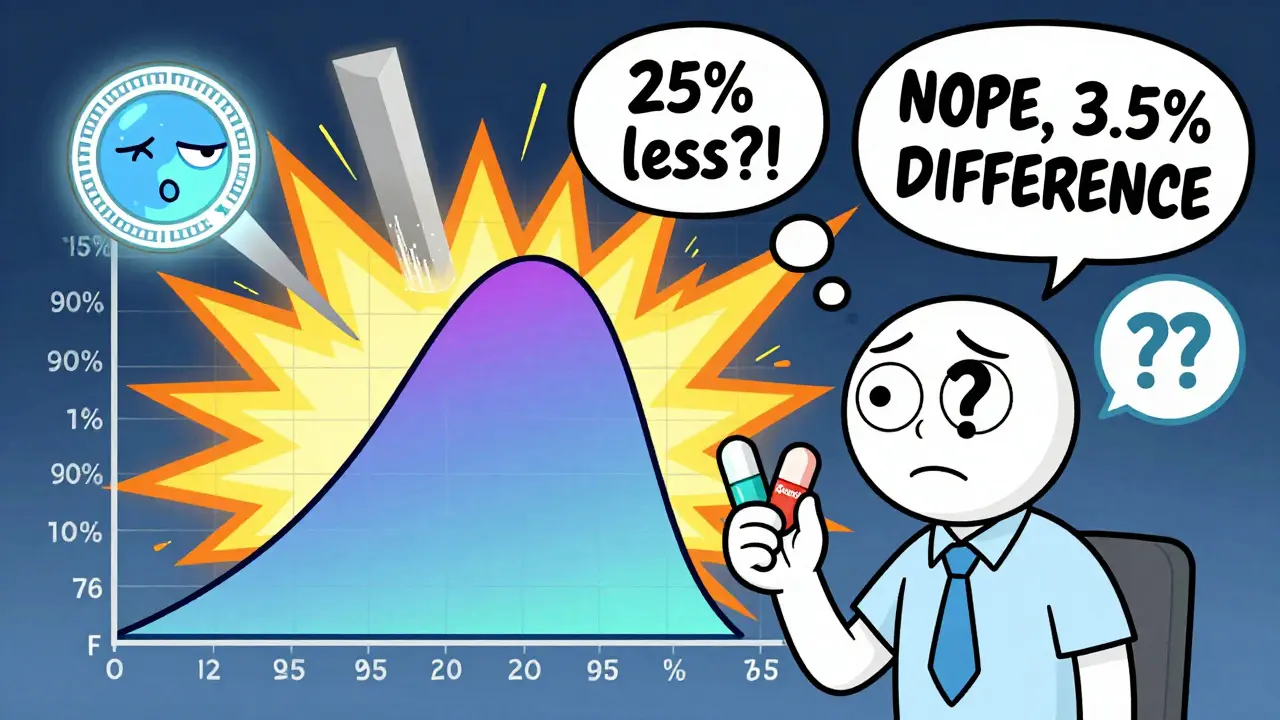
Even more telling: a Harvard Medical School analysis showed that on average, the difference in absorption between brand and generic drugs is just 3.5%. That’s less than the natural variation you’d see if the same person took the same brand drug twice, weeks apart.
Where the Rule Gets Tighter
Not all drugs are created equal. For drugs with a narrow therapeutic index - where small changes in blood levels can cause serious side effects or treatment failure - the rules are stricter. The FDA uses a 90-111% range for drugs like warfarin, levothyroxine, and phenytoin. These are the ones where even a 5% difference could matter. If you’re on one of these, your doctor might monitor your levels more closely - but not because the generic is less reliable. It’s because your body’s response to small changes is more sensitive.
Why This Rule Exists
The 80-125% rule didn’t come from guesswork. It was developed in the 1980s after the Hatch-Waxman Act made it easier to approve generics. Before that, companies had to run full clinical trials to prove a generic worked - a costly and time-consuming process. The FDA needed a way to ensure safety without repeating expensive studies. So they turned to pharmacokinetics. By measuring blood levels in healthy volunteers, they could predict how the drug would behave in patients.
The 80-125% range was chosen because experts agreed that differences under 20% in systemic exposure are unlikely to affect how well a drug works or how safe it is. It’s not arbitrary. It’s based on decades of clinical data and statistical modeling. And it’s used globally. The European Medicines Agency and Health Canada use the same standard.
Common Myths and Misunderstandings
One of the biggest myths is that generics can have 20-25% less active ingredient. That’s wrong. The active ingredient in the pill is tightly controlled - it must be within 5% of the brand’s amount. The 80-125% rule applies to what your body absorbs, not what’s in the tablet.
Another myth: if a generic passes the test, it’s just "close enough." But the data shows otherwise. Most generics are nearly identical. A 2020 survey of 1,200 pharmacists found that 63% said patients’ concerns vanished once they understood the rule. The FDA’s #GenericsWork campaign reached over 1.2 million people, helping clear up confusion.

What Happens in a Bioequivalence Study?
Before a generic is approved, it goes through a clinical study with 24-36 healthy volunteers. Each person takes both the brand and generic drug at different times, in a random order, with no food or other drugs that could interfere. Blood is drawn 12-18 times over 72 hours to map out how the drug rises and falls in the bloodstream. The data is analyzed using statistical models that account for individual differences.
The analytical methods must be precise - with a coefficient of variation under 15%. If a drug is highly variable (like some seizure medications), the study might use a replicate design, where each person takes each version multiple times to get a clearer picture.
Why This Matters for You
If you’re taking a generic drug, you’re not taking a second-rate version. You’re taking a drug that’s been tested under the same scientific standards as the brand. The 80-125% rule isn’t a loophole - it’s a rigorous filter. It ensures that when you switch from brand to generic, your body gets the same amount of medicine, at the same speed, with the same safety profile.
And it’s why generics now make up 90% of U.S. prescriptions but only 23% of drug spending. In 2021 alone, they saved the healthcare system $373 billion. That’s not magic. That’s science.
What’s Next?
The FDA is working on new tools for complex drugs - like inhalers, topical creams, and extended-release tablets - where blood levels don’t tell the whole story. By 2025, they plan to use computer modeling to predict bioequivalence for these harder-to-test products. But for standard oral pills, the 80-125% rule remains the gold standard. It’s stood the test of time. And it’s backed by more than three decades of real-world use.
Does the 80-125% rule mean generic drugs can have 25% less active ingredient?
No. The active ingredient in a generic pill must be within 5% of the brand-name drug’s amount. The 80-125% rule applies to how much of that ingredient your body absorbs into your bloodstream - not what’s in the tablet. It’s about bioavailability, not content.
Are generics as safe as brand-name drugs?
Yes. Studies tracking millions of patients show no meaningful difference in safety or effectiveness between brand and generic drugs. The FDA’s Sentinel Initiative found no significant rise in adverse events for 94% of generic drugs compared to their brand equivalents over five years.
Why do some people say generics don’t work for them?
Sometimes, switching from one generic to another (even if both are approved) can cause a noticeable difference - not because either is faulty, but because different manufacturers use slightly different inactive ingredients. These can affect how fast the pill breaks down. If you notice a change, talk to your pharmacist. They can check if you’re getting the same generic each time or suggest sticking with one brand.
Is the 80-125% rule the same everywhere?
Yes. The U.S. FDA, the European Medicines Agency, and Health Canada all use the same 80-125% bioequivalence standard with a 90% confidence interval. It’s the global benchmark for generic drug approval.
Can I trust my generic thyroid or blood thinner medication?
Yes, but with extra care. For drugs with a narrow therapeutic index - like levothyroxine or warfarin - the FDA uses a tighter range (90-111%) and often requires more frequent monitoring. If you’re on one of these, your doctor may check your blood levels more often, but that’s standard practice - whether you take brand or generic.



Reviews
Really appreciate this breakdown. I’ve been on a generic thyroid med for years and used to stress about whether it was "good enough." Learning that the 80-125% rule is about absorption, not pill content, was a game-changer. It’s not magic - it’s math, and it’s solid.
Also, the part about 98% of generics falling between 95-105%? That’s wild. We’re talking about near-identical performance. Why do people still think generics are "second-tier"?
Maybe we need to teach this in high school bio class. Seriously.
Oh please. The FDA is just another government agency trying to save a buck. They let these generics fly because they’re cheaper - not because they’re safe. I’ve seen people crash after switching. It’s not coincidence. It’s corruption.
And don’t even get me started on how they approve drugs from India and China without proper oversight. You think they test these things? LOL.
lmao so the generic is "just as good" but my doctor still makes me pay extra for the brand?? 🤡
they dont want us to know how much they’re skimming off the top. #GenericsWork but they dont want you to use them
This is one of those posts that quietly changes how you think. I used to assume generics were a compromise. Now I see they’re a triumph of science.
It’s fascinating how the log-normal distribution shaped the whole standard. Most people don’t realize that behind every pill is a mountain of statistical rigor.
Also, the 3.5% average difference? That’s less than the natural variation in your own body from day to day. Mind blown.
generic drugs are just placebos with a different label. i dont trust em. also why do they even exist if the brand is better? its all a scam.
This is so important!! I used to be scared to switch to generics too - until my dad had a stroke and we realized we couldn’t afford the brand anymore.
He’s been on generic clopidogrel for 5 years now. No issues. No hospital trips. Just cheaper, same results.
Shoutout to the scientists who made this possible. 🙌
80-125%? That’s not science - that’s a loophole designed by Big Pharma to let foreign labs cut corners. You think they test every batch? They run one study on 24 people and call it a day.
The real data? Hidden. The FDA? Captured. The system? Rigged.
And don’t even get me started on the fact that the same generic from two different manufacturers can behave differently. That’s not bioequivalence - that’s chaos.
I wonder if the reason people feel different on generics has less to do with pharmacokinetics and more to do with expectation. Our minds are powerful. If you believe a cheaper pill is inferior, your body might respond accordingly - no matter what the numbers say.
It’s not the drug. It’s the story we tell ourselves about it.
As a pharmacist, I see this all the time. Patients panic when they get a different-looking generic. They think it’s a different drug.
Truth is? The active ingredient is identical. The only difference is the filler - cornstarch vs. lactose, dye colors, that kind of stuff. Sometimes that affects absorption speed - especially in sensitive cases.
But here’s the kicker: if you’re stable on a generic, don’t switch unless you have to. Consistency matters more than brand name. And yes, I’ve seen people do better on generics than brand because they actually take them.
generics are fake. they dont work. my cousin took one for blood pressure and ended up in the hospital. the system is broken.
How quaint. America thinks its regulatory system is the gold standard. In Europe, they actually test drugs on real patients, not just healthy volunteers. Your 80-125% rule is laughable. Real science doesn’t rely on averages from 24 college kids on a treadmill.
AUC. Cmax. Log-normal distribution. 90% CI.
These aren’t buzzwords - they’re the architecture of safety.
The fact that 98% of generics fall within 95-105% isn’t luck. It’s design.
And the 3.5% average difference? That’s within the noise of human biology.
We’re not talking about "close enough." We’re talking about statistically indistinguishable.
Thank you for this meticulously researched and clearly articulated exposition. The distinction between active ingredient content and bioavailability is not only scientifically critical but also ethically significant in the context of public health equity.
It is both admirable and necessary that regulatory agencies maintain such rigorous standards - and equally important that such information is communicated with clarity to the lay public.
One can only hope that this level of precision becomes the norm in all areas of health communication.
generics are a scam. the government lets them in to save money. they dont care if you die. i know people who died on generics. its not a coincidence.