
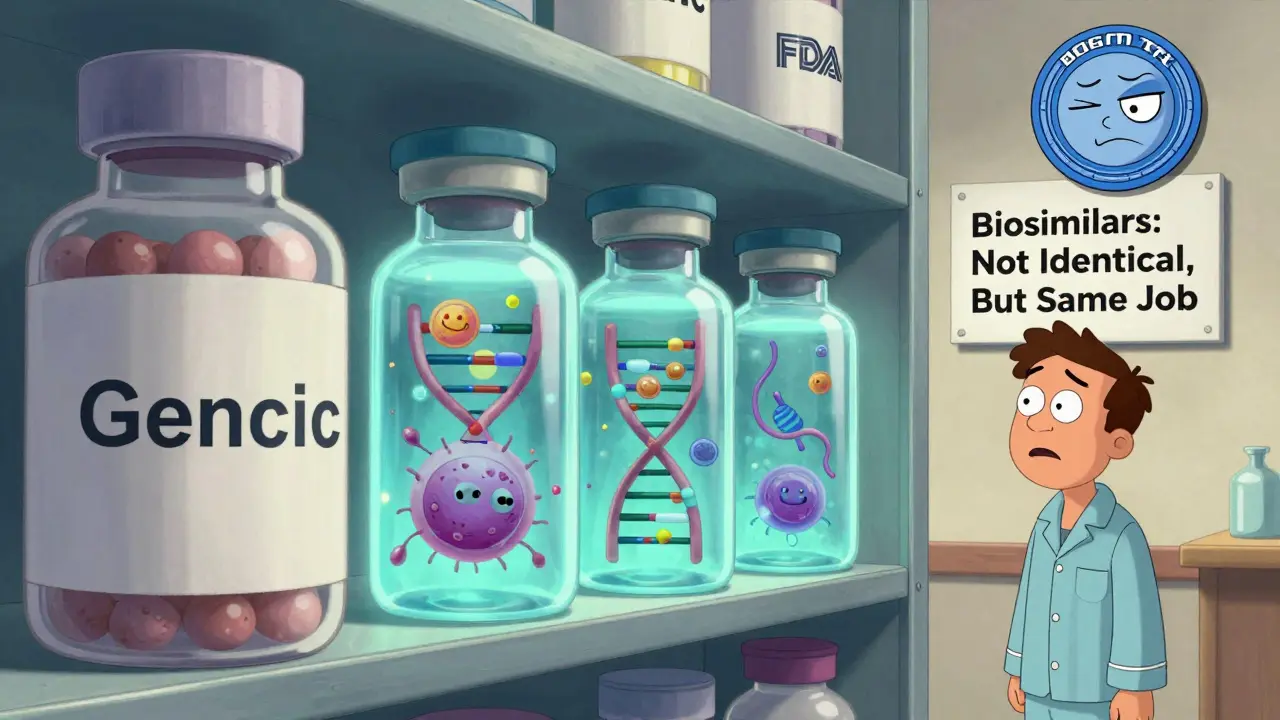
When you need a cheaper version of a brand-name pill, you probably reach for a generic. It’s the same active ingredient, same dosage, same effect - just lower cost. But what if your medicine isn’t a pill? What if it’s an injection you get every few weeks for arthritis, cancer, or Crohn’s disease? That’s where biosimilars come in - the closest thing to generics for complex biologic drugs. And yes, they’re not the same as the generics you know, but they’re designed to do the same job: save money without sacrificing safety.
Why Biosimilars Aren’t Just Like Regular Generics
Regular generics are chemical copies. If your brand-name drug is a small molecule like ibuprofen or metformin, a generic version is made in a lab using the exact same chemical structure. The FDA approves them based on bioequivalence - meaning they behave the same way in your body. That’s why 90% of prescriptions in the U.S. are filled with generics. But biologics? They’re different. These drugs come from living cells - yeast, bacteria, or animal cells - and are made through complex processes. Think of them like a handmade cake versus a box mix. Even if you follow the same recipe, no two batches are perfectly identical. That’s why you can’t just copy a biologic drug the way you copy aspirin. Biosimilars are not identical copies. They’re highly similar. The FDA requires them to show no clinically meaningful differences in safety, purity, or potency compared to the original biologic. That means your body responds the same way. But proving that takes more than a blood test. Manufacturers must run dozens of tests: comparing protein structures, how the drug behaves in the body, immune responses, and even real-world patient outcomes.Interchangeable Biosimilars: The Real Equivalent to Generics
Not all biosimilars are created equal. There’s a special category called interchangeable biosimilars. These are the ones that can be swapped at the pharmacy without your doctor’s approval - just like generics. To earn that label, a biosimilar must meet extra requirements. It has to prove that switching back and forth between the original and the biosimilar doesn’t increase risk or reduce effectiveness. This is critical for chronic conditions like rheumatoid arthritis or psoriasis, where patients might stay on the same drug for years. As of late 2023, the FDA has approved 76 biosimilars, but only a handful have interchangeable status. The first interchangeable version of Humira (adalimumab), called Amjevita, got approved in November 2023. That was a big deal. Humira was the top-selling drug in the world for years. Now, with a cheaper, interchangeable version available, costs could drop significantly.How Much Do Biosimilars Actually Save?
Generics typically cut costs by 80-85%. Biosimilars? They’re more modest - usually 10% to 50% cheaper. Why the difference? Because making biologics is expensive. The manufacturing process is complex, requires specialized facilities, and takes years to perfect. You can’t just build a new factory and start pumping out copies like you can with pills. Still, even a 30% savings adds up fast. For a drug that costs $20,000 a year, that’s $6,000 saved per patient. Multiply that by thousands of people on treatment, and you’re talking about billions in healthcare savings. The Congressional Budget Office estimates biosimilars could save Medicare $53 billion between 2024 and 2033. Some patients have seen dramatic changes. One woman with breast cancer switched from Herceptin to its biosimilar and went from paying $1,200 per infusion to just $450. Others report no difference in side effects or results. But not everyone has a smooth transition.
Why Are Biosimilars Still So Hard to Get?
Despite being approved and proven safe, biosimilars make up less than 20% of the biologic market. Why? One reason: fear. Some doctors and patients worry that switching to a biosimilar might cause unexpected side effects. That’s not based on science - the FDA and independent studies show they’re just as safe. But perception matters. A 2023 study in JAMA Oncology found that oncologists still hesitate to prescribe biosimilars, even when they’re appropriate. Insurance plays a role too. Some plans push patients to switch to biosimilars to save money - but they don’t always give patients a choice. A 2022 survey by the Arthritis Foundation found 37% of patients were forced to switch, and while only 12% had worse symptoms, many reported disruption in their care routine. That kind of experience breeds distrust. Another issue: pharmacy laws. Only 32 states allow pharmacists to substitute interchangeable biosimilars without telling the doctor. In the other 18, even if a biosimilar is interchangeable, the pharmacist can’t switch it unless the prescriber says so. That slows adoption.Who Makes Biosimilars? And What’s Next?
Big names in pharma are jumping in. Amgen has 12 approved biosimilars. Sandoz and Pfizer each have 8. These companies aren’t just copying drugs - they’re building entire supply chains for complex biological manufacturing. The pipeline is full. The FDA aims to approve 15-20 new biosimilars each year by 2025. Major biologics like Enbrel, Remicade, and Rituxan are losing patent protection soon. That means more biosimilars will hit the market - and prices should drop further. Hospitals are leading the charge. According to a 2022 American Hospital Association survey, 87% of U.S. hospitals have formal policies to use biosimilars when available. They’re saving millions on drugs for cancer, autoimmune diseases, and transplant patients.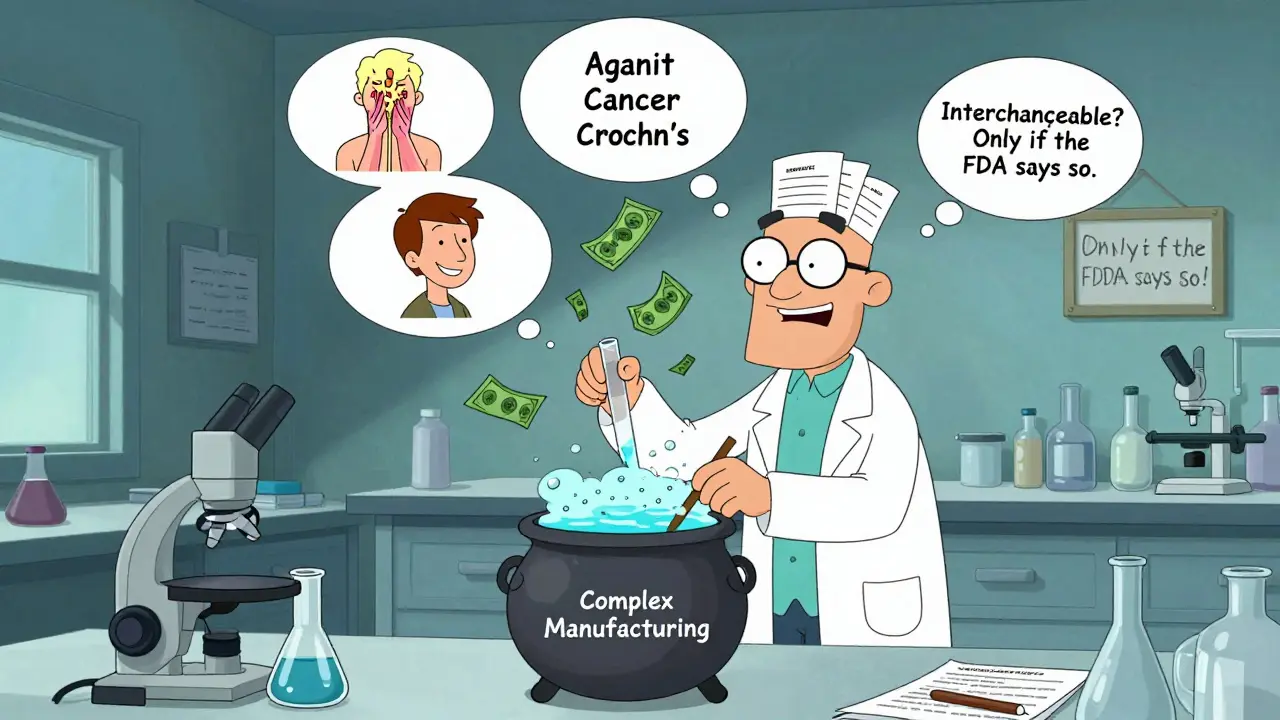
What Should You Do If You’re Prescribed a Biosimilar?
If your doctor suggests switching to a biosimilar, ask these questions:- Is this biosimilar interchangeable? (That means it can be swapped without your doctor’s permission.)
- Has this biosimilar been used successfully by other patients with my condition?
- Will my insurance cover it at the same cost as the brand?
- What happens if I have a reaction? Is there a plan to switch back?


Reviews
I switched to a biosimilar for my rheumatoid arthritis last year and honestly? My joint pain didn’t change at all. The only difference was my co-pay dropping from $800 to $250. I was scared at first, but my doctor walked me through the data. Turns out, the FDA doesn’t approve these things lightly.
Now I tell everyone I know who’s on biologics to ask about biosimilars. If it saves you thousands and works just as well, why not?
OMG I HATE THIS SO MUCH!!! WHY DO THEY WANT TO FORCE US TO SWITCH TO FAKE DRUGS?? MY BODY KNOWS THE DIFFERENCE!!! I SWEAR I GOT WORSE AFTER SWITCHING TO THAT AMJEVITA THING!!! I’M SENDING A LETTER TO THE FDA AND TAGGING EVERY SENATOR ON TWITTER!!! #BIOFAKE #SAVEHUMIRA
Yessss!! Biosimilars are the future and we need to stop acting like they’re some kind of dangerous experiment. I’m a nurse and I’ve seen patients cry because they can’t afford their meds - then they switch to a biosimilar and breathe again. It’s not magic, it’s science. And it’s saving lives.
Let’s stop the fear-mongering and start celebrating smart healthcare.
cool story bro 🤔 but have you ever actually read the clinical trial data? like... really read it? not just the press release? i mean... the protein folding stuff is wild. even tiny differences can trigger immune responses. not saying it’s dangerous... just saying... maybe don’t trust the pharma companies too much 😅
i was on humira for 6 years then switched to the biosimilar and nothing changed. no new rashes no fatigue no weird side effects. my doc said it was like swapping one brand of coffee for another that tastes the same but costs less. i dont get why people are scared. also i spelled biosimilar wrong like 3 times in this comment whoops 😅
Simple truth: if it’s FDA-approved and works the same, use it. Saves money. Saves lives. End of story.
There’s something deeply poetic about this whole biosimilar movement - we’re learning that perfection isn’t necessary for healing. We’ve been conditioned to believe that only the original, the pure, the expensive, can be good enough. But biology doesn’t care about brand names. It cares about function. About relief. About dignity.
These drugs aren’t copies. They’re echoes - reverberations of hope made affordable. And maybe, just maybe, that’s more beautiful than the original ever was.
so i just found out my insurance switched me to a biosimilar without telling me and i was like wait what?? but then i checked my blood work and everything’s normal so… maybe it’s fine?? i guess i’m just used to paying more for peace of mind 😅
my mom has lupus and she’s been on a biologic for 10 years. when they switched her to the biosimilar, she was nervous. but after three months? same energy, same pain levels, same sleep. she even started saving for a vacation. that’s the real win - not the savings number, but the freedom to live again.
Let me be clear: biosimilars are not ‘generic biologics.’ That’s a misnomer. They are highly complex, meticulously characterized, and clinically validated alternatives. The regulatory pathway is more rigorous than for small-molecule generics. To dismiss them as inferior is not just inaccurate - it’s dangerous.
As a healthcare professional, I’ve seen patients lose access to life-sustaining treatment because they can’t afford the brand. Biosimilars are equity in medicine.
in nigeria we dont even have access to the original drugs… so when biosimilars come? we treat them like gold. my cousin with crohns? he got his first injection last year - it cost 1/5th of what it would’ve cost in the US. he’s walking again. who cares if it’s ‘not identical’? it’s healing. 🙏
I’m just… I’m just so confused. I mean, I know the science says it’s fine, but what if… what if something happens? And then what? And who do you blame? And then the paperwork? And the insurance? And the doctor’s office? And what if it’s not really interchangeable? What if it’s just… not? What if I’m just… too scared? 😅
It is a profound ethical violation, this commodification of biological therapeutics. The FDA's approval criteria, while ostensibly rigorous, are predicated upon a reductionist paradigm that fails to account for the holistic, dynamic nature of human immunological response. To equate biosimilars with therapeutic equivalence is to engage in a form of medical nihilism - a surrender to corporate efficiency at the expense of patient autonomy and biological integrity. One cannot replicate the soul of a living system with a manufacturing protocol.