

What Exactly Is a Rotator Cuff Tear?
A rotator cuff tear happens when one or more of the tendons connecting the shoulder muscles to the upper arm bone rip or fray. These four muscles - supraspinatus, infraspinatus, teres minor, and subscapularis - work together to keep your shoulder stable and let you lift and rotate your arm. It’s not just athletes who get these tears. People over 40, especially those doing repetitive overhead motions like painting, gardening, or lifting groceries, are at higher risk. In fact, studies show that over half of people over 60 have a rotator cuff tear without even knowing it because they don’t feel pain.
How Do You Know If You Have One?
Most people notice a dull ache deep in the shoulder that gets worse at night or when reaching behind the back. Weakness when lifting your arm, especially overhead, is another big clue. You might hear a popping sound when moving your shoulder, or find it hard to comb your hair or reach for a top shelf. Doctors check for these signs using simple physical tests: the Empty Can test (raising your arm straight out with thumbs down), the Neer impingement test (lifting your arm while the doctor holds it), and the Hawkins-Kennedy test (bending your arm and rotating it inward). If any of these cause sharp pain, it’s a red flag.
Imaging: X-rays, Ultrasound, or MRI - Which One Do You Need?
First, most doctors start with an X-ray. It won’t show the torn tendon, but it can reveal bone spurs, arthritis, or changes in joint position that might be causing the problem. About 100% of initial evaluations include an X-ray. After that, the real decision comes: ultrasound or MRI?
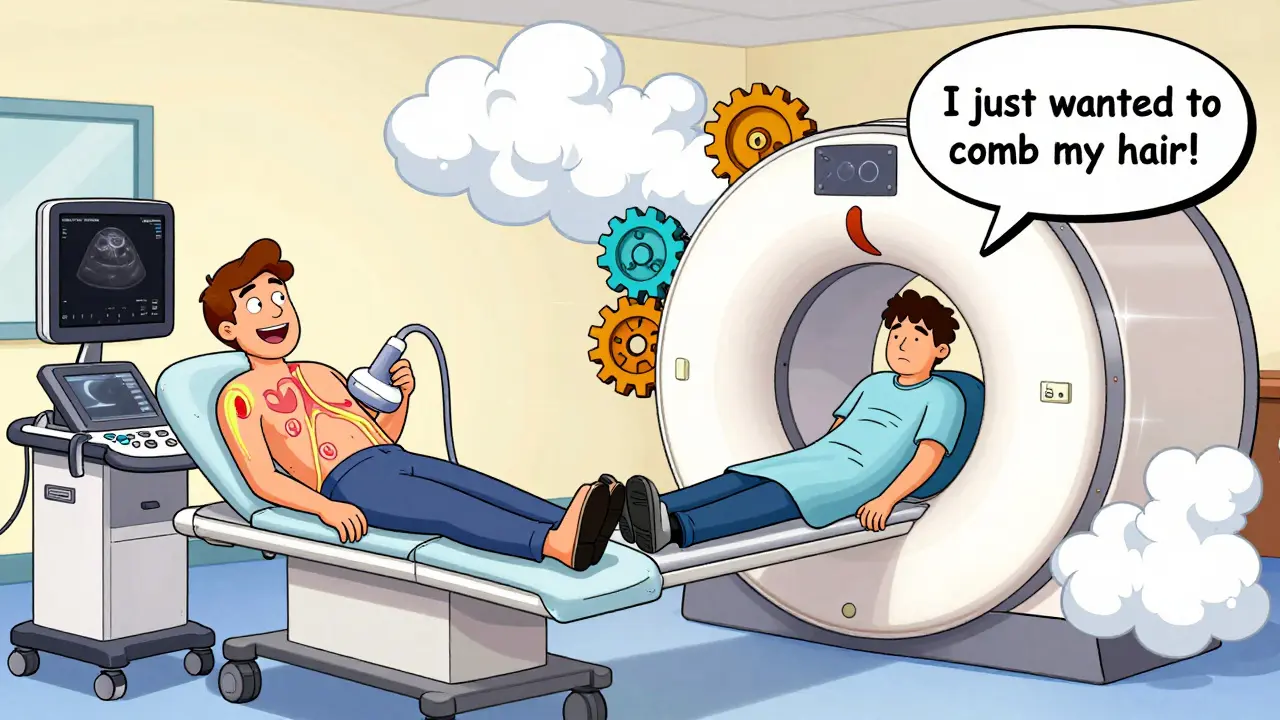
Ultrasound is fast, cheap, and doesn’t require you to lie still in a noisy tube. It costs about $200-$400, compared to $500-$1,200 for an MRI. It also lets the doctor watch your shoulder move in real time - something MRI can’t do. Experts say expert ultrasound is just as accurate as MRI for spotting full-thickness tears, with sensitivity rates between 87% and 91%. Plus, 92% of patients prefer it over MRI because it’s less claustrophobic and has no metal restrictions.
But ultrasound has a catch: it depends heavily on who’s holding the probe. Only 45% of general radiologists have the special training needed to read these scans well. If you’re overweight (BMI over 35), the images can get blurry. That’s why MRI is still the gold standard for complex cases - especially if surgery is being considered. MRI shows the exact size, shape, and location of the tear with 92% accuracy for full-thickness tears. It also reveals tendon degeneration, inflammation, and even early signs of retear after surgery. No contrast dye is needed unless you’ve had prior surgery and the doctor suspects a recurrence.
Rehabilitation: Can You Heal Without Surgery?
Yes - and many people do. About 85% of patients with partial-thickness tears recover fully with physical therapy alone. The key is consistency and timing. Rehab follows three clear phases:
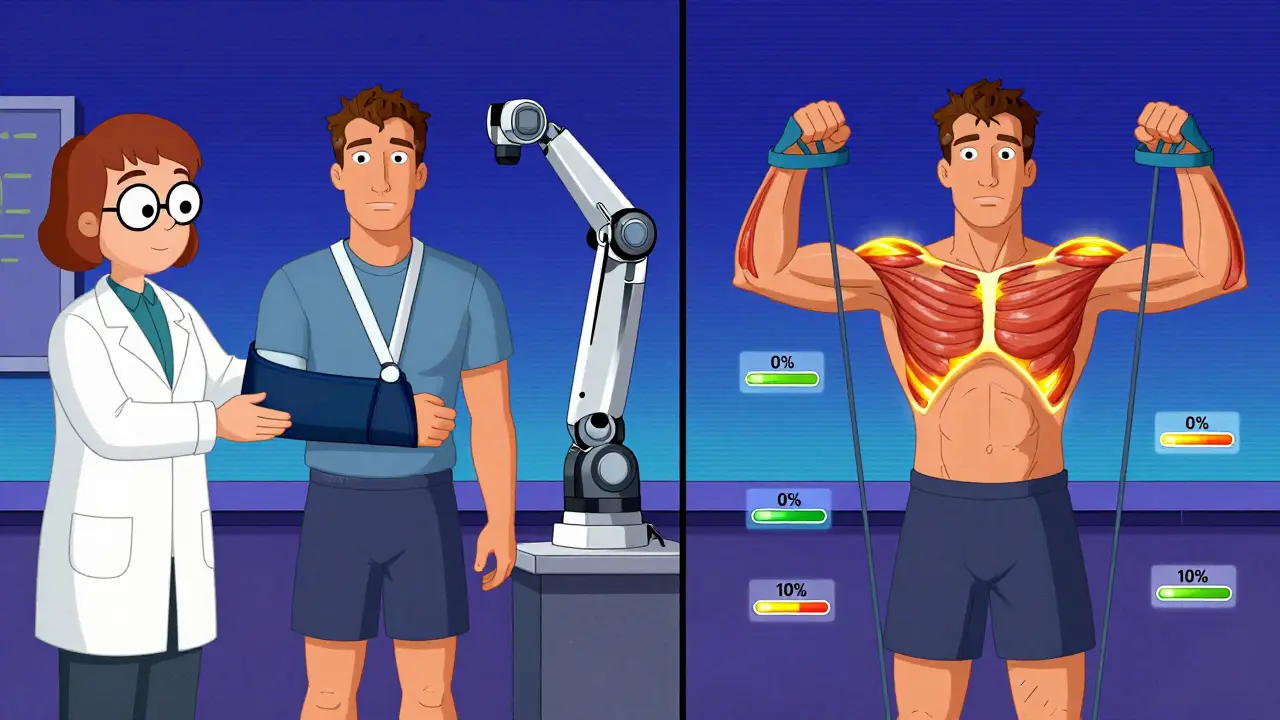
- Weeks 1-6: Passive motion - Your arm is moved for you by a therapist or a machine. No lifting. No pushing. The goal is to prevent stiffness while protecting the tear.
- Weeks 6-12: Active-assisted motion - You start using your own muscles, with light help from bands or your other arm. This builds control without strain.
- After 12 weeks: Strengthening - Resistance exercises focus on the rotator cuff and scapular muscles. Things like external rotation with a band, wall push-ups, and rows become routine.
Studies show that people who stick with rehab for at least 3 months see major improvements in pain and function. The American Academy of Orthopaedic Surgeons now recommends trying 6-8 weeks of physical therapy before jumping to imaging or surgery - especially for older adults or those with small tears. Why? Because many tears don’t cause symptoms, and the body can adapt.
Surgical Repair: When and How?
Surgery becomes the best option if you’re under 65, active, and have a full-thickness tear that hasn’t improved after 3 months of rehab. It’s also recommended if you’ve lost significant strength or if the tear is large (over 3 cm). Arthroscopic surgery - done through tiny keyhole incisions - is used in 90% of cases today. It’s less invasive than the old open methods, with fewer complications (7.2% vs. 10.3%) and faster recovery.
During arthroscopic repair, the surgeon uses a small camera and instruments to stitch the torn tendon back to the bone. Sometimes, if the tendon is badly frayed or the tear is massive, they’ll use a patch or graft to reinforce it. Platelet-rich plasma (PRP) injections are sometimes added during surgery, but the evidence is mixed. The Cochrane Review found only moderate benefit, and it’s not routinely covered by insurance.
Recovery after surgery isn’t quick. You’ll wear a sling for 4-6 weeks, but now, most surgeons let you start passive motion the day after surgery - a big shift from the old 6-week immobilization rule. Full strength takes 4-6 months. Return to sports or heavy lifting? That’s usually around 6 months, depending on your progress and the size of the tear.
Long-Term Outcomes: What Can You Expect?
Eighty-two percent of people report being satisfied with their results five years after arthroscopic repair. But not everyone heals perfectly. Retear rates vary: 12% for small tears, up to 27% for large ones. Factors like age, smoking, diabetes, and how long the tear was untreated all play a role. Even if the tendon doesn’t fully reattach, most patients still feel better because the pain goes down and movement improves.
One surprising fact: people who don’t have surgery but stick with rehab often end up with similar long-term function to those who do - as long as the tear isn’t too big or too old. That’s why shared decision-making matters. Talk to your doctor about your goals. Are you trying to play tennis? Lift your grandkids? Or just sleep through the night? Your answer guides the treatment path.
What’s New in Rotator Cuff Care?
Technology is changing the game. Machine learning algorithms are now being trained to read MRIs faster and more accurately. A 2023 study showed AI could classify partial vs. full-thickness tears with 89% accuracy - nearly matching expert radiologists. This could cut down wait times and reduce misdiagnoses.
Another emerging area is early intervention. Instead of waiting for pain to get unbearable, doctors are now recommending rehab as soon as a tear is diagnosed - even if it’s asymptomatic. Catching it early helps prevent the tendon from shrinking or turning into fatty tissue, which makes repair harder later.
What Not to Do
Don’t ignore shoulder pain. Don’t push through it with ice and ibuprofen alone. Don’t rush back to lifting weights or playing sports before you’re ready. And don’t assume surgery is the only fix - many people heal without it.
Also, avoid cortisone shots unless absolutely necessary. While they reduce pain temporarily, repeated injections can weaken the tendon and increase retear risk. Use them sparingly, and only as part of a broader rehab plan.
Can a rotator cuff tear heal on its own without surgery?
Yes, especially partial-thickness tears or small full-thickness tears in older, less active people. With consistent physical therapy, the body can adapt, pain can improve, and function can return. But the tendon itself rarely reattaches completely without surgery. The goal of rehab is to strengthen surrounding muscles so they compensate for the damaged tendon.
Is MRI always necessary for diagnosing a rotator cuff tear?
No. Many doctors start with a physical exam and X-ray. If symptoms are typical and conservative treatment is planned, MRI isn’t always needed right away. Ultrasound is often the next step - it’s cheaper, faster, and nearly as accurate for full-thickness tears. MRI is reserved for complex cases, surgical planning, or when ultrasound results are unclear.
How long does rotator cuff rehab take?
For non-surgical rehab, most people see improvement in 6-12 weeks, but full recovery can take 3-6 months. After surgery, the timeline is longer: passive motion starts immediately, active motion begins at 6-8 weeks, and strengthening starts around 12 weeks. Full strength and return to sports usually take 4-6 months. Rushing this process increases retear risk.
What’s the difference between arthroscopic and open surgery for rotator cuff repair?
Arthroscopic surgery uses small incisions and a camera to guide instruments - it’s minimally invasive. Open surgery requires a larger cut to directly access the tendon. Arthroscopic repair has lower complication rates (7.2% vs. 10.3%), less scarring, and faster recovery. Functionally, both methods give similar results, which is why arthroscopy is now the standard for most cases.
Can I prevent a rotator cuff tear?
You can’t always prevent it, especially as you age, but you can reduce your risk. Focus on shoulder blade strength (scapular stabilizers), avoid repetitive overhead lifting without rest, and maintain good posture. Regular rotator cuff strengthening exercises - like external rotations with a band - help keep the tendons resilient. If you’re over 40 and do overhead work, get checked if you feel persistent discomfort.


Reviews