
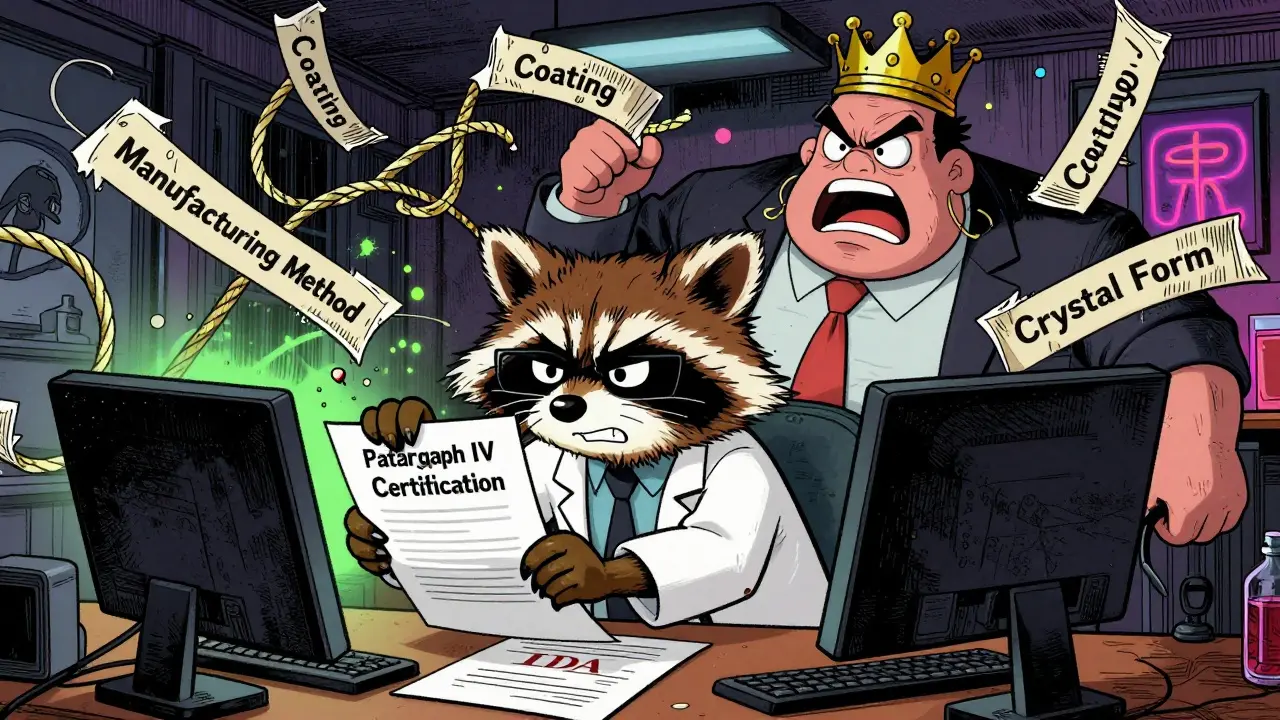
When a brand-name drug company holds a patent, it can block generic versions from entering the market for years. But there’s a legal backdoor-called a Paragraph IV certification-that lets generic drug makers challenge those patents before the drug even hits shelves. This isn’t a loophole. It’s a deliberate part of U.S. drug law designed to speed up affordable medicine. Since 1984, this mechanism has saved U.S. consumers over $1.7 trillion in drug costs. Yet, it’s also a high-stakes legal game where one misstep can cost millions-or even the right to sell the drug at all.
What Exactly Is a Paragraph IV Certification?
A Paragraph IV certification is a formal statement filed with the FDA as part of an Abbreviated New Drug Application (ANDA). It’s not just a notice-it’s a legal declaration that a patent listed for a brand-name drug is either invalid, unenforceable, or won’t be infringed by the generic version. This is the most aggressive of four patent certification options under the Hatch-Waxman Act of 1984. While other certifications simply acknowledge patent existence or wait for expiration, Paragraph IV says: ‘We think this patent doesn’t hold up.’
The law treats this declaration as an ‘artificial act of infringement.’ That means even though the generic drug hasn’t been made or sold yet, the act of filing the certification triggers the brand company’s right to sue. This sounds backwards, but it’s intentional. It forces patent disputes into court before the generic product hits the market, avoiding chaos where generics launch ‘at-risk’ and face massive lawsuits later.
How It Works: The 4 Key Steps
There’s a strict sequence. Get one step wrong, and your application gets rejected-or worse, you lose your chance at exclusivity.
- File the ANDA with Paragraph IV certification: The generic company must include a detailed legal and factual statement explaining why the patent is invalid or won’t be infringed. The FDA doesn’t judge the claim’s merit-it just checks if the statement exists. But courts do. And if it’s too vague, your application gets tossed.
- Send a notice letter to the patent holder: Within 20 days of filing, the generic company must mail a letter to the brand-name manufacturer and patent owner. This letter must include the same detailed basis as the FDA filing. If the wording is off-even slightly-the FDA can reject the application. About 12% of Paragraph IV filings in 2021-2022 failed here.
- Wait for a lawsuit: The brand company has 45 days to sue. If they do, the FDA can’t approve the generic for 30 months. That’s a long delay, but it’s not absolute. Courts can shorten or extend it based on the case’s progress.
- Win or lose: If the generic wins, it gets 180 days of exclusive market access. That’s huge. If it loses, the drug can’t launch until the patent expires. And if the generic fails to market within a certain window, it forfeits that exclusivity-something Teva learned the hard way with Copaxone in 2017.
Why Companies Risk It: The 180-Day Exclusivity Prize
The real power of Paragraph IV isn’t just breaking patents-it’s winning the right to be the only generic on the market for six months. That’s called 180-day exclusivity. During that time, no other generic can enter, even if they’ve filed their own challenge. This creates a massive financial incentive.
Take Apotex’s 2004 challenge to GlaxoSmithKline’s Paxil patent. After winning, Apotex had the market to itself for six months. It made over $1.2 billion in revenue. That’s not unusual. For a blockbuster drug selling $2 billion a year, 180 days of exclusivity can mean $500 million in profit. That’s why companies spend $10 million to $15 million on litigation, sometimes more. Fish & Richardson’s 2022 report found the median cost of a Paragraph IV lawsuit is $12.7 million.
But here’s the catch: only the first company to file a substantially complete ANDA with a Paragraph IV certification qualifies. If two companies file on the same day, they share the exclusivity. If one drops out or changes its certification later, it loses everything. That’s why timing and precision matter more than almost anything else.
The Hidden Costs: Patent Thickets and Pay-for-Delay
Brand-name companies aren’t sitting still. They’ve learned to protect their patents with ‘patent thickets’-layers of overlapping patents covering everything from the active ingredient to the pill’s coating to the way it’s manufactured. In 2023, 63% of generic manufacturers said these thickets made challenges harder than they were five years ago.
Then there’s ‘pay-for-delay.’ This happens when a brand company pays a generic maker to delay its launch instead of fighting in court. The FTC found 197 such deals between 1999 and 2009. In 2013, the Supreme Court ruled in FTC v. Actavis that these deals can violate antitrust laws-if they’re meant to keep prices high. But they still happen. In 2021, the FTC sued Shire over ‘authorized generics’-where the brand company launches its own generic version during the 180-day window, undercutting the challenger. It’s a legal gray area, but one that’s drawing more scrutiny.
Who’s Winning? The Top Players in Paragraph IV Challenges
Paragraph IV challenges aren’t for small players. The top five generic manufacturers-Teva, Viatris, Sandoz, Hikma, and Amneal-controlled 58% of all Paragraph IV filings between 2022 and 2023. These companies have teams of patent lawyers, regulatory experts, and scientists working full-time on these cases. They file 800 to 1,000 ANDAs a year, and 60-70% of those include Paragraph IV certifications.
Some of the most famous cases show the strategy in action. In 2019, Mylan successfully challenged Gilead’s patent on tenofovir disoproxil fumarate, launching its generic 27 months before the patent expired. That’s a huge win. But it took four years of litigation and millions in legal fees.
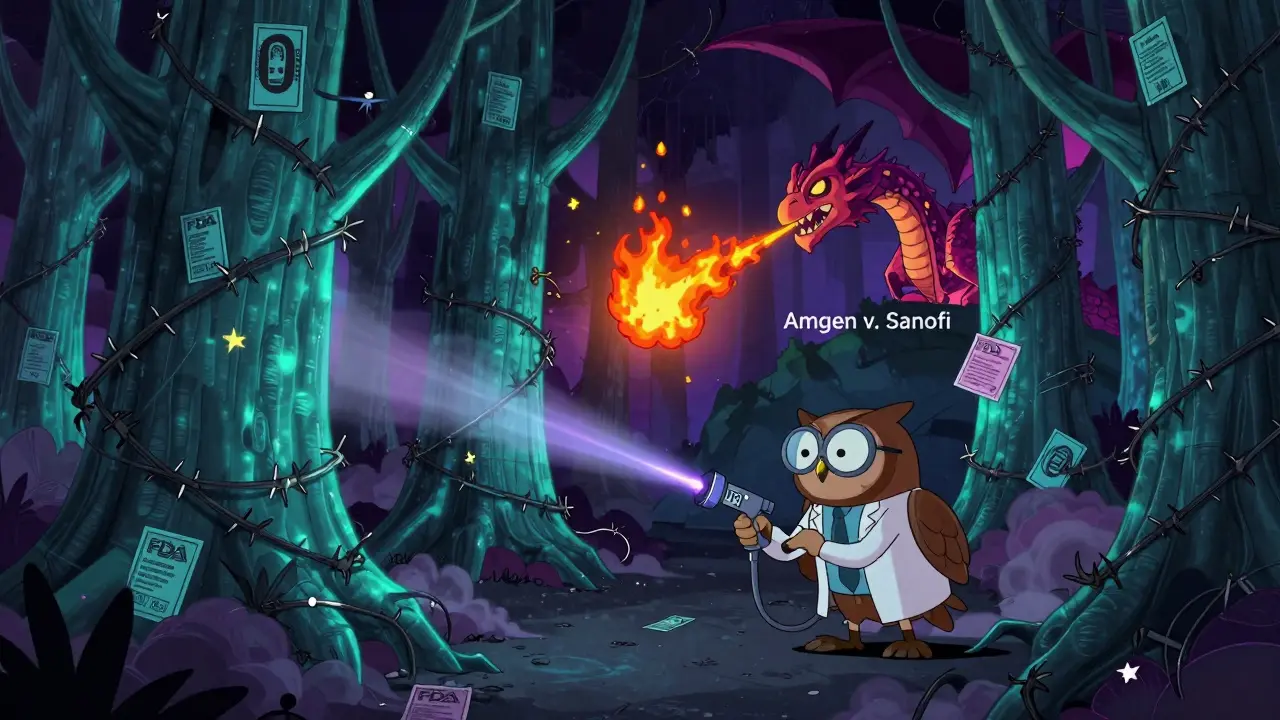
Meanwhile, biologics-complex drugs made from living cells-are becoming the new battleground. The 2023 Supreme Court decision in Amgen v. Sanofi raised the bar for proving a patent is invalid. Now, companies must show the patent enables the full scope of what it claims. That makes Paragraph IV challenges against biologics much harder. Lawyers at Covington & Burling predict this will slow down generic entry for these high-cost drugs.
What’s Next for Paragraph IV?
The system isn’t broken-it’s evolving. The FDA’s 2023 Orange Book Modernization Act made it harder to list weak or irrelevant patents, which should reduce patent thickets. At the same time, more generic companies are combining Paragraph IV challenges with Inter Partes Review (IPR) at the Patent Trial and Appeal Board. In 2022-2023, 42% of Paragraph IV cases involved parallel IPR proceedings. This dual approach gives challengers two chances to kill a patent.
Looking ahead, challenges are shifting toward complex generics-like inhalers, injectables, and topical creams. These are harder to copy than pills, so the patent battles are more technical. Evaluate Pharma predicts a 78% increase in these types of challenges by 2028.
One thing’s clear: as long as brand drugs cost hundreds or thousands of dollars a month, generic manufacturers will keep using Paragraph IV certifications to break the monopoly. The system isn’t perfect. It’s expensive, slow, and sometimes manipulated. But it’s also the single biggest reason why U.S. patients pay less for medicines today than they did 40 years ago.
Is This Strategy Right for Every Generic Drug?
Not all drugs are worth the fight. For a drug with $50 million in annual sales, spending $10 million on litigation doesn’t make sense. But for a blockbuster-anything over $1 billion a year-it’s almost mandatory. In fact, every top-selling drug with annual sales over $1 billion has faced at least one Paragraph IV challenge, according to a 2023 analysis in the Journal of Law & Economics.
The decision comes down to three things: the strength of the patent, the size of the market, and the cost of delay. If the patent looks shaky, the drug sells well, and you’re first in line-then it’s worth the risk. If not, it’s better to wait for expiration or file a Paragraph II certification and save your money.


Reviews
This system is wild. One filing, one mistake, and you lose millions. I’ve seen small labs go under because they misspelled ‘infringement’ in the notice letter. The FDA doesn’t care if you’re right-only if you followed the rules. It’s legal Russian roulette.
Let’s be real-this isn’t about access to medicine. It’s about hedge funds betting on patent expiry dates. The 180-day exclusivity? That’s a monopoly disguised as competition. The real winners aren’t patients-they’re the lawyers and the first-to-file conglomerates who already own 60% of the market.
Oh wow, so the ‘heroic generic warriors’ are just corporate mercenaries with law degrees? 🤡 And we’re supposed to cheer because they ‘saved’ $1.7 trillion? Bro, that’s just the money they didn’t pay to Big Pharma because they litigated instead of paying royalties. Meanwhile, the patents were probably valid. But hey, let’s call it ‘consumer savings’ while the FDA gets buried in paperwork.
Y’all keep talking about Paragraph IV like it’s some noble underdog story. It’s not. It’s a legal loophole that only works if you’ve got a $20M litigation budget and a team of ex-FDA regulators on retainer. The average person doesn’t even know what an ANDA is. Meanwhile, the real problem is that the FDA approves generics based on bioequivalence studies done in 12 healthy white men aged 25–35. So yeah, your ‘affordable’ generic might not even work for women, elderly, or people of color. But hey, at least it’s cheap, right? 🤷♂️
It’s fascinating how this system balances innovation and access. The Hatch-Waxman Act was a masterstroke-creating incentive without destroying monopoly rights. The Paragraph IV certification forces transparency: if a patent is weak, it should be invalidated. If it’s strong, the generic must wait. That’s not a loophole-it’s a calibrated equilibrium. The real tragedy isn’t the litigation-it’s the pay-for-delay deals that corrupt the process. Those are the true villains.
Why do we even let this happen? The system’s rigged. Patent trolls? Nah. It’s the generic giants who game the clock. They file just before the patent expires, drag it out for 30 months, then claim exclusivity. Meanwhile, patients wait. And the brand companies? They just raise prices on other drugs. This isn’t competition-it’s a tax on sick people.
This is why global health equity is so hard. In the U.S., we have this complex, expensive, lawyer-driven system to get cheap drugs. In India, generics are made without litigation-because patents aren’t enforced the same way. Shouldn’t we be asking: Why can’t we simplify this? Why must access to medicine be a legal battle instead of a human right? The technology exists. The will doesn’t.
Imagine if we applied this model to housing or education. ‘Hey, I think your mortgage contract is invalid, so I’m gonna build a house next door and sell it for 70% less.’ 😂 The fact that we treat medicine like a courtroom sport says everything about how broken our system is. We reward lawyers, not patients. 🫡
Let’s not romanticize this. The 180-day exclusivity is a cartel mechanism. It’s not competition-it’s a first-mover monopoly. And the fact that Teva lost exclusivity because they didn’t launch fast enough? That’s not a failure of the system. That’s the system working exactly as designed: to punish sloppiness, reward timing, and let the rich play chess with people’s lives. Also, biologics? Yeah, good luck challenging those. The science is so opaque, even the scientists don’t agree. So now we’re litigating quantum biology. 🤯
My uncle in Delhi gets insulin for $2. Here, it’s $300. We fight over patents while people ration doses. The real innovation isn’t in the courtroom-it’s in the villages where someone reverse-engineered a drug without a lawyer. Maybe we should stop pretending this is about justice and admit it’s about who can afford the best legal team.
There’s a deeper issue here: the entire regulatory framework assumes that patent validity can be determined by litigation. But patents are technical documents, not legal ones. Judges aren’t scientists. Juries don’t understand bioequivalence. We’re outsourcing medical science to a system designed for property disputes. We need specialized patent courts with technical experts-not lawyers who learned pharmacology from a textbook.
Love how we call this ‘saving’ money. It’s not saving-it’s redistribution. The same companies that fight patents are the ones who later buy out the small generics who won. It’s consolidation disguised as disruption. Also, anyone else notice how every ‘winning’ generic company is owned by a bigger pharma? The game hasn’t changed. The players just got shinier suits.
Paragraph IV? More like Paragraph ‘I’m gonna sue you’.
The entire Paragraph IV framework is a relic of 1984. We’re still using analog-era legal structures to regulate digital-age biologics. The FDA’s Orange Book is a spreadsheet. The Patent Office is backlogged. The courts are overloaded. And we wonder why drug prices are still insane? This isn’t innovation-it’s bureaucratic theater.
One must consider the epistemological foundation of patent law in the context of pharmaceutical innovation. The Paragraph IV certification functions as a performative act of epistemic disruption-a declaration that challenges the ontological legitimacy of the patent claim. The legal system, in its current form, is incapable of adjudicating the technical complexity inherent in modern drug development. Therefore, the entire mechanism is not merely flawed-it is fundamentally incoherent. The 180-day exclusivity period, far from incentivizing innovation, merely institutionalizes rent-seeking behavior under the guise of market competition. The true solution lies not in reforming the process, but in replacing it with a public-domain, open-access model of drug development, funded through progressive taxation and administered by international scientific consortia.