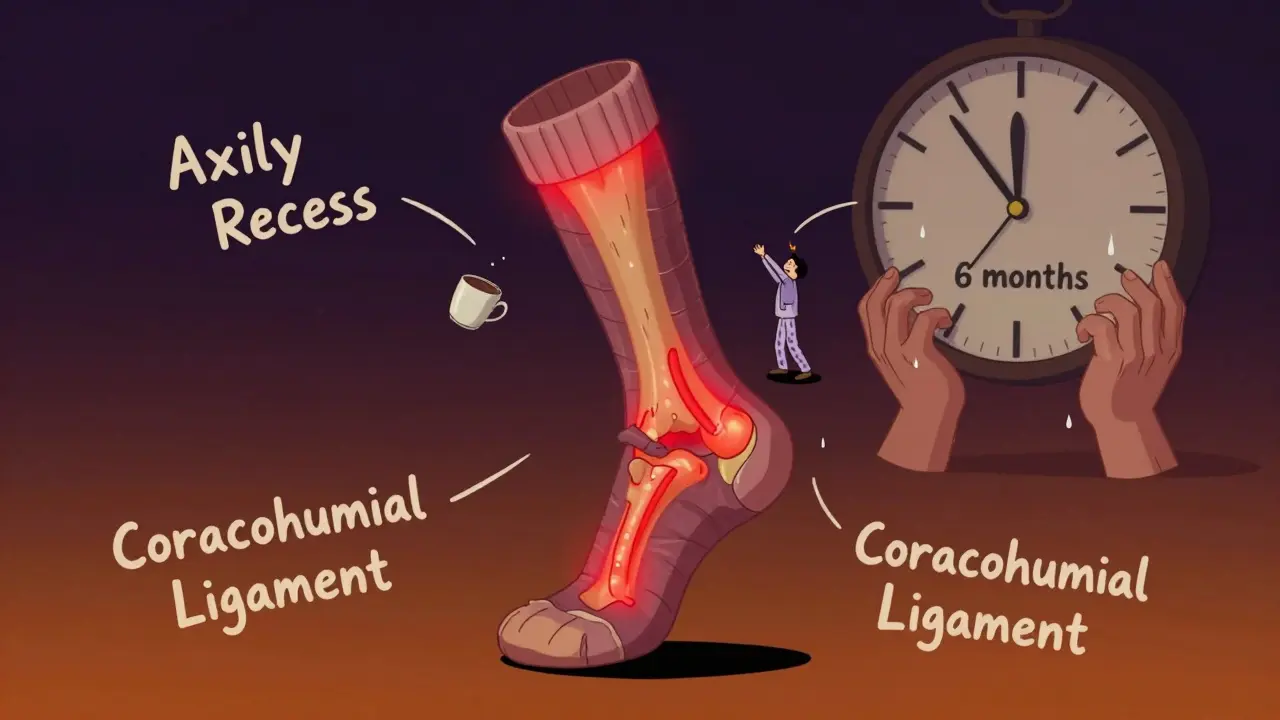
When your shoulder starts to hurt and won’t move - not even when you try to reach for a coffee cup or brush your hair - it’s not just a bad day. It could be frozen shoulder, also known as adhesive capsulitis. This isn’t just stiffness. It’s a slow, painful tightening of the shoulder joint capsule that can lock your arm in place for months, sometimes years. And if you’ve got diabetes, your risk jumps from 2-5% in the general population to as high as 20%.
What Actually Happens Inside Your Shoulder?
Your shoulder joint is surrounded by a flexible, bag-like structure called the joint capsule. It’s full of fluid and allows your arm to swing in almost any direction. In frozen shoulder, this capsule gets inflamed, then thickens and shrinks. Studies using joint injections show the capsule’s volume drops from a normal 30-35 mL down to just 10-15 mL. That’s a 45% loss in space. No wonder your arm feels glued in place. The real issue isn’t glue or adhesions (despite the name). It’s contraction. The front and top parts of the capsule - especially around the axillary recess and coracohumeral ligament - tighten up like a shrunken sock. This isn’t just about muscle tightness. It’s the joint itself getting smaller. That’s why both your own movement (active) and someone else moving your arm (passive) are limited. That’s a key difference from rotator cuff tears, where you can still move your arm with help. The pattern of restriction is very specific. External rotation - like reaching behind your back to grab a seatbelt - suffers the most, often dropping by 60-70%. Then comes abduction (lifting your arm out to the side), then internal rotation (reaching across your chest). If your doctor checks these three movements and finds this exact order of loss, it’s a strong sign of frozen shoulder.The Three Stages: What to Expect
This isn’t something that happens overnight. It follows a predictable, though frustrating, timeline:- The Freezing Stage (6 weeks to 9 months): Pain gets worse, especially at night. You might wake up because your shoulder feels like it’s on fire. Movement becomes harder each week. This is the most painful phase.
- The Frozen Stage (4 to 6 months): The pain starts to settle down, but your shoulder is locked. You can’t lift it, reach behind you, or even put on a shirt. The stiffness is at its worst.
- The Thawing Stage (6 months to 2+ years): Slowly, painfully, motion returns. It can take over a year. But here’s the good news: with the right approach, you can cut this time in half.
Why Most People Wait Too Long - And Why That Makes It Worse
Too many people wait. They think, “It’ll go away on its own.” And yes, it usually does - but not before you’ve lost months, sometimes years, of normal function. The natural course without treatment? 24 to 40 months. That’s over two years. But research shows something powerful: if you start gentle movement during the freezing stage - while the pain is still high - you can shrink that timeline to 6-12 months. A 2019 review in American Family Physician found that early mobilization cuts recovery time dramatically. The key? Don’t wait for pain to disappear. Work within it. The old advice - rest until the pain goes away - is outdated. New guidelines from the American Academy of Family Physicians (September 2023) now say: move as much as you can tolerate. Pain is a guide, not a stop sign. Pushing too hard? Bad. Not moving at all? Also bad.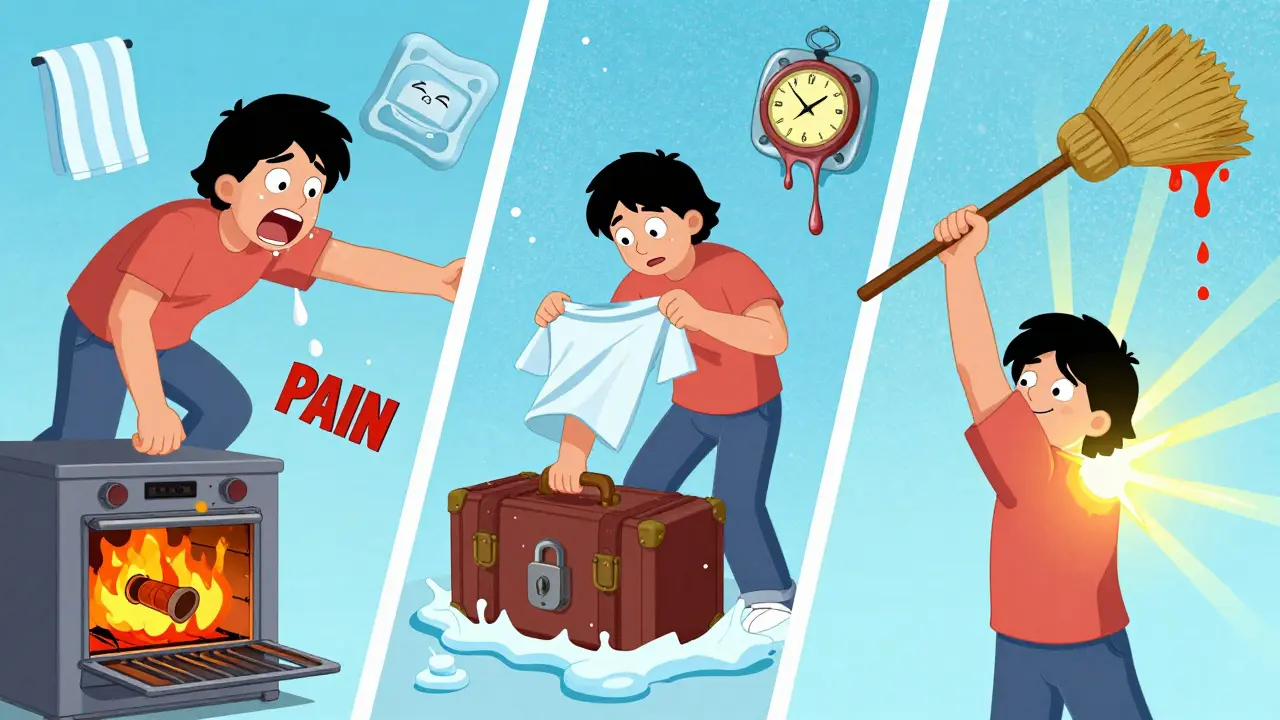
What Works: Proven Mobilization Strategies
You don’t need fancy gear. Most of what helps is simple, daily movement done consistently.- Pendulum Exercises: Lean forward, let your arm hang down. Gently swing it like a pendulum - small circles, back and forth, side to side. Do this for 5 minutes, 2-3 times a day. This keeps the joint lubricated without forcing it. Many patients report seeing gains in external rotation within weeks.
- Towel Stretch: Hold a towel behind your back with both hands. Use your good arm to gently pull the affected arm up. You’re not trying to force it - just encourage motion. Repeat 10 times, twice daily.
- Doorway Stretch: Stand in a doorway. Place your hand on the frame at waist height. Gently lean forward until you feel a stretch in your shoulder. Hold for 30 seconds. Repeat 3 times. This helps with internal rotation.
- Wand Exercises: Use a broomstick or cane. Lie on your back. Hold the wand with both hands. Slowly lift it overhead, letting your affected arm follow. Stop when you feel resistance. Do 10 reps.
What Doesn’t Work - And What Can Hurt
Some people try to “break” the stiffness. They force their arm into position. One patient on MyClevelandClinic reported forcing a cross-body stretch during the freezing phase - and ended up with pain that spiked from 4/10 to 8/10 for three weeks. That’s not progress. That’s injury. Aggressive manipulation under anesthesia - where a doctor forcibly moves your shoulder while you’re asleep - sounds tempting. But experts like Dr. Robert K. Morgan at the Cleveland Clinic warn: don’t do it until you’ve tried 6 months of conservative care. Risks include fractures, torn tendons, and nerve damage. Corticosteroid injections? They can help with short-term pain relief - maybe 4 to 8 weeks. But they don’t improve long-term mobility. The AAOS says there’s no meaningful benefit at 12 weeks. So if you’re getting one just to “get you through,” think again. It’s not a fix.How to Sleep Without Pain
Night pain is one of the most common complaints. 78% of patients say it ruins their sleep. The fix? Positioning. Sleep on your back with a pillow under your affected arm. Or sleep on your good side with a pillow hugged to your chest - that keeps your shoulder from rolling inward. Avoid sleeping on the affected side. Even if you think you’re being careful, pressure during sleep can flare inflammation.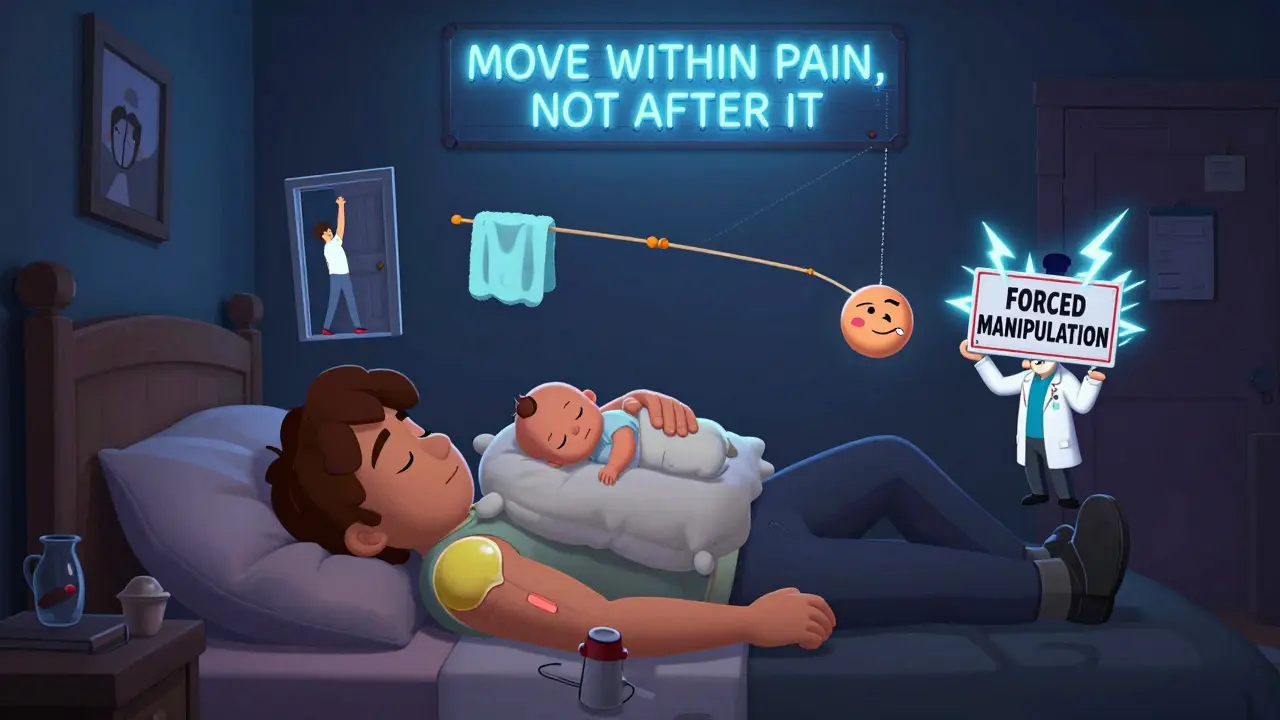
When to See a Professional
If you’ve had shoulder pain for more than 2-3 weeks with no improvement - especially if it’s getting worse - see a physical therapist. A supervised program in the freezing phase leads to 28% faster recovery than home-only efforts, according to AAOS guidelines. But don’t go to a gym trainer or a massage therapist who doesn’t know about capsular patterns. You need someone who understands the difference between frozen shoulder and a rotator cuff tear. The wrong treatment can make it worse. Red flags? Fever, night sweats, unexplained weight loss. These aren’t typical for frozen shoulder. They could mean something more serious - infection, cancer, autoimmune disease. Get those checked out immediately.What’s New in 2026
Technology is catching up. The FDA-cleared ShoulderROM device from Precision Rehab Solutions gives real-time feedback during home exercises. Clinical trials show users recover 32% faster than those using traditional methods. It’s not cheap - but if you’re serious about recovery, it’s worth considering. Research is also moving toward personalized rehab. Scientists are studying IL-6, a blood marker for inflammation, to predict who will respond best to stretching vs. other techniques. This could mean your rehab plan is tailored to your biology, not just your symptoms.Bottom Line: You Can Get Your Shoulder Back
Frozen shoulder doesn’t have to take years. It’s not a death sentence for your mobility. But it does require patience, consistency, and smart timing. Start gentle movement early. Don’t wait for the pain to vanish. Use heat. Use a towel. Use a doorframe. Do it every day. Track your progress - even small gains matter. And remember: this is a journey, not a race. Most people - 87% - regain full function within two years. The ones who don’t? They usually waited too long or pushed too hard. You don’t have to be one of them.Is frozen shoulder the same as a rotator cuff tear?
No. A rotator cuff tear involves damage to the tendons that stabilize the shoulder. You can still move your arm passively (with help) with a tear. With frozen shoulder, both active and passive movement are limited because the joint capsule itself is tightening. The key clue? Frozen shoulder has a specific pattern: external rotation is most affected, followed by abduction and internal rotation. Rotator cuff tears don’t follow that pattern.
Can frozen shoulder come back after it’s gone?
It’s rare, but possible. Most people recover fully and never have it again. However, if you have diabetes or another autoimmune condition, your risk of recurrence is higher. Staying active and keeping your shoulder mobile with regular stretching - even after recovery - reduces the chance of it returning.
How long should I do each exercise?
Start with 5-10 minutes per session, 2-3 times a day. Focus on consistency, not intensity. For example, 5 minutes of pendulum swings before bed is better than 20 minutes once a week. Gradually increase as your range improves, but never push into sharp pain. Mild discomfort is okay. Shooting pain is a warning.
Should I use ice or heat for frozen shoulder?
Use heat before stretching. A warm shower, heating pad, or warm towel for 10 minutes helps relax the tight capsule and makes stretching more effective. Use ice only if you’ve had a flare-up after exercise - like after doing too much too soon. Ice reduces inflammation, but it doesn’t help with stiffness. Heat helps with mobility.
Is surgery ever needed?
Only in about 13% of cases. Surgery - like arthroscopic capsular release - is considered only after 6-12 months of consistent physical therapy with no improvement. It’s effective, but it’s not a first-line treatment. Most people recover without it. The goal is always to avoid surgery by starting movement early and staying consistent.
Can I still work out with frozen shoulder?
Yes - but avoid anything that stresses the shoulder. Don’t do push-ups, overhead lifts, or heavy pulling. Focus on your legs, core, and your good arm. Light cardio like walking or cycling is fine. The key is to stay active overall without aggravating the shoulder. Movement elsewhere helps your whole recovery.