
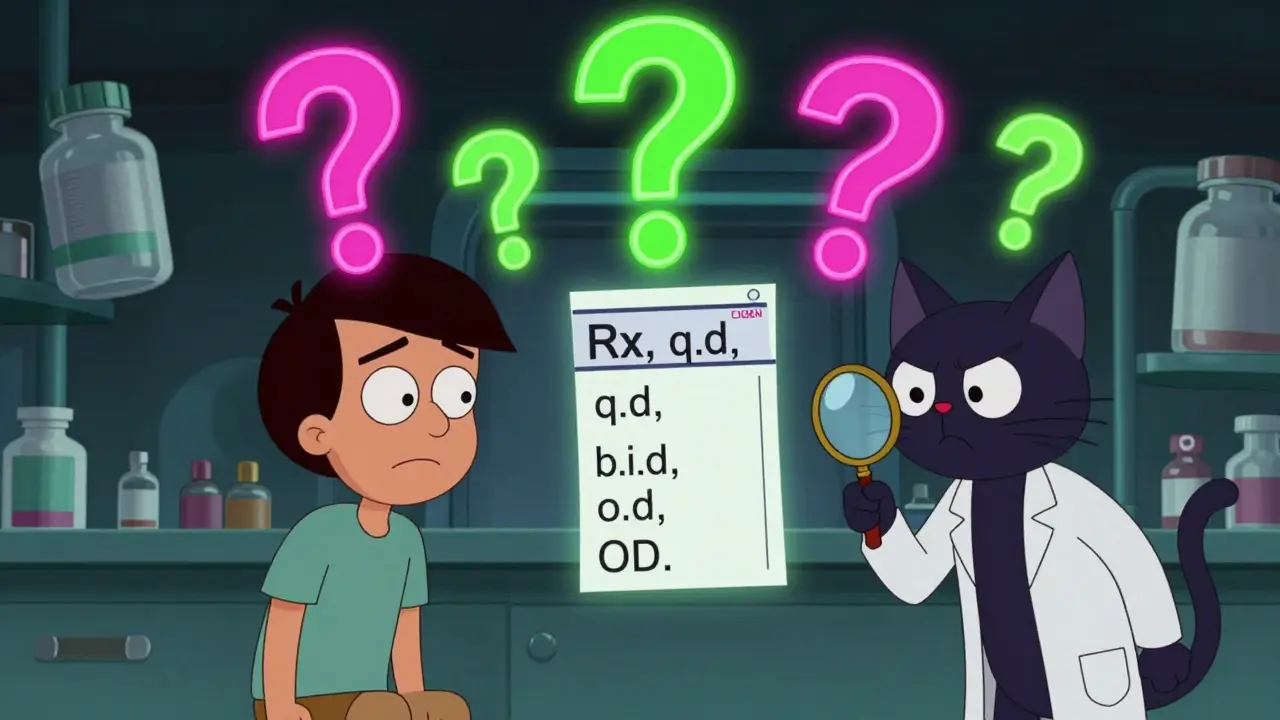
Have you ever looked at your prescription label and felt like you’re reading a secret code? That little Rx at the top? The q.d. or b.i.d.? The o.d. or a.s.? You’re not alone. These symbols aren’t random-they’re shorthand that doctors, pharmacists, and nurses use every day. But what they mean isn’t always clear to patients. And when they’re misunderstood, it can lead to dangerous mistakes.
Why Do Prescription Labels Use Abbreviations?
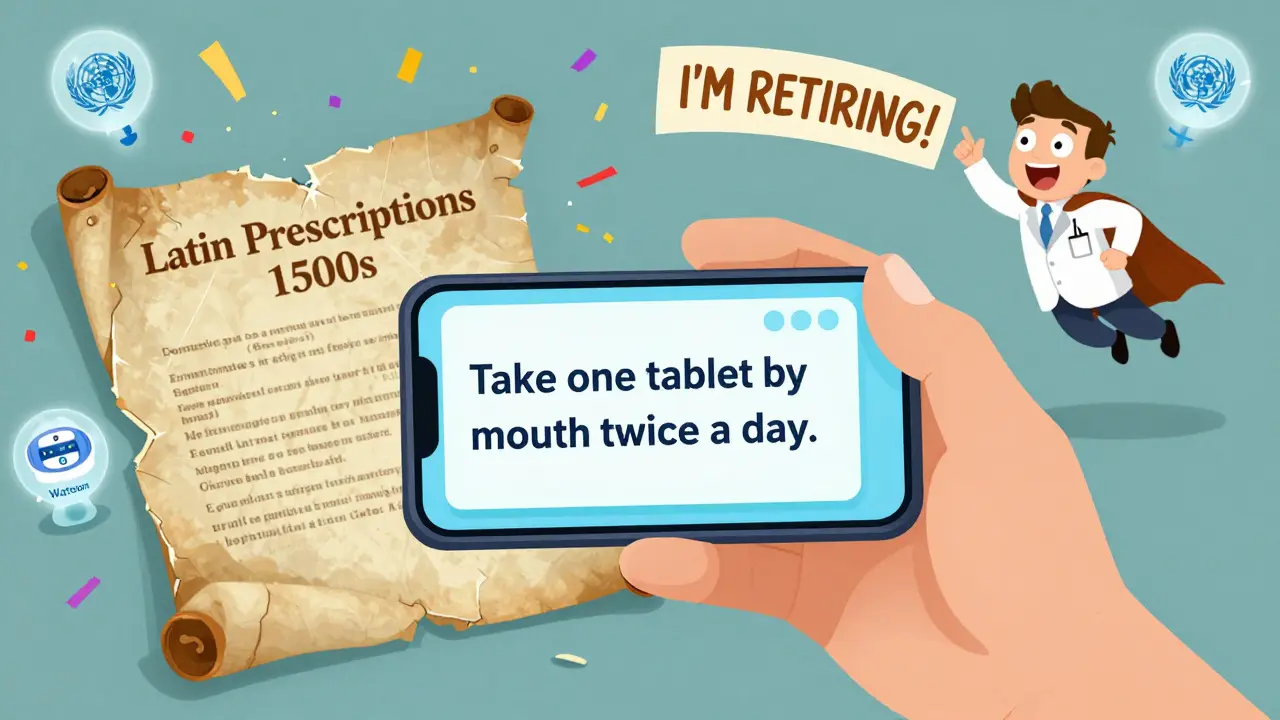
The roots of these symbols go back hundreds of years. Back in the 1500s, Latin was the universal language of medicine across Europe. Doctors wrote prescriptions in Latin so that pharmacists in different countries could understand them. The symbol Rx comes from the Latin word recipe, which means “take.” It’s not a symbol for a prescription-it’s a command: take this. Today, we still use these abbreviations because they’re fast. A doctor writing 30 prescriptions in an hour doesn’t have time to spell out “take one tablet by mouth twice a day.” But speed comes at a cost. The Institute for Safe Medication Practices found that nearly 7% of all medication errors in U.S. hospitals are linked to confusing abbreviations. That’s not a small number. It’s thousands of mistakes every year.The Most Common Prescription Abbreviations (and What They Really Mean)
Here are the abbreviations you’re most likely to see on your label-and what they actually mean in plain English.- Rx = Prescription (from Latin recipe)
- p.o. = By mouth (Latin per os)
- p.r. = Rectally (Latin per rectum)
- SC, SQ, SubQ = Under the skin (subcutaneous)
- q.d. = Daily (Latin quaque die)
- b.i.d. = Twice a day (Latin bis in die)
- t.i.d. = Three times a day (Latin ter in die)
- q.i.d. = Four times a day (Latin quater in die)
- q.h. = Every hour (Latin quaque hora)
- PRN = As needed (Latin pro re nata)
- o.d. = Right eye (Latin oculus dexter)
- o.s. = Left eye (Latin oculus sinister)
- a.d. = Right ear (Latin auris dexter)
- a.s. = Left ear (Latin auris sinister)
- OD = Overdose (not the same as o.d.!)
- U = Units (dangerous-can be mistaken for “0” or “IV”)
- MS = Morphine sulfate (but also means magnesium sulfate-confusing!)
- OTC = Over-the-counter (not on your prescription, but often noted)
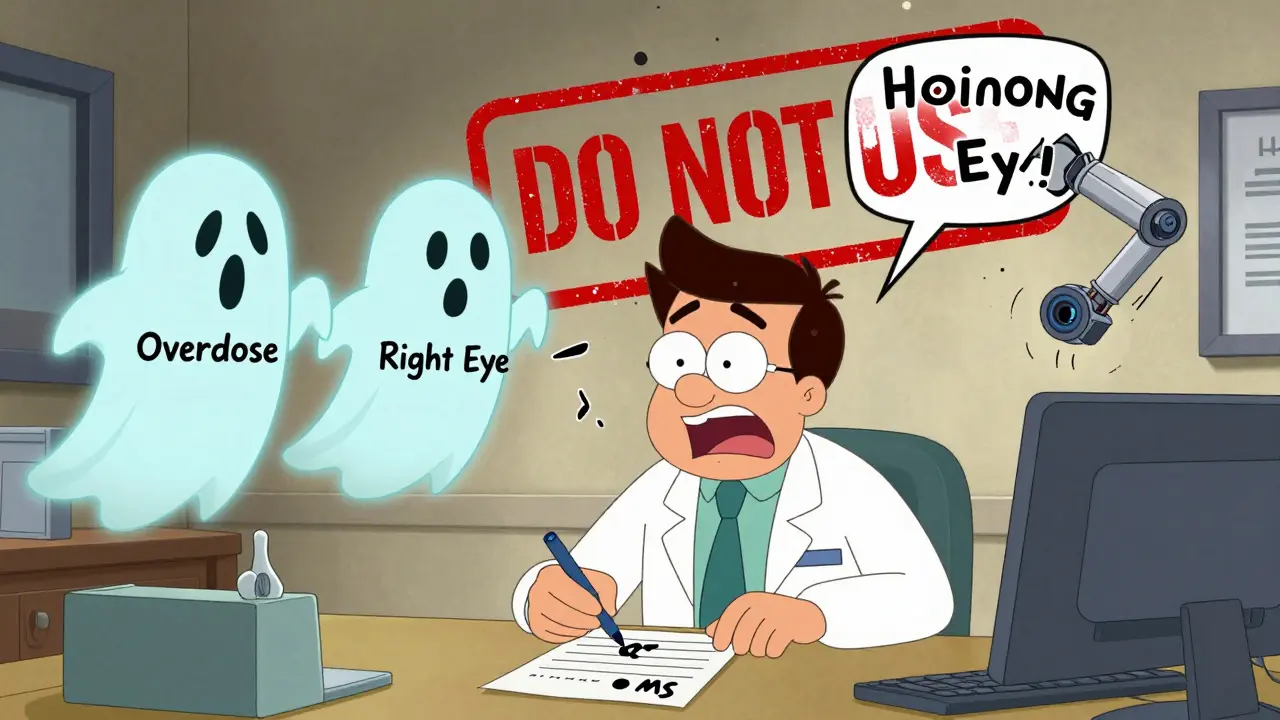
Some of these are easy. p.o. is just “take by mouth.” But others? o.d. and OD look almost identical. One means “right eye,” the other means “overdose.” A single misread can lead to a patient getting eye drops instead of a life-saving dose of naloxone-or worse.
The Dangerous Abbreviations That Are Being Phased Out
Not all abbreviations are created equal. Some are so risky they’ve been banned. The Joint Commission, which sets safety standards for U.S. hospitals, has a strict “Do Not Use” list. These are the top offenders:- U for units → Always write “units”
- IU for international units → Write “international units”
- q.d. → Write “daily” (people confuse it with q.i.d.)
- Q.O.D. → Write “every other day”
- MS or MSO4 → Write “morphine sulfate”
- Trailing zeros (like 1.0 mg) → Write “1 mg” (a .0 can be mistaken for 10)
- Leading zeros (like .5 mg) → Write “0.5 mg” (to avoid missing the decimal)
These aren’t just suggestions. They’re rules. A hospital that uses “U” for units could be fined. A pharmacy that dispenses based on “q.d.” instead of “daily” could be liable if someone gets the wrong dose.
And it’s not just hospitals. Community pharmacies still see these mistakes every day. In 2023, a survey of 1,200 pharmacists found that 19.3% of errors in community settings came from mixing up eye and ear abbreviations-like using a.d. instead of o.d.. One patient got ear drops in their eye. Another got insulin under the skin instead of into the vein because someone misread “SC” as “IV.”
What’s Changing? The Push Toward Plain Language
The tide is turning. More and more places are ditching Latin abbreviations entirely. In 2019, the UK’s National Health Service banned all Latin abbreviations except for metric units (mg, mL). The result? A 28.7% drop in dispensing errors. That’s huge. It means fewer people got the wrong medicine, fewer ended up in the ER, and fewer died from mistakes. Australia is following suit. Since 2022, new prescriptions in public hospitals here use only English. No more b.i.d.-just “twice daily.” No more o.d.-just “right eye.” Electronic prescribing systems are helping too. If a doctor types “q.d.” into an EHR system like Epic or Cerner, the software automatically changes it to “daily.” It flags “U” and says, “Did you mean ‘units’?” It even warns if you type “MS” and asks if you meant morphine sulfate or magnesium sulfate. But here’s the catch: not everyone uses these systems. Some doctors still write prescriptions by hand. Some clinics use old software. And if a handwritten prescription with “q.d.” or “U” ends up in a pharmacy, the pharmacist has to guess what was meant.What You Should Do as a Patient
You don’t need to memorize all these abbreviations. But you do need to ask questions. When you get your prescription:- Ask: “Can you write this out in plain English?”
- Ask: “Is this for my eye, ear, or mouth?”
- Ask: “How many times a day? And what time?”
- Ask: “Is this a pill, a liquid, or a shot?”
Pharmacists are trained to explain this. If your label says “o.d. 1 drop,” don’t assume it’s for your eye. Ask. It could be for your ear. Or worse-it could be a typo.
Also, check your pill bottles. Many pharmacies now print labels in plain English. Walmart, CVS, and Walgreens have all switched to full sentences: “Take one tablet by mouth twice a day.” That’s not a luxury-it’s a safety feature.
What’s Next? The Future of Prescription Labels
By 2027, most electronic prescriptions in the U.S. will have no Latin abbreviations left. AI systems like IBM Watson Health’s MedSafety AI can now convert every old-style abbreviation into plain language with 99.2% accuracy. That means in just a few years, your prescription label will look more like a text message than a medical textbook. The World Health Organization wants all countries to eliminate non-English abbreviations by 2030. Australia, Canada, and Germany are already halfway there. The U.S. is moving slower-but the pressure is growing. Starting in 2024, hospitals that don’t follow abbreviation safety rules could lose millions in Medicare payments. The bottom line? The old system was built for speed. But now, safety matters more. And patients are the ones who benefit the most.What to Do If You’re Still Confused
If you’re unsure about your prescription:- Call your pharmacy. They’re required to explain it to you.
- Ask your doctor for a printed instruction sheet.
- Use apps like Medisafe or MyTherapy-they can translate abbreviations and remind you when to take your medicine.
- Keep a list of your medications with plain-language instructions. Update it every time you get a new prescription.
Never guess. Never assume. And never be afraid to ask.




Reviews
Bro this is just lazy medicine. Latin? In 2024? If you can't write 'twice daily' instead of 'b.i.d.', maybe you shouldn't be prescribing. I've seen people die because some doc thought 'U' was cute. Get with the program.
Thank you for breaking this down so clearly. As someone who helps care for an elderly parent, I’ve been terrified of misreading labels. The part about 'o.d.' vs 'OD' made my stomach drop. I’m going to start asking my pharmacist to rewrite everything in plain text. No more guessing.
Appreciate the context. I used to work in a pharmacy back in the day, and yeah, we’d get handwritten scripts with 'MS' and 'U' all the time. The pharmacist would just sigh and call the doctor. One time, a guy got morphine instead of magnesium because the script was smudged. He ended up in ICU. That’s why I’m glad they’re phasing this out. Safety > speed.
Latin. Outdated. Unnecessary. Done.
It is a well-documented fact, based on empirical data collected by the Institute for Safe Medication Practices, that the continued use of non-standardized, archaic, and linguistically ambiguous abbreviations in pharmaceutical documentation constitutes a systemic failure in patient safety protocols. The persistence of 'q.d.' and 'U' is not merely negligent-it is an affront to evidence-based practice. Furthermore, the reliance on human interpretation in high-stakes clinical environments is statistically indefensible. One must ask: why are we still allowing analog errors in a digital age? The answer, regrettably, lies in institutional inertia and a profound underestimation of the cognitive load placed upon frontline healthcare workers.
Y’all know what’s wild? I got my meds from Walmart last week and the label said 'Take one pill by mouth every morning.' No Latin, no symbols. I cried. Not because I’m emotional-because for once, I didn’t have to call the pharmacy. That’s the future. Simple. Clear. Safe.
good post! i had a friend who got eye drops in her ear bc of o.d. vs a.d. she was so confused. now she always asks for the 'english version' and takes a pic of the label. smart move. also, apps like medisafe are lifesavers. just sayin' 😊
Let me tell you something they don’t want you to know. This whole 'plain language' push? It’s not about safety. It’s about control. Who benefits from making prescriptions simpler? The pharmaceutical companies. Easier to market. Easier to upsell. Easier to slip in new drugs without patients realizing. And don’t get me started on AI converting 'q.d.' to 'daily'-that’s not accuracy, that’s algorithmic gatekeeping. Who programmed those systems? Who owns the data? The government? Big Pharma? You think they’re not tracking every medication you take? Wake up. The real danger isn’t 'U' or 'MS'-it’s the surveillance state disguised as healthcare reform.
USA is the only country that actually gives a damn about patient safety. Europe? They banned Latin because they’re too lazy to learn. We’re fixing this. We’re leading. 💪🇺🇸
You think this is bad? Try being a pharmacist in rural Kentucky. Half the doctors still write prescriptions on napkins. I had one last week that said 'o.d. 2 drops'-no context, no name, no date. I called the clinic. They said, 'Oh yeah, that’s for the eye.' But the patient’s chart said glaucoma. So I gave her eye drops. Two hours later, she called back screaming because her ear infection got worse. Turns out she had ear drops in her eye. I had to call the doctor again. He said, 'I thought you’d know.' Know what? That I’m a mind reader? I’m not a mind reader. I’m a pharmacist. And this system is broken. And no one cares until someone dies.
The transition from Latin medical nomenclature to vernacular instruction represents not merely a pragmatic evolution, but a profound epistemological shift in the relationship between healer and healed. The erasure of classical terminology-once a lingua franca of learned discourse-signals the commodification of medical knowledge into a consumer-facing product. The patient, once a passive recipient of arcane wisdom, is now an active interpreter, stripped of the ritualistic authority that once demarcated professional expertise. One cannot help but wonder: in democratizing understanding, have we diminished reverence?
They banned 'U' but not 'PRN'? That’s like banning 'q.d.' but letting 'OD' slide. Hypocrites. Also, why are we still using 'SC' instead of 'subcutaneous'? It’s 2024. Just say it. No more abbreviations. Ever. No exceptions.