
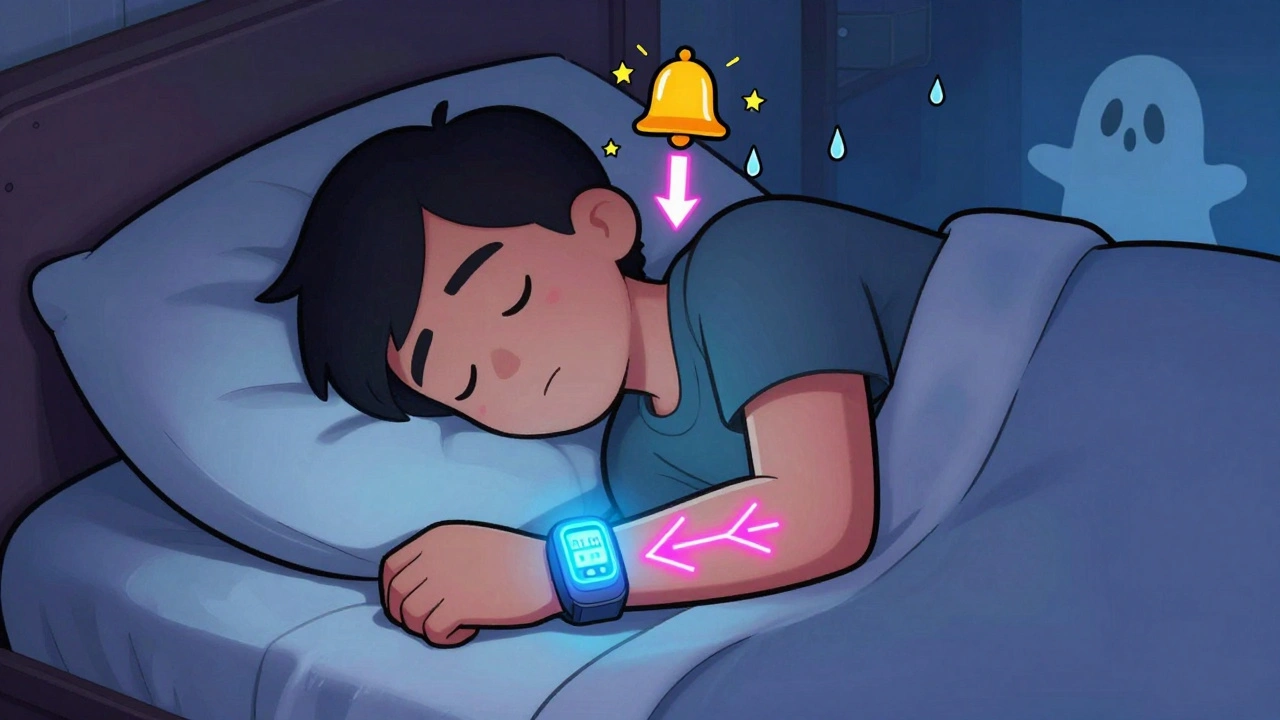
Imagine knowing your blood sugar is dropping while you’re asleep - before you even feel dizzy or sweaty. That’s not science fiction. It’s what continuous glucose monitors do every day for millions of people with diabetes. Unlike fingerstick tests that give you a single snapshot, CGMs track your glucose levels 24/7, showing you not just the number, but the direction it’s moving and how fast. This isn’t just convenient - it’s life-saving.
How CGMs Actually Work
A CGM isn’t a magic box. It’s a small, wearable device with three parts: a tiny sensor inserted just under your skin, a transmitter that sends data wirelessly, and an app or receiver that shows you the numbers. The sensor, usually placed on your belly or arm, has a thin filament that reacts with glucose in your interstitial fluid - the fluid surrounding your cells. This reaction creates a tiny electric signal, which the device turns into a glucose reading.
Modern CGMs like the Dexcom G7 and FreeStyle Libre 3 update every 1 to 5 minutes. That’s up to 288 readings a day, compared to the 4 to 8 you’d get from fingersticks. The data doesn’t just sit there - it shows you trend arrows. Up, down, flat. These arrows tell you if your glucose is rising fast after a meal or dropping slowly overnight. That’s the real power: seeing patterns, not just points.
But here’s the catch: CGMs don’t measure blood glucose directly. They measure glucose in the fluid between your cells. That means there’s a delay - usually 5 to 20 minutes - between what’s happening in your blood and what the CGM shows. If you’re sprinting, eating candy, or taking insulin, your blood sugar can change faster than the CGM can catch up. That’s why you still need a fingerstick test if you feel symptoms but the CGM says you’re fine.
Who Actually Benefits from a CGM?
If you have type 1 diabetes, a CGM isn’t optional anymore - it’s standard care. The American Diabetes Association says everyone with type 1 should use one. Why? Because they cut severe low-blood-sugar events by 31%, according to a major 2022 study of 32 clinical trials. For people who don’t feel when their blood sugar drops (hypoglycemia unawareness), this is huge. One Reddit user said his Libre 3 alarm woke him up at 3 a.m. when his glucose hit 32 mg/dL. He said, “I’d have been dead without it.”
People with type 2 diabetes who take insulin multiple times a day also benefit. If you’re on basal-bolus therapy, a CGM helps you fine-tune your doses. Studies show it lowers A1C by 0.5% to 0.8% - enough to reduce long-term risks like nerve damage, kidney disease, and vision loss.
Even people not on insulin are starting to use CGMs. Athletes, biohackers, and those with prediabetes are tracking glucose to understand how food affects them. A 2023 study from Zoe Health found a 18% annual increase in non-diabetic users. But for them, it’s about optimization, not survival.
Real-Time vs. Flash: What’s the Difference?
Not all CGMs are the same. There are two main types: real-time and flash.
Real-time CGMs - like Dexcom G7 and Eversense E3 - send data automatically to your phone. They beep when your glucose is too high or too low. Some can even pause your insulin pump if you’re at risk of a low. These are best for people who need alerts while driving, sleeping, or exercising.
Flash monitors - like FreeStyle Libre 3 - don’t send data unless you scan them with your phone. No automatic alarms. But they’re cheaper and don’t need fingerstick confirmations. If you’re disciplined and check your glucose regularly, this works great. Many users say they feel more in control because they choose when to look.
Here’s how they stack up:
| Device | Update Frequency | Sensor Life | Calibration | Cost (Monthly, No Insurance) | Alerts |
|---|---|---|---|---|---|
| Dexcom G7 | Every 5 minutes | 10 days | Twice daily | $399 | Yes, customizable |
| FreeStyle Libre 3 | Every minute | 14 days | None (factory-calibrated) | $110 | No (requires scanning) |
| Eversense E3 | Every 5 minutes | 180 days | None | $1,200 (device + sensors) | Yes, vibration alerts |
FreeStyle Libre 3 is the most affordable and easiest to use. Dexcom G7 is the most accurate and has the best alert system. Eversense E3 is the longest-lasting but requires a minor surgical procedure to insert and remove.
Why People Love - and Hate - CGMs
Most users report high satisfaction. On Amazon, CGMs average 4.2 out of 5 stars. The top reasons? Nighttime alerts and trend arrows. One user said, “I used to wake up exhausted from low blood sugar. Now I sleep through the night.”
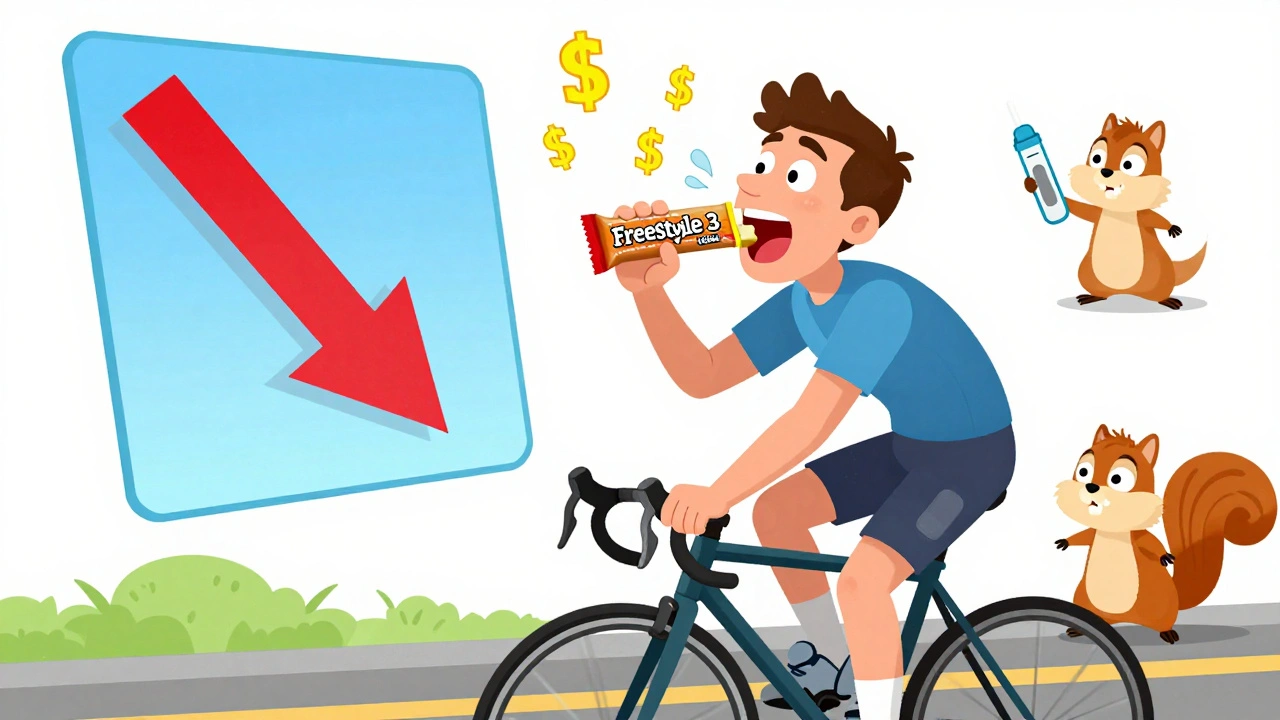
But there are downsides. Skin irritation is the #1 complaint, especially with Dexcom’s adhesive. Many users swear by Skin Tac wipes or Opsite Flexifix tape to make sensors stick better. Another issue? False alarms. One cyclist said his Dexcom spiked a low reading while he was pedaling hard - he ate carbs unnecessarily and ended up with a high sugar spike.
Cost is a big barrier. In the U.S., without insurance, you’re looking at $110 to $400 a month. Medicare now covers Dexcom and Medtronic CGMs for insulin users, but not flash monitors unless you’re on multiple daily injections. In the UK, the NHS gives FreeStyle Libre 2 to half a million people for free. In Australia, Medicare subsidizes CGMs for eligible type 1 patients, but out-of-pocket costs still run $50-$100 per month.
Then there’s information overload. Some older adults or people with anxiety find constant numbers overwhelming. Dr. John Buse from UNC warns that for some, “more data doesn’t mean better control - it means more stress.”
What’s Next for CGM Technology?
The field is moving fast. Dexcom G7, released in 2022, cut warm-up time from 2 hours to just 30 minutes. FreeStyle Libre 3 Plus, launched in 2023, now tracks insulin doses too. In 2024, Tandem’s Control-IQ 3.0 will predict lows 30 minutes before they happen and adjust insulin automatically.
Non-invasive tech is coming. Glucowise, a device that measures glucose through the skin using radio waves, completed Phase 2 trials in late 2023. Apple is rumored to be developing a glucose-sensing smartwatch - if it happens, it could change everything.
Future sensors might measure more than glucose. Sano Health is testing patches that track ketones and lactate - giving you a full metabolic picture. This could help not just diabetics, but people managing weight, fitness, or metabolic health.
Getting Started with a CGM
If you’re considering a CGM, talk to your doctor first. Most require a prescription. Your provider will help you pick the right one based on your needs, budget, and insurance.
Once you have it:
- Wash your skin with soap and water before inserting the sensor. Let it dry completely.
- Use adhesive patches or Skin Tac if the sensor keeps peeling off.
- Wait for the warm-up period (30 minutes to 2 hours, depending on the device).
- Scan or check your readings regularly - especially after meals, exercise, or insulin.
- Learn the trend arrows: up-right = rising fast, down-left = dropping fast.
- Always confirm low readings with a fingerstick if you feel symptoms.
- Use apps like LibreView or Dexcom Clarity to review weekly trends.
Most people get comfortable within 3 to 5 days. The biggest mistake? Ignoring the trend arrows. The number matters, but the direction matters more. A glucose of 140 mg/dL is fine if it’s flat. It’s dangerous if it’s dropping 5 points per minute.
Final Thoughts
Continuous glucose monitors have transformed diabetes care. They’re not perfect - they lag, they cost money, they can irritate your skin. But for people who need to avoid dangerous lows, understand food impacts, or manage insulin better, they’re the closest thing to a superpower.
The goal isn’t to chase perfect numbers. It’s to reduce fear, prevent emergencies, and live without constantly wondering if your sugar is about to crash. That’s what CGMs give you: peace of mind, one reading at a time.
Can CGMs replace fingerstick tests completely?
No - not yet. While newer CGMs like FreeStyle Libre 3 are approved for non-adjunctive use (meaning you don’t need fingersticks to confirm readings), you should still use a fingerstick if you feel symptoms like shakiness or dizziness but the CGM says your glucose is normal. This is because CGMs measure glucose in interstitial fluid, which lags behind blood glucose during rapid changes like after eating or exercising.
Are CGMs covered by insurance?
Coverage depends on your country and insurance plan. In the U.S., Medicare covers Dexcom and Medtronic CGMs for people on insulin. Private insurers often cover them too, especially for type 1 diabetes. FreeStyle Libre 3 is now covered by many plans, but you may need to prove medical necessity. In Australia, Medicare subsidizes CGMs for eligible type 1 patients. In the UK, the NHS provides FreeStyle Libre 2 at no cost to qualifying patients. Always check with your provider about specific device coverage.
Do CGMs work during exercise or swimming?
Yes, most CGMs are water-resistant and designed for daily life, including swimming, showering, and workouts. Dexcom G7 and FreeStyle Libre 3 are rated for up to 1 meter of water for 60 minutes. However, intense sweating or friction from tight clothing can loosen the sensor. Use adhesive patches or tape for extra hold. Keep in mind: during intense exercise, glucose levels can change quickly, and the 5-20 minute lag may cause temporary inaccuracies.
Can non-diabetics use CGMs?
Yes, and their use is growing. People with prediabetes, metabolic syndrome, or those focused on fitness and nutrition are using CGMs to see how food affects their glucose. Studies show that tracking glucose can help identify hidden spikes from foods like rice or fruit. However, insurance typically doesn’t cover CGMs for non-diabetics, so they’re paid out-of-pocket. They’re not medical devices for this group - more like wellness tools.
How accurate are modern CGMs?
Modern CGMs are highly accurate. The FreeStyle Libre 3 has a mean absolute relative difference (MARD) of 7.9%, meaning its readings are within 7.9% of lab blood glucose results on average. Dexcom G7 is at 9.1%. For comparison, traditional glucometers are around 10-15% accurate. These devices are considered clinically reliable, but they’re not perfect. Always verify with a fingerstick if you feel symptoms that don’t match your CGM reading.
What should I do if my CGM keeps giving me false alarms?
First, check if the sensor is properly inserted and the transmitter is secure. Skin irritation or poor adhesion can cause erratic readings. If the sensor is new, wait 24-48 hours - initial calibration can be unstable. If alarms persist, compare the CGM reading with a fingerstick. If they match, your alarms may be set too sensitively. Adjust your high/low thresholds in the app. If alarms are still wrong, the sensor may be faulty. Replace it. You can also turn off non-critical alerts (like post-meal highs) to reduce noise.
Can CGMs help me lower my A1C?
Yes - and the evidence is strong. Multiple studies show that using a CGM lowers A1C by 0.5% to 0.8% on average for people with type 1 and type 2 diabetes on insulin. This isn’t just a small improvement - it’s enough to reduce the risk of complications like kidney disease, nerve damage, and vision loss. The reason? CGMs help you catch highs and lows you’d otherwise miss, letting you adjust food, activity, or insulin in real time.
How long does it take to learn how to use a CGM?
Most people feel comfortable within 3 to 5 days. The biggest learning curve is understanding trend arrows and the 5-20 minute lag between blood and interstitial glucose. Many new users initially panic over small changes or false alarms. But after a few days of reviewing data, they start to recognize patterns - like how pasta spikes glucose slower than white bread, or how morning insulin needs are different than evening. Manufacturer apps like LibreView and Dexcom Clarity offer tutorials and weekly reports to help you learn faster.


Reviews
After using a CGM for two years, I can say with absolute certainty that it saved my life. I used to wake up in a cold sweat, heart racing, confused, and barely conscious. Now? I sleep. Not because I’m lucky, but because the damn thing beeps at 3 a.m. when my glucose hits 31. No more hospital trips. No more panic. Just quiet, steady control. This isn’t luxury. It’s basic human dignity.
For anyone considering a CGM: DO IT. Even if you think you’re fine. I’m type 2, on metformin, never thought I needed one. Then I saw how my ‘healthy’ oatmeal spiked me to 190. My avocado toast? Barely a blip. I lost 12 pounds just by adjusting meals based on real data. This isn’t about diabetes-it’s about understanding your body. You owe it to yourself to try.
CGMs are expensive and unnecessary for most people. Fingersticks work fine. If you can’t manage your blood sugar with four tests a day, maybe you need to change your diet, not buy a gadget.
Let’s be crystal clear: CGMs are not a ‘nice-to-have’-they are a medical necessity for anyone on insulin, period. The data is irrefutable. Studies show a 31% reduction in severe hypoglycemia. That’s not a statistic-that’s lives. And yes, the cost is outrageous, but if your insurance denies coverage, fight them. Call your rep. Write your congressperson. This isn’t optional. People are dying because they can’t afford to monitor their own blood sugar. That’s not healthcare. That’s cruelty wrapped in bureaucracy.
I got one last year. I check it maybe twice a day. Mostly just to see if I’m still alive. The alerts are annoying. I don’t care about trend arrows. I just want to know if I’m about to pass out. Still, it’s better than nothing. I keep it on my arm and forget about it. Until it peels off. Then I hate it again.
I’m a mom of a 10-year-old with type 1. I used to sleep with one ear open, listening for any sign of distress. Now? I get a text on my phone while I’m folding laundry. I can breathe. I can actually relax. My kid doesn’t feel like a walking lab experiment anymore. He just feels like a kid. And that? That’s everything. Thank you to every engineer, doctor, and advocate who made this possible. We’re not just managing a disease-we’re reclaiming normalcy.
Let’s be honest-CGMs are just another wellness-industrial complex scam. You’re not a metabolic robot. Glucose isn’t a leaderboard. People who track their interstitial fluid like it’s a Fitbit step count are just performing biohacker theater. Real health is about intuition, not data points. And don’t get me started on the $400/month price gouging. If you’re spending that much on a sensor, you probably need a therapist more than a glucose monitor.
As someone who works in public health, I appreciate the accessibility of devices like the FreeStyle Libre 3. The fact that it requires no calibration and is now covered by many U.S. insurers is a major step forward. However, we must not overlook the systemic inequities that still prevent marginalized communities from accessing these tools. Technology alone cannot solve healthcare disparities. Policy, education, and affordability must move in tandem.
use free style libre 3 since 2023. best thing ever. no calibaration. 14 day sensor. i scan 5-6 times a day. no alerts but i dont need them. i just look when i feel weird. my a1c dropped from 7.8 to 6.2. also my wife started using it and she lost 8kg just by avoiding bread and rice. its not magic but its real. also dont forget to use skin tac its a game changer
There’s a quiet revolution happening here. We’re moving from reactive medicine to proactive health. CGMs don’t just prevent emergencies-they teach us about our bodies in ways we never understood before. For non-diabetics, it’s not about disease. It’s about awareness. And awareness is the first step toward true autonomy over our health. This isn’t just a device. It’s a new kind of literacy.
Oh, so now we’re all metabolic engineers? You track your glucose like it’s your ex’s Instagram activity. ‘Oh no, my post-meal spike is 180-quick, eat a protein bar!’ Meanwhile, the rest of us are just eating food and living. CGMs are cool, sure. But let’s not pretend this is some kind of enlightenment. You’re not a cyborg. You’re just someone who’s really good at worrying about numbers.
I used to think CGMs were for diabetics only. Then I saw my father, 72, get one after his prediabetes diagnosis. He didn’t want to. Said it was too much. But after two weeks? He started cooking differently. He stopped drinking soda. He walks after dinner. He didn’t change because he was scared. He changed because he finally saw the truth. Sometimes, the most powerful thing isn’t a cure. It’s a mirror.
The real magic of CGMs isn’t in the sensor or the app-it’s in the narrative shift. We’re no longer just ‘diabetics’ or ‘prediabetics.’ We’re data-driven agents of our own health. We’re learning how food, sleep, stress, and even weather affect our bodies. And for the first time, we’re not guessing. We’re knowing. That’s not just medical advancement-it’s a philosophical evolution. We’re learning to listen to our bodies, not just obey them. And that changes everything.