
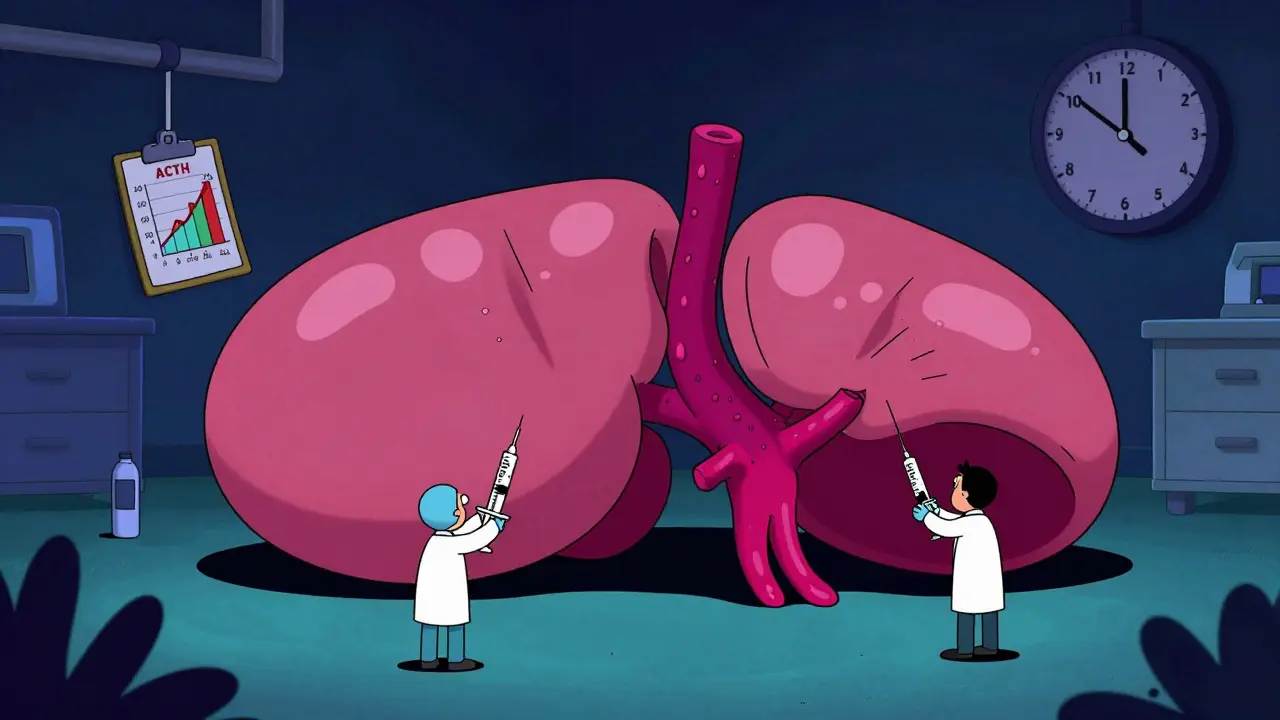
ACTH Test Result Calculator
Adrenal Recovery Calculator
Enter your ACTH stimulation test results to determine if your adrenal recovery is sufficient for steroid tapering.
When you’ve been on steroids like prednisone for months or years, stopping them isn’t as simple as just skipping a pill. Your body’s natural hormone system - the hypothalamic-pituitary-adrenal (HPA) axis - has been turned off. If you quit cold turkey, your adrenal glands won’t know how to wake up. That’s when life-threatening adrenal crisis can happen: extreme fatigue, vomiting, low blood pressure, even shock. The solution isn’t guesswork. It’s a structured taper, guided by ACTH stimulation testing.
Why Your Adrenals Go Silent on Long-Term Steroids
Your body naturally makes cortisol, the stress hormone that keeps you going through illness, injury, or even a bad day. When you take synthetic steroids - whether for asthma, lupus, rheumatoid arthritis, or Duchenne muscular dystrophy - your brain hears the extra cortisol and says, “No need to make more.” Over time, your adrenal glands shrink. They forget how to produce cortisol on their own. This isn’t weakness. It’s biology. The longer you’re on steroids, the deeper the suppression. If you’ve been on high doses for more than 12 months, recovery can take a year or more. That’s why rushing the taper is dangerous. Stopping too fast doesn’t just cause fatigue or mood swings - it can land you in the ER.What ACTH Stimulation Testing Actually Measures
ACTH stimulation testing is the gold standard to check if your adrenals are ready to work again. Here’s how it works: you get a shot of synthetic ACTH (called cosyntropin), which tells your adrenal glands, “Wake up and make cortisol.” Then, your blood is drawn at 0, 30, and 60 minutes to measure cortisol levels. The results tell your doctor one thing: can your adrenals respond? - Normal recovery: Peak cortisol ≥18-20 mcg/dL (500-550 nmol/L). Your body is ready to stop steroids. - Insufficient response: Peak cortisol <14 mcg/dL (386 nmol/L). Your adrenals are still shut down. You need to keep taking replacement steroids. This test isn’t optional for people on long-term therapy. A 2024 study from the Mayo Clinic showed that using ACTH testing reduced adrenal crisis rates from 8.5% to just 1.2% during steroid withdrawal. That’s an 86% drop.When to Test - Not Just Anytime
Testing too early gives false negatives. Your adrenals need time to start waking up before they can respond. The 2024 joint guideline from the Endocrine Society and European Society of Endocrinology says clearly: test only after you’ve reached a physiologic replacement dose - about 4-6 mg of prednisone per day. That’s not the same as your starting dose. If you were on 60 mg a day, you’re not ready for testing at 30 mg. You need to get down to the body’s natural level first. Only then does the test mean anything. For people on steroids for 3-12 months, a common taper is to drop 2.5-5 mg every 1-2 weeks until you hit 10-15 mg/day, then slow down to 20-25% weekly reductions. For those on therapy longer than a year, experts say: wait one month of tapering for every month you were on steroids. That’s not a suggestion - it’s a rule backed by clinical data.
Two Major Protocols - And the Key Differences
There’s no single official plan, but two frameworks dominate clinical practice:- The Endocrine Society 2024 Guideline: Recommends ACTH testing only for patients with symptoms of adrenal insufficiency (like dizziness, nausea, low blood pressure) or those at high risk. It’s conservative, aiming to avoid unnecessary testing.
- The PJ Nicholoff Protocol: Used widely in neuromuscular diseases like Duchenne muscular dystrophy. It calls for routine ACTH testing at every major taper milestone, regardless of symptoms. It’s more aggressive - and more protective.
The Real-World Problem: Access and Complexity
Here’s the catch: ACTH testing isn’t easy to get. It requires a lab that can draw blood at 30 and 60 minutes after the shot. Many rural clinics don’t have the setup. A 2023 survey by the Adrenal Insufficiency Coalition found 61% of patients waited over four weeks for testing. Some had to go to the ER because they couldn’t get tested in time. Primary care doctors are often left in the dark. A 2022 study in Endocrine Practice found 68% of GPs felt unprepared to manage steroid tapers with ACTH testing. They don’t have the training. They don’t have the time. They don’t have the specialist support. Patients feel it too. A survey by Adrenal Insufficiency United found 78% of patients experienced high anxiety during tapering. Forty-two percent had severe withdrawal symptoms - headaches, joint pain, insomnia - even when following the plan. These aren’t “just in their head.” They’re signs the body is struggling to reboot its hormone system.
What You Should Do - Practical Steps
If you’re on long-term steroids, here’s what you need to do:- Don’t stop or change your dose without your doctor’s direction.
- Ask your doctor if you’re on a structured taper plan based on the 2024 Endocrine Society or PJ Nicholoff guidelines.
- Request ACTH stimulation testing once you reach 4-6 mg of prednisone daily - don’t wait for symptoms.
- Get a steroid alert card. Carry it at all times. It tells emergency staff you need extra steroids if you’re sick or hurt.
- Know your stress dose rules. If you get a fever, have surgery, or get into an accident, you need more steroids - not less.



Reviews
For anyone coming off long-term steroids, this is the kind of info you wish you had six months ago. I was on prednisone for 18 months after a lupus flare. My doctor just said 'taper slow'-no testing, no real guidance. I ended up in the ER with low BP and dizziness. ACTH testing wasn't even mentioned until I pushed for it. Don't let your care be this hit-or-miss.
Man, I wish more docs knew this. I’ve seen too many patients get dropped off a cliff after a year on steroids. It’s not laziness-it’s ignorance. ACTH testing should be standard, not optional. You wouldn’t pull the plug on a ventilator without checking oxygen levels. Why treat your adrenals any differently?
My mom did a 2-year taper after a transplant and they never tested her. She was exhausted for over a year. Then a new endo ordered the ACTH test and it was clear her adrenals were still asleep. Took another 9 months but now she’s back to hiking. This isn’t just medical-it’s life-changing. Stop guessing. Test.
Americans waste so much money on tests. Just taper slower. Why pay for cortisol shots when you can just wait?
While the clinical rationale for ACTH stimulation testing is well-established, it is important to note that individual variability in adrenal recovery can be influenced by comorbidities, genetic factors, and prior duration of glucocorticoid exposure. Standardized protocols remain essential, but personalized monitoring should be emphasized in clinical practice.
Stop. This. Nonsense. If you’re on steroids for over a year, you’re already weak. You shouldn’t have gotten there in the first place. Just stop. Build up your willpower. No tests. No excuses. People in my old neighborhood didn’t have ACTH tests-they just got up and worked. You think your body is fragile? It’s not. You are.
This is SO important 😭 I was on prednisone for 3 years after a kidney transplant. My doctor said 'just cut back a little every month.' I almost died. Then I found a specialist who did the ACTH test-and holy cow, my cortisol was at 2.3. They adjusted everything. I’m finally sleeping again. Please, if you’re tapering-ask for this test. It saved me.
Adrenal suppression? How quaint. In the UK, we just taper based on clinical judgment. Testing is overkill. You’re treating a physiological response like it’s a software bug.
my bro did this after duchenne meds-tapered too fast, ended up in hospital. doc said he needed the cosyntropin test. turns out his cortisol was below 5. they gave him a slow ramp-up and now he’s good. it’s not magic, it’s science. if u got long-term steroids, ask for the test. no cap.
There’s something deeply human about the way our bodies remember how to heal-even when we’ve silenced them for years. It’s not just physiology. It’s resilience. The ACTH test doesn’t just measure cortisol. It measures whether the body still believes it’s allowed to be strong again. That’s the real question we’re asking.
you think this is new? i did this 15 years ago and everyone laughed at me for asking for the test. now everyone does it. i told them it was basic. you guys are slow. i knew this before you were out of med school
Just to clarify-cosyntropin stimulation tests measure adrenal reserve, not HPA axis integrity. The peak cortisol at 30 min is the key metric. 18 mcg/dL is the widely accepted threshold, but some centers use 20. Also, baseline cortisol before the test matters-low baseline + low peak = primary adrenal failure, not just suppression. If you're tapering, get both values. #AdrenalHealth #EndoTips