
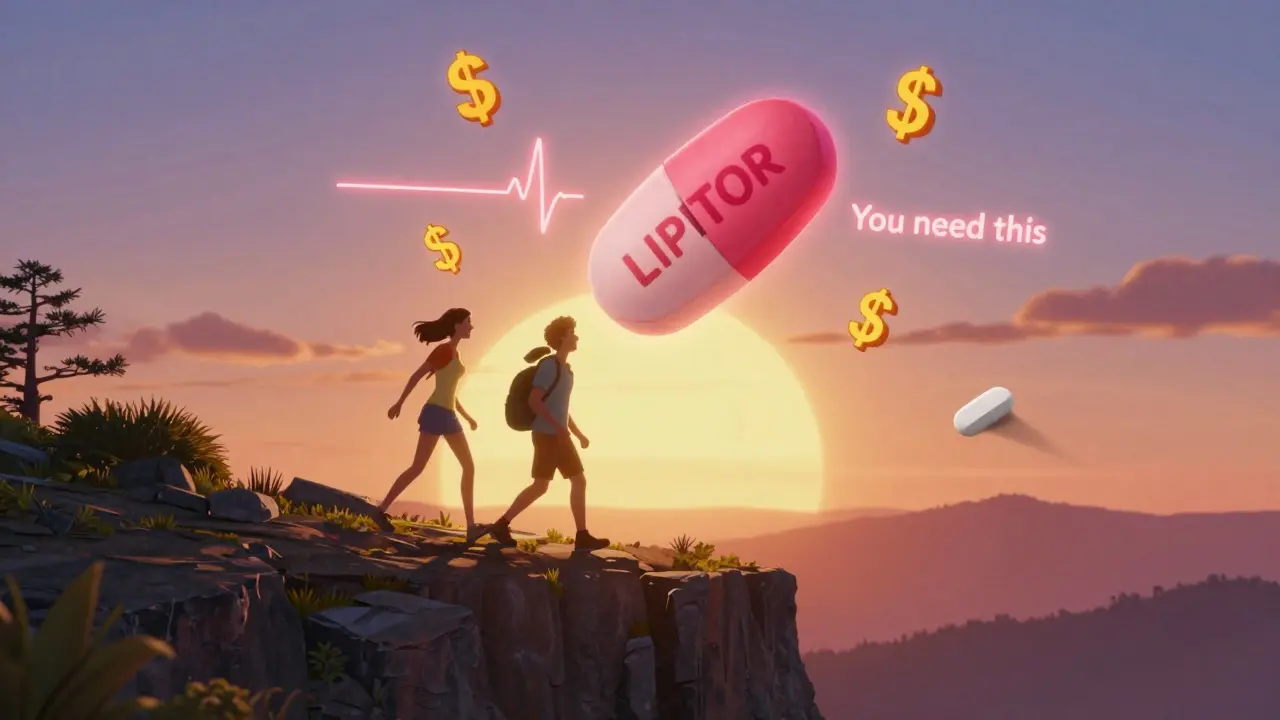
When you see a TV ad for a drug that treats high cholesterol, it’s hard not to notice. The scene shows a happy couple hiking at sunrise, laughing as they watch the waves. The voiceover says, "Don’t let cholesterol hold you back-talk to your doctor about Lipitor." You walk away thinking, "That’s the one I need." But what you didn’t hear? That a generic version of that same drug costs 80% less and works just as well.
This isn’t an accident. It’s by design. In the United States and New Zealand, pharmaceutical companies are allowed to advertise prescription drugs directly to patients. No other country permits this. And the numbers tell a story: in 2020, drug companies spent over $6.58 billion on these ads. That’s more than ten times what they spent in 1996. For every dollar spent, they got back over $4 in sales. That’s a return most businesses would kill for.
Ads Don’t Just Sell Drugs-They Change What Patients Ask For
Research from the Wharton School found that when advertising for a branded drug like Lipitor increases by 10%, prescriptions for that drug class go up by about 5%. But here’s the twist: most of those new prescriptions aren’t for the branded drug shown in the ad. They’re for the generic version in the same class. Patients hear "Lipitor," ask for it, and their doctor says, "We can give you the generic-it’s the same thing, cheaper." And so, the generic gets prescribed.
That’s called the "spillover effect." Advertising for branded drugs lifts the whole category. But here’s the problem: patients still walk away thinking the branded drug is better. Even when they get the generic, they don’t feel like they got the "real" treatment. A 2005 study showed that when patients asked for a specific brand, doctors filled those requests 80% of the time-even if the doctor thought the drug wasn’t necessary. That’s not just about prescribing habits. It’s about perception. Ads make patients believe they need the fancy version.
Why Generics Get Left Behind in the Ad Game
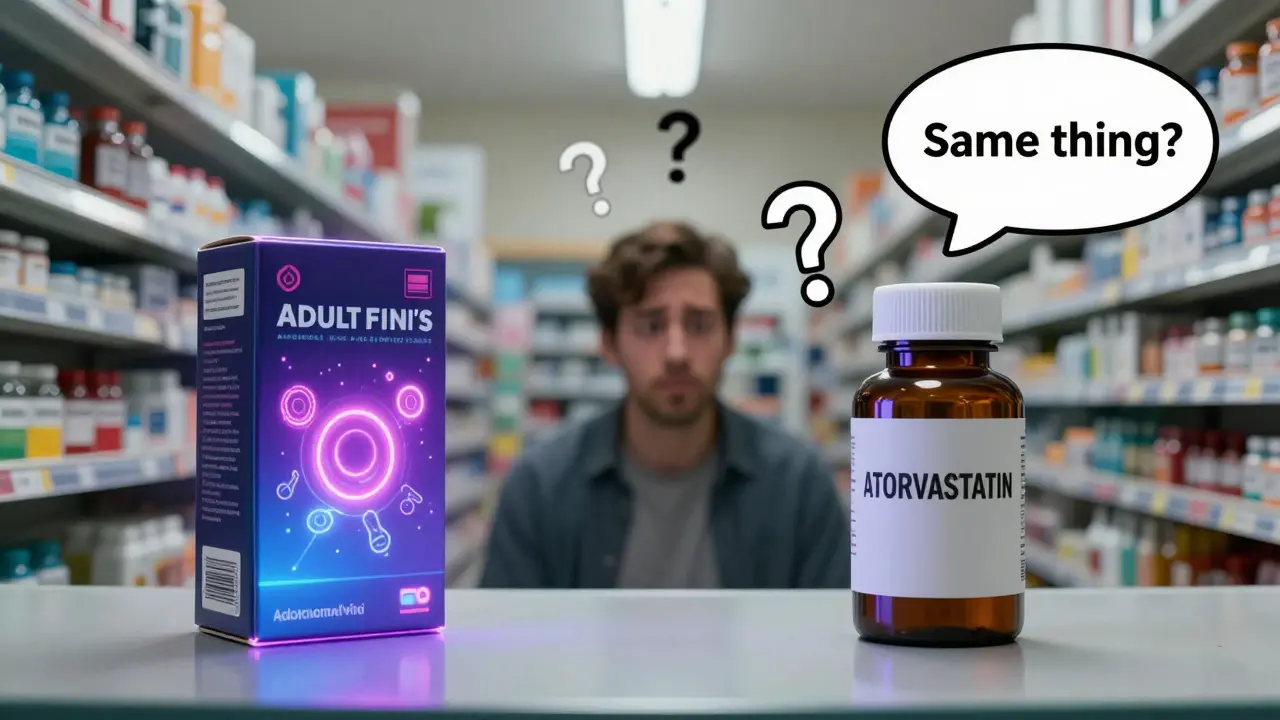
Generic drug makers almost never run DTC ads. Why? Because they can’t. The FDA doesn’t allow them to advertise generics unless they’re promoting a specific brand-name version first. So while Pfizer spends millions telling you about Lipitor, the generic version-atorvastatin-stays silent. No sunrises. No hiking couples. No emotional music. Just a plain pill in a bottle.
That creates a massive imbalance. Patients see ads for branded drugs and assume they’re more effective, safer, or more advanced. But the FDA says generics must have the same active ingredient, strength, dosage form, and route of administration as the brand. They’re bioequivalent. That means they work the same way in your body. Yet the ads don’t say that. They show happy people living their best lives. They don’t show side effects, costs, or alternatives.
What You’re Not Hearing in Those Ads
Drug ads are carefully crafted to highlight benefits and bury risks. A 2018 FDA study found that even after seeing an ad four times, people still remembered less than half of the risk information. Benefits? Easier to recall. Risks? Harder to remember. And the more times you see the ad, the more you associate the drug with positive emotions-not science.
One study analyzed 230 drug ads. They counted how long scenes showed smiling people outdoors, how much motion was on screen, how many young, fit actors were featured. The ads for branded drugs had more movement, brighter lighting, and more emotional storytelling than ads for any other kind of medication. The generic? No ad at all. So your brain learns: "This drug = joy. That pill = boring."
That’s not just misleading. It’s manipulative. It makes people think the branded drug is superior-even when it’s not. And it makes them less likely to accept a generic, even when it’s the better choice.
The Real Cost: More Money, Less Health
When patients ask for a branded drug, they don’t just get a more expensive pill. They get a longer, costlier treatment cycle. Research shows that people who start a drug because of an ad are actually less likely to stick with it. Why? Because they didn’t need it in the first place. The ad created a desire, not a medical need.
One study found that a 10% increase in advertising led to only a 1-2% increase in adherence among people already on the drug. Meanwhile, new users who started because of the ad had lower adherence overall. That means more prescriptions, more spending, and little to no improvement in health outcomes.
And it’s not just about money. A national survey of physicians found that 69% of the time, when patients requested a drug because of an ad, the doctor thought it was inappropriate. That’s nearly seven in ten cases where the patient’s request overruled medical judgment. That’s not empowerment. That’s pressure.
Why This Matters in Australia (and Everywhere Else)
Australia doesn’t allow direct-to-consumer advertising for prescription drugs. So here, you don’t see ads for statins or antidepressants on TV. That means patients don’t walk into clinics demanding specific brands. They ask about their condition. Their doctor explains options-including generics. The decision is based on clinical need, not emotional appeal.
That’s why Australia’s generic drug use is higher than the U.S.’s. And why prescription costs are lower. It’s not because Australians are smarter. It’s because they’re not being sold a story.
The U.S. system isn’t broken because of bad doctors or greedy patients. It’s broken because advertising rewires how people think about medicine. It turns pills into brands. It turns science into storytelling. And it makes people feel like they’re missing out if they don’t take the "premium" version-even when the generic does the same job.
What Can You Do?
If you’re prescribed a generic drug, don’t assume it’s inferior. Ask your pharmacist: "Is this the same as the brand?" The answer is almost always yes.
If you see a drug ad and think, "I need this," pause. Ask yourself: "Do I have a diagnosed condition that requires this?" Or am I just reacting to a sunset and some happy music?"
Talk to your doctor about alternatives. Ask: "Is there a generic?" "What are the risks?" "Is this really necessary?" Most doctors appreciate the question. They’re not just selling pills-they’re trying to help you stay healthy.
And if you’re in the U.S., remember: you’re not alone in feeling confused. Millions of people are. But awareness is the first step. Knowing how ads shape your choices gives you power-power to ask better questions, to demand better information, and to choose based on science, not salesmanship.


Reviews
I never realized how much those ads mess with your head. I asked my doctor for Lipitor last year because of that hiking couple ad, and she just handed me the generic. I felt like I got cheated until I read up on it. Turns out, they're literally the same chemical. Weird how your brain tricks you into thinking fancy packaging = better medicine.
Let’s be clear: the FDA’s regulatory framework for direct-to-consumer advertising is a grotesque market distortion-essentially, pharmaceutical capitalism operating in a regulatory vacuum. The spillover effect you mention? It’s not an accident; it’s a feature. Branded pharma leverages affective capitalism to commodify health anxiety. Meanwhile, generics, despite bioequivalence, are rendered invisible by design. This isn’t about efficacy-it’s about semiotic hegemony.
USA is a joke. You people let corporations sell you fear and then charge you triple for the same pill. In India, we don’t have these ads. We know generics work. We’ve seen it. Our doctors prescribe them. Our families live longer. You’re not sick-you’re being exploited. Stop watching TV and start reading science.
This is such an important topic. I’ve had patients come in asking for brand-name drugs because of ads, and honestly? It’s heartbreaking. They’re not dumb-they’ve just been sold a story. The real tragedy is that they don’t know they’re being manipulated. We need more public education on this. Generics aren’t second-rate-they’re science that got left out of the marketing budget.
So let me get this straight… you pay $200 for a pill with a sunset in the ad, and $40 for the exact same pill with a plain label? And you feel like you’re getting the "premium experience"? Honey. That’s not healthcare. That’s a theme park ride with a stethoscope.
Admit it: you’re just mad because you can’t afford the branded version. The fact that generics work doesn’t mean they’re equal. There’s bioavailability variance. There’s inactive ingredients. There’s manufacturing standards. You think your $40 pill is identical? Newsflash: it’s not. And you’re risking your health for a few bucks.
The American healthcare system is a carnival of exploitation, where every human vulnerability is monetized. Direct-to-consumer advertising is not marketing-it’s psychological warfare. You don’t need a doctor when you have a 30-second commercial that makes you feel like you’re dying unless you buy the product with the pretty music. Generics are not inferior-they’re the victims of a system designed to profit from ignorance. And you, the consumer, are the primary target.
Just wanted to say-this post made me cry. Not because I’m emotional, but because I realized I’ve been doing this for years. I took brand-name meds because I thought they were "better." Then I switched to generics after a pharmacy error. I didn’t notice any difference. My blood pressure? Same. My energy? Same. My wallet? So much happier. 🙏💊
Okay, but… can we just talk about how weird it is that the FDA allows this? Like, they regulate food labels, cigarette warnings, even toy safety… but let drug companies run emotional propaganda that makes people think a sunset equals better health? That’s not a loophole-that’s a system failure. And it’s not just about money. It’s about trust in medicine.
So… Australia doesn’t have ads? So what? They’re probably just jealous. You think we’re dumb because we see ads? Nah. We’re just more… invested. In our health. In our choices. In our right to be told what’s out there. You want to live in a world where doctors decide everything? Cool. I’ll take my sunset and my statin, thanks.