
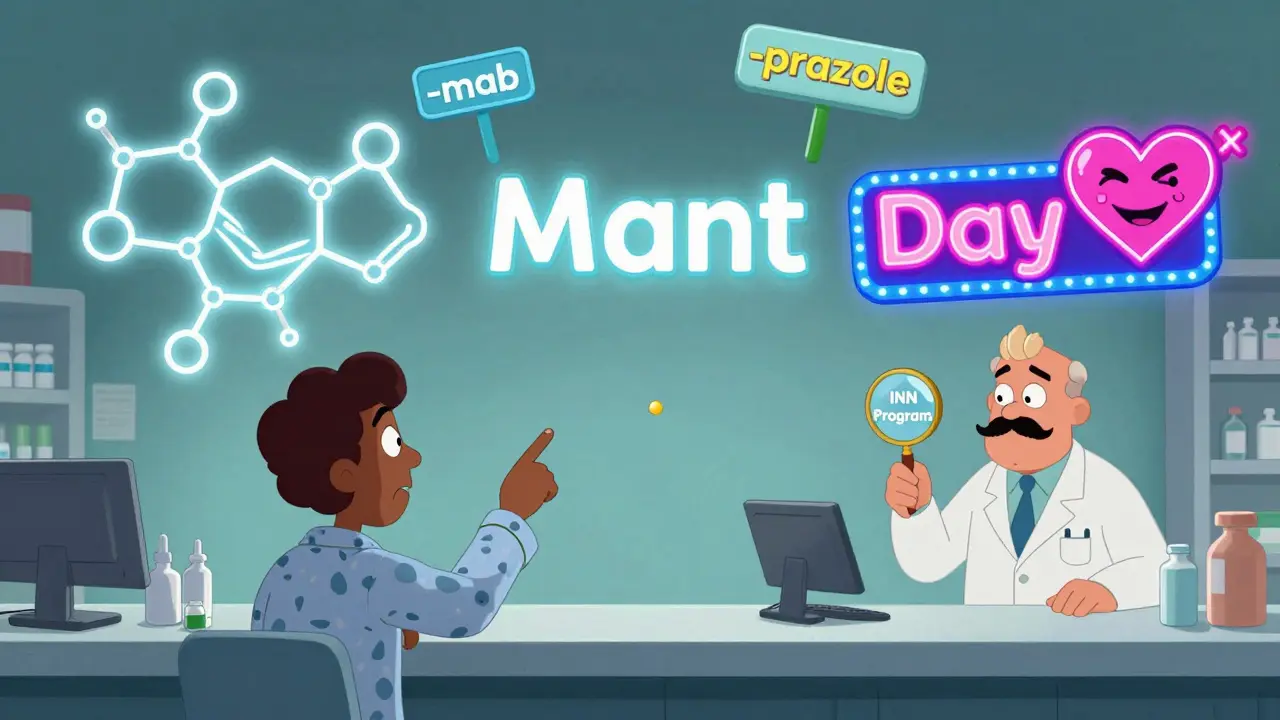
Have you ever looked at a prescription and wondered why your medicine has three different names? One looks like a science experiment, another is short and familiar, and the third sounds like a brand of shampoo? That’s not confusion-it’s design. Drug nomenclature exists to keep you safe. Every pill, injection, or inhaler you take has a chemical name, a generic name, and a brand name. Each one serves a different purpose, and understanding them can help you avoid mistakes, ask better questions, and feel more in control of your health.
What’s in a name? The three layers of drug identification
Every drug has a triple identity. Think of it like a person: your legal name, your nickname, and your professional title. The chemical name is your full legal name-it’s precise, technical, and almost impossible to say out loud. The generic name is your nickname-simple, standardized, and used by doctors and pharmacists. The brand name is your professional title-it’s catchy, owned by a company, and often seen in ads.
Let’s take a real example: the blood pressure drug you might be prescribed. Its chemical name is 1-(isopropylamino)-3-(1-naphthyloxy)propan-2-ol. That’s not something you’ll ever write on a sticky note. But its generic name? Propranolol. And the brand name? Inderal. You’ll see the generic name on your pharmacy receipt. You’ll hear the brand name in a TV commercial. But only a chemist will say the full chemical name.
Chemical names: The science behind the molecule
Chemical names follow strict rules set by the International Union of Pure and Applied Chemistry (IUPAC). They describe exactly how atoms are arranged in the molecule-every bond, every ring, every side chain. That’s why they’re so long. Propranolol’s chemical name? It tells you there’s a propane backbone, an isopropyl group attached to nitrogen, and a naphthyl group stuck to an oxygen. It’s like a blueprint.
But here’s the catch: these names aren’t meant for humans. They’re for scientists. A single chemical name can be over 50 characters long. Try saying that while rushing to work. That’s why no one uses them in clinics, pharmacies, or hospitals. They’re too slow, too complex, and too easy to misread. Even pharmacists don’t memorize them. They rely on the generic name instead.
Still, chemical names matter. They’re the foundation. If two drugs have the same chemical name, they’re the exact same molecule. That’s why generic drugs work the same as brand ones-they contain the identical active ingredient, spelled out in chemical terms. No tricks. No shortcuts.
Generic names: The safety system you don’t know you’re using
Generic names are where safety meets simplicity. They’re created by international teams-first by the World Health Organization (WHO) through its International Nonproprietary Names (INN) program, and in the U.S., by the United States Adopted Names (USAN) Council. These groups don’t pick names randomly. They follow patterns so you can tell what a drug does just by its ending.
Look at these endings:
- -prazole = proton pump inhibitors (omeprazole, esomeprazole)
- -tinib = tyrosine kinase inhibitors (imatinib, sunitinib)
- -mab = monoclonal antibodies (adalimumab, trastuzumab)
- -siran = RNA-based therapies (new since 2023)
- -citinib = Janus kinase inhibitors (tofacitinib)
That’s not coincidence. It’s intentional design. If you hear a drug ends in “-prazole,” you know it’s for stomach acid. If it ends in “-mab,” it’s likely for cancer or autoimmune disease. This system cuts down errors. A 2020 study by Dr. Robert M. Goggin, former head of the USAN Council, found that stem-based naming reduces medication errors by 27% compared to random names.
But it’s not perfect. The USAN Council rejects about 30% of proposed generic names because they sound too similar to existing ones. “Vigabatrin” and “Vigabatrin” might look alike, but “Vigabatrin” and “Vigabatrin” could be confused by a tired pharmacist. That’s why names go through a 12- to 18-month review. The goal? Make sure no one mixes up “Alprazolam” with “Aripiprazole.” One treats anxiety. The other treats schizophrenia. Mix them up, and the consequences can be deadly.
Brand names: Marketing, not medicine
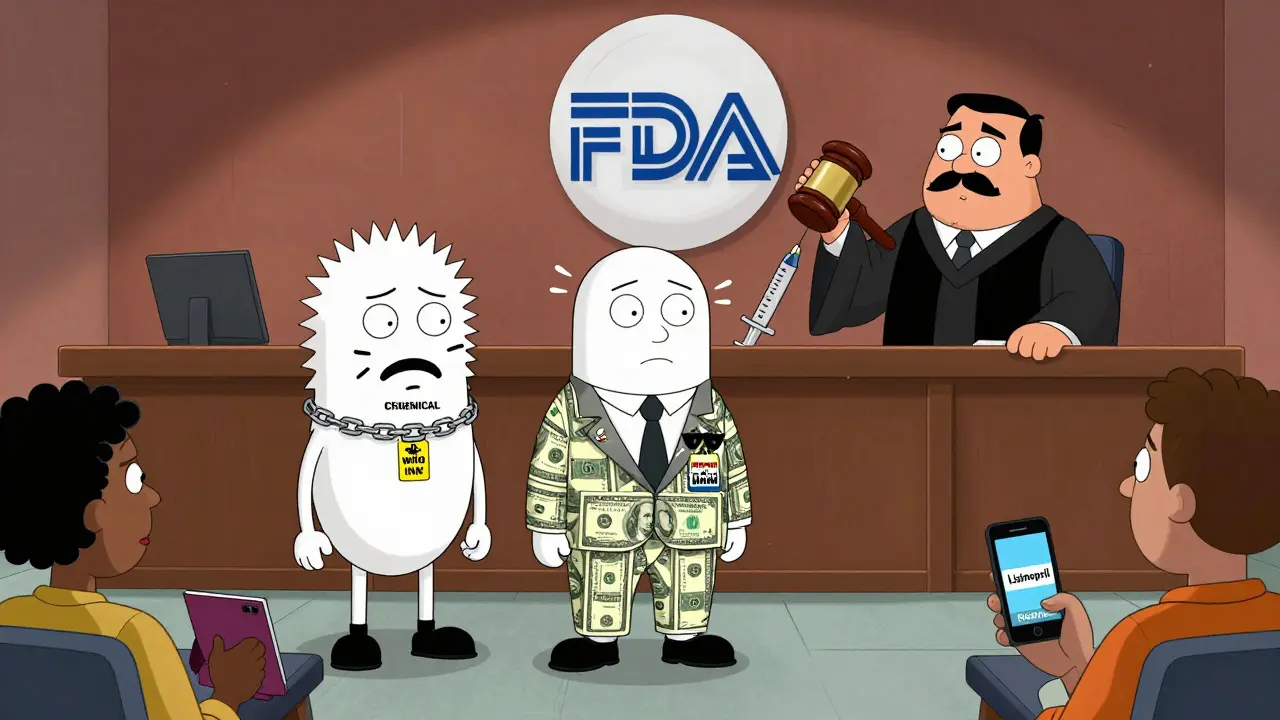
Brand names are all about selling. They’re chosen by pharmaceutical companies-not scientists. Companies spend millions testing names for memorability, pronunciation, and trademark availability. They want something that sticks: “Viagra,” “Lipitor,” “Ozempic.” But there are rules. The FDA won’t approve a brand name if it sounds like another drug. “Zyrtec” and “Zyrtec” might seem harmless, but if they’re too close in spelling or sound, they get rejected.
Here’s how it works: a company might submit 150 to 200 name ideas. The FDA’s Medication Errors team screens them using AI tools that check for similarities across 15,000 existing drug names. About one in three gets turned down. Why? Because a typo or misheard name can lead to the wrong drug being given. In 2022, the FDA recorded 347 medication errors linked to confusing brand or generic names.
Brand names also can’t make claims. You won’t see “Cure-All” or “Blood Pressure Miracle” on a label. The FDA requires that the generic name appear just as prominently as the brand name in all advertising. That’s so you know what you’re really getting. And here’s something most people don’t realize: brand and generic drugs contain the exact same active ingredient. The only differences are color, shape, filler ingredients, and the name on the bottle. That’s why generics cost less-they don’t pay for marketing, ads, or patent protection.
Why this system matters more than you think
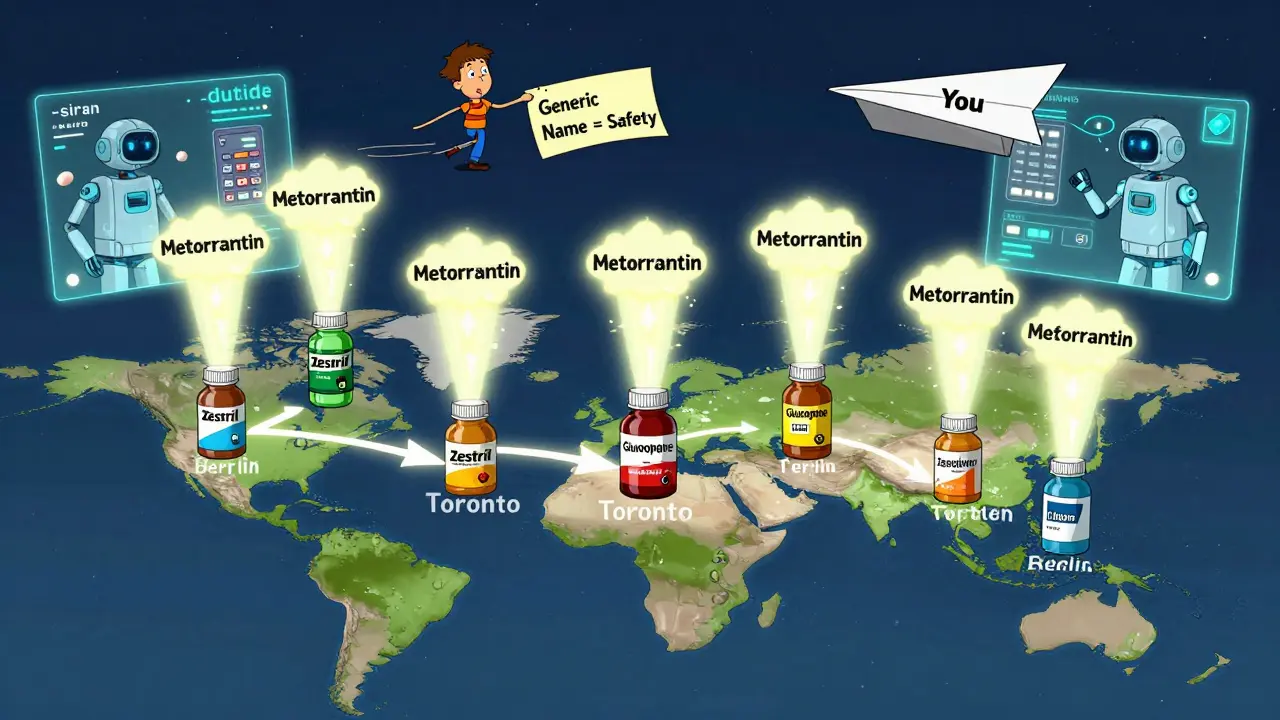
Imagine you’re in a hospital in Sydney, then you travel to Toronto. You’re given a drug with the same generic name: metformin. That’s the same drug. Same molecule. Same effect. No matter where you are, the name doesn’t change. That’s global standardization. Before the WHO’s INN program started in 1953, countries used different names for the same drug. One place called it “glucophage,” another called it “dimethylbiguanide.” Confusion was common. Mistakes were deadly.
Today, over 10,000 INNs have been assigned. About 200 new ones are added every year. The system has helped reduce international medication errors by 18.5% since 2010, according to WHO data. It’s not flashy. It’s not glamorous. But it saves lives.
And it’s evolving. New drug types need new naming rules. RNA therapies? They now use the stem “-siran.” Peptide-drug conjugates? “-dutide.” Protein degraders? The upcoming stem is “-tecan.” The system is designed to grow. The USAN Council now uses AI to scan potential names in milliseconds. It checks for phonetic similarities, visual confusions, and even how the name sounds in different languages.
What you need to know as a patient
You don’t need to memorize chemical names. But you should know your generic name. If your doctor prescribes “Lisinopril,” that’s the drug. Whether it’s sold as “Zestril,” “Prinivil,” or a store-brand version, it’s still Lisinopril. Ask your pharmacist: “Is this the generic version?” They’ll tell you. And if you’re confused by the name-say it out loud. Ask: “Does this end in ‘-prazole’? Is it a blood pressure drug?”
Don’t assume brand names mean better. They don’t. Generics are held to the same FDA standards. The only time you might need the brand version is if you’re allergic to an inactive ingredient in the generic-like dye or lactose. That’s rare, but it happens.
And if you’re ever unsure, write down the generic name. Keep it on your phone. Show it to any new doctor or pharmacist. It’s your safety net.
What’s next for drug naming?
The future of drug naming is getting more complex. New therapies-like gene edits, cell therapies, and personalized medicines-are harder to name. A drug made just for you doesn’t fit neatly into a “-mab” or “-tinib” category. The WHO and USAN Council are working on new rules. AI will play a bigger role. But the goal stays the same: clarity, safety, and consistency.
For now, the system works. It’s not perfect, but it’s the best we have. And it’s the reason you can walk into any pharmacy in the world and get the right medicine-no matter what language they speak, or what brand is on the bottle.
Why do drugs have three different names?
Drugs have three names because each serves a different purpose. The chemical name describes the exact molecular structure and is used by scientists. The generic name is the standardized, nonproprietary name used by healthcare providers to ensure clarity and safety. The brand name is chosen by the manufacturer for marketing and is protected by trademark laws. All three names refer to the same drug, but they’re used in different contexts.
Are generic drugs as effective as brand-name drugs?
Yes. Generic drugs must contain the same active ingredient, strength, dosage form, and route of administration as the brand-name version. They’re required by law to meet the same quality and safety standards set by the FDA and other global regulators. The only differences are in inactive ingredients like fillers, dyes, or flavorings-none of which affect how the drug works in your body.
How are generic drug names chosen?
Generic names are chosen by international bodies like the WHO’s INN Programme and the USAN Council. They follow strict rules: the suffix (or stem) indicates the drug class (like “-prazole” for acid-reducing drugs), and the prefix distinguishes individual drugs. Names are tested for pronunciation, spelling, and similarity to existing drugs. About 30% of proposed names are rejected to avoid confusion.
Can brand names be confusing or dangerous?
Yes. Brand names that sound or look too similar to other drugs can lead to dangerous errors. The FDA rejects about one-third of proposed brand names because they risk confusion. For example, “Zyrtec” and “Zyrtec” might seem harmless, but if they’re too close in spelling or sound, they’re blocked. In 2022, 347 medication errors were reported to the FDA linked to confusing drug names.
Why do some drug names end in ‘-mab’ or ‘-tinib’?
Those endings are stems that tell you the drug’s class and how it works. “-mab” means it’s a monoclonal antibody, often used for cancer or autoimmune diseases. “-tinib” means it’s a tyrosine kinase inhibitor, used to block signals that cause cancer cells to grow. These stems help doctors and pharmacists quickly identify what a drug does, reducing the chance of mistakes.
Do I need to know the chemical name of my drug?
No. Chemical names are for scientists and regulators. As a patient, you only need to know your generic name. That’s what your pharmacist uses, what your doctor writes on the prescription, and what you should reference when asking questions. If you’re curious about the chemical name, your pharmacist can provide it-but you don’t need to memorize it.
Understanding drug names isn’t about becoming a chemist. It’s about becoming a smarter patient. When you know the difference between a brand name and a generic, you can ask the right questions, save money, and avoid dangerous mix-ups. The system was built to protect you. Now you know how to use it.


Reviews
Man, I never thought about how wild it is that my blood pressure med has a name longer than my ex’s Instagram bio. Propranolol? Sure. But that chemical name? I’d need a PhD just to order it at Starbucks.
THIS IS WHY AMERICA IS STILL THE BEST! We don’t let other countries mess with our drug names! The FDA’s got our backs-no sneaky ‘-mab’ imposter drugs slipping in! If you can’t pronounce it, you don’t deserve it!!
It’s not just nomenclature-it’s epistemological scaffolding. The chemical name is the ontological truth; the generic, the phenomenological interface; the brand, the capitalist spectacle. We’re not naming drugs-we’re negotiating the semiotic collapse of medicine into consumerism. The -tinib suffix? That’s not a suffix-it’s a Foucauldian biopower marker. You think you’re taking a pill. You’re actually consenting to a regulatory regime.
And don’t get me started on how the WHO’s INN program is just a neocolonial linguistic hegemony disguised as global health equity. Why should a Nigerian pharmacist learn ‘-siran’ when their local dialect has a perfectly functional term for RNA modulators? The system isn’t safe-it’s sanitized.
Meanwhile, Big Pharma’s marketing teams are out here A/B testing brand names like they’re designing TikTok ads. ‘Ozempic’ sounds like a luxury yacht. ‘Metformin’ sounds like a spreadsheet error. And we wonder why people don’t trust the system?
The real tragedy? We’re all complicit. We click on ‘generic equivalent’ without asking if the filler is gluten-free. We assume ‘same active ingredient’ means same experience. But what about bioavailability? What about gut microbiome modulation? What about the placebo effect embedded in the bottle’s color?
And yet-despite all this-we’re still safer than in 1953. The system is flawed, but it’s the only one that doesn’t kill you by accident. That’s not progress. That’s just… less carnage.
Love this breakdown. It’s like learning the alphabet of your own body. Once you know ‘-prazole’ means acid, you start seeing patterns everywhere. It’s not just medicine-it’s a language. And knowing it? That’s power.
Stop letting pharma sell you fear. Your generic metformin isn’t ‘lesser.’ It’s the same molecule, same effect, same life-saving potential. You’re not buying a brand-you’re buying biology.
And hey-if you’re worried about the color or shape? Talk to your pharmacist. They’ve seen it all. They’ll tell you if it’s safe. No need to overthink it.
Actually, darling, this is why the Global South suffers. You Americans think your FDA is the pinnacle of human achievement. But in Lagos, pharmacies still sell ‘Lipitor’ with no active ingredient. The naming system doesn’t fix corruption. It just makes it prettier. And don’t even get me started on how ‘generic’ drugs in Kenya cost more than brand-name ones because of import taxes. Your ‘global standardization’? It’s a luxury.
Also, ‘-siran’? Cute. But who decided that? A committee in Bethesda? Not a single African scientist had a say. You name our medicines, then tell us to trust you.
Interesting how the -mab suffix evolved from ‘monoclonal antibody’ to a cultural signifier. It’s like ‘-zilla’ in monster movies-once you hear it, you know you’re in for something big. But here’s the twist: the stem system is becoming a self-fulfilling prophecy. New drugs are being designed around naming conventions now, not just pharmacology. We’re engineering molecules to fit the label, not the other way around.
And the AI scanning? Brilliant, but biased. It’s trained on Western drug names. What happens when a Chinese or Indian lab invents a new class? Will their stem get rejected because it ‘sounds too similar’ to ‘-dutide’? The system’s brilliant… until it isn’t.
Of course the FDA rejects 30% of names. People are idiots. If you can’t come up with a name that doesn’t sound like ‘Zyrtec’ or ‘Vigabatrin,’ you shouldn’t be in pharma. I mean, really. Do you want your grandma to accidentally take a schizophrenia drug because someone misspelled ‘Alprazolam’? That’s not a mistake-that’s negligence. And the fact that people still think brand names are ‘better’? Pathetic. You’re paying for glitter, not medicine.
Propranolol’s chemical name is like a Shakespearean sonnet written by a robot. 1-(isopropylamino)-3-(1-naphthyloxy)propan-2-ol? That’s not a name-it’s a cry for help. Meanwhile, ‘Inderal’ sounds like a luxury spa treatment. And ‘Propranolol’? Just… chill. It’s the Goldilocks name. Not too sci-fi. Not too salesy. Just right.
Also, I just learned ‘-siran’ is for RNA stuff? That’s fire. Like, if ‘-mab’ is the superhero, ‘-siran’ is the glitch in the matrix. Future medicine is gonna sound like a sci-fi game.
Let’s be real: this whole system is a distraction. The real issue? Drug prices. You think knowing ‘-prazole’ makes you smarter? It doesn’t lower your co-pay. The FDA’s naming rules are just theater. Meanwhile, insulin still costs $300. And no one’s naming that crisis.
Also, ‘-tinib’? Sounds like a rejected Pokémon. Who thought that was a good idea?
generic drugs are the same but sometimes they make me feel weird idk maybe its the fillers??
It is not merely ‘informal’ or ‘colloquial’ to refer to pharmaceutical nomenclature in this manner. The casual tone employed throughout this article undermines the gravitas of regulatory science. Furthermore, the assertion that ‘you don’t need to memorize chemical names’ is dangerously reductive. A patient who does not understand the molecular basis of their therapy is not an empowered patient-they are a passive recipient. The WHO’s INN system, while commendable, remains an imperfect artifact of 20th-century pharmacology. The future demands precision-not simplification.
Great post. Seriously. This is the kind of info everyone should know. I used to panic when my pill looked different. Now I just check the generic name. Saved me $80 last month. Thanks for making it simple.
Y’all are missing the point. This isn’t about names-it’s about control. Who gets to name your medicine? Who decides what ‘safe’ looks like? The WHO? The FDA? Pharma execs with 150 name ideas and a focus group of 12 people?
We think we’re being protected. But we’re being curated. The system works… because we let it. And that’s the most dangerous thing of all.
Interesting! 😊 In Nigeria, we call some drugs by their brand names even when generic is cheaper. Maybe because we trust the name more? But your point about generic being same-yes! I told my cousin this last week. She switched and saved money. 🙌
THEY’RE LYING. The ‘same active ingredient’ is a lie. They change the fillers to make you dependent. The brand version has ‘hidden’ ingredients that make you feel better. That’s why you get withdrawal if you switch. Big Pharma knows. They don’t want you to know. 😡
@6525 bro… no. If that were true, every single generic drug would be a death trap. The FDA requires bioequivalence testing. Same absorption. Same effect. Your ‘hidden ingredients’ theory is what makes people buy $200 brand pills when $4 generics work just fine. Chill. 😅