
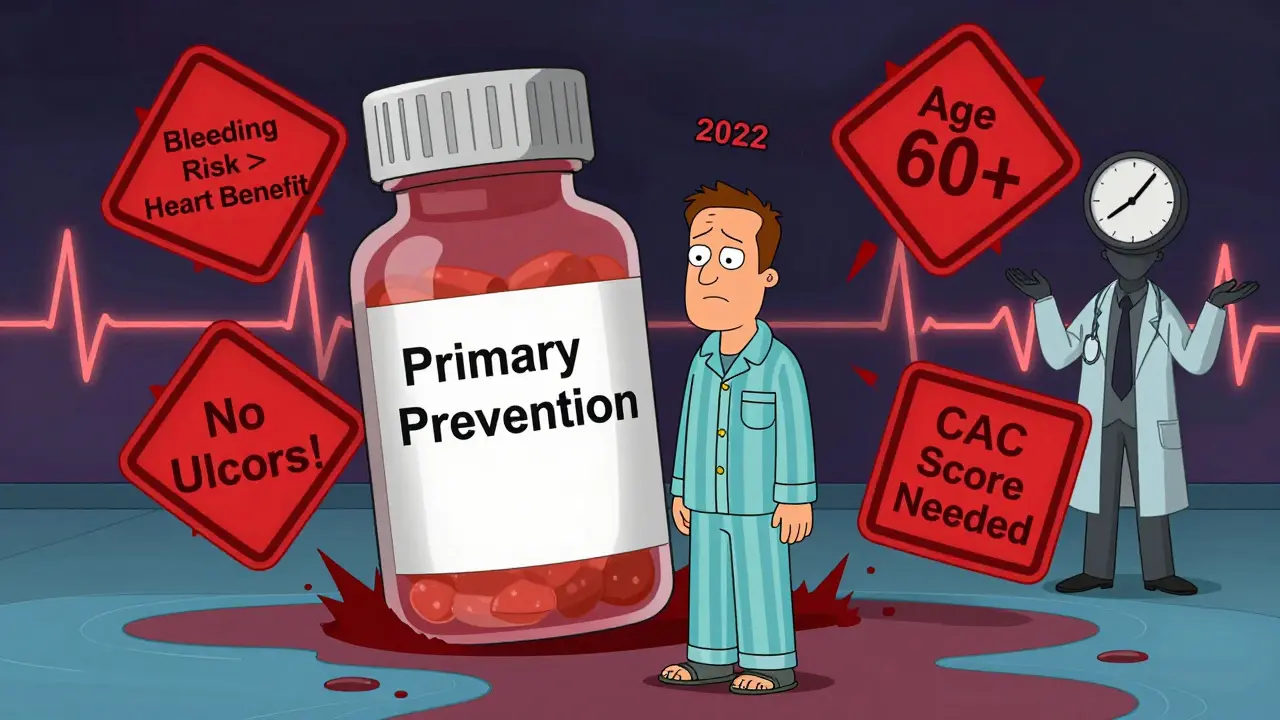
For years, taking a daily low-dose aspirin was seen as a simple, cheap way to protect your heart-especially if you were over 50. But that advice has changed. Aspirin is no longer recommended for most healthy adults as a routine preventive measure. In fact, for many people, taking it daily does more harm than good.
Why the Rules Changed
Back in the 1990s, studies showed aspirin could lower the chance of a first heart attack. That led to millions of people popping a pill every day, even if they had no heart disease. But newer, larger studies-like the ASPREE trial published in 2018 and updated analyses through 2023-revealed a troubling truth: the benefits were tiny, and the risks were real. The biggest danger? Bleeding. Aspirin thins your blood. That helps prevent clots that cause heart attacks and strokes. But it also means you’re more likely to have serious internal bleeding-especially in the stomach or brain. For people without existing heart disease, the math doesn’t add up. The number of people who avoid a heart attack by taking aspirin is almost the same as the number who suffer a dangerous bleed. In 2022, the U.S. Preventive Services Task Force (USPSTF) flipped its recommendation. They now say: do not start daily aspirin if you’re 60 or older. For people between 40 and 59, it’s not a blanket yes or no-it’s a personal decision, based on your specific risks.Who Should Definitely Skip Aspirin
If you fall into any of these groups, you should not take daily aspirin for heart protection:- Age 60 and older-This is the clearest group. For every 1,000 people over 60 taking aspirin for 10 years, about 1.6 will have a major bleed, but only 0.9 will avoid a heart attack. The harm outweighs the help.
- History of stomach ulcers or GI bleeding-If you’ve had a bleeding ulcer, or even frequent heartburn that required treatment, aspirin can trigger another episode. About 4% of U.S. adults have a history of ulcers.
- Taking other blood thinners-If you’re on warfarin, apixaban, rivaroxaban, or even regular NSAIDs like ibuprofen or naproxen, adding aspirin increases your bleeding risk by up to 3 times.
- High risk of falls or frailty-Older adults who are unsteady, have balance issues, or live alone are at higher risk of head injuries. A minor bump can turn into a brain bleed when you’re on aspirin.
- Known bleeding disorders-Conditions like hemophilia or von Willebrand disease make aspirin dangerous, regardless of age.
Who Might Still Benefit (But Only With Care)
There’s a small group where aspirin might still make sense-but only after careful testing and discussion with your doctor.- Adults 40-59 with 10% or higher 10-year heart disease risk-This is calculated using tools like the Pooled Cohort Equations. If your risk is below 10%, aspirin won’t help. If it’s above 10%, you and your doctor need to weigh the bleeding risk.
- People with very high coronary calcium scores (CAC > 100)-A CAC scan shows how much plaque is in your heart arteries. If your score is over 300, your risk is high enough that aspirin might tip the balance toward benefit. Some cardiologists still recommend it in these cases, despite general guidelines.
- People with type 2 diabetes and high ASCVD risk (≥15%)-New 2025 guidelines say aspirin might be considered for diabetic adults aged 40-70 if their 10-year risk is high and bleeding risk is low.
Even in these cases, aspirin isn’t automatic. You need a full risk assessment-no shortcuts.
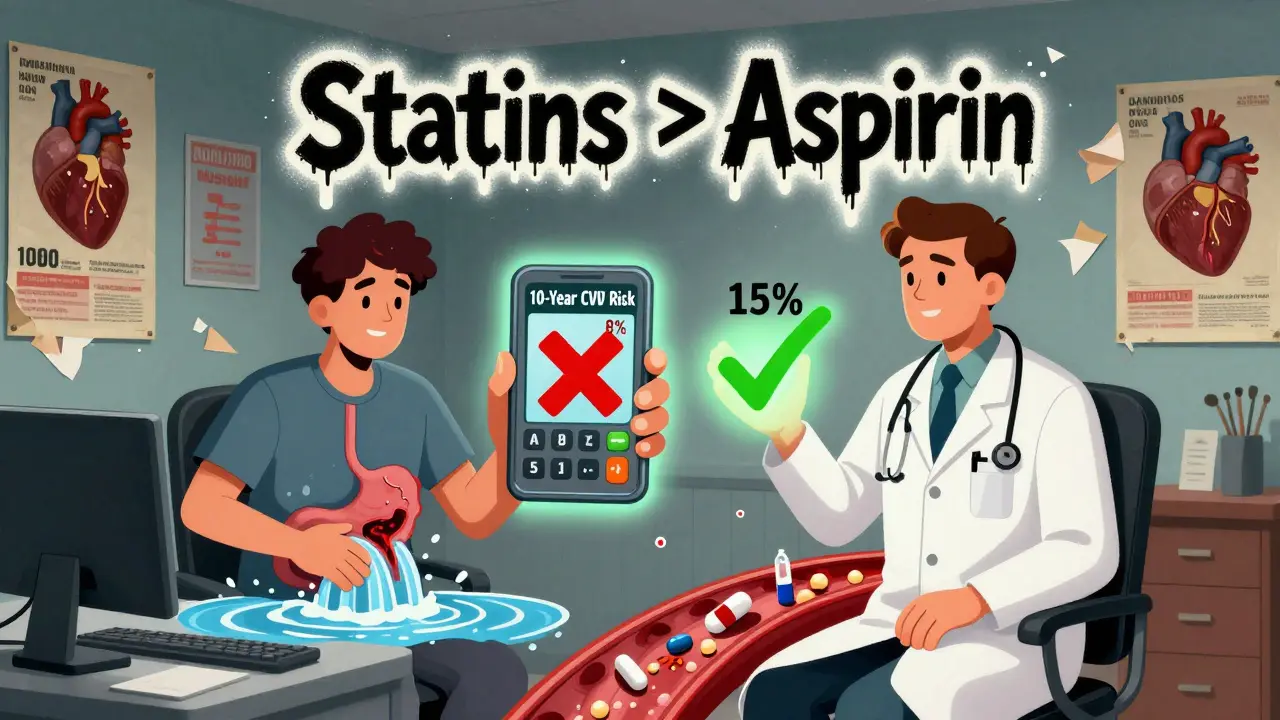
What About Diabetes? It’s Complicated
Diabetes increases heart disease risk, so it’s tempting to assume aspirin helps. But studies show mixed results. A 2024 meta-analysis found aspirin reduced heart events by 19% in diabetics with high Lp(a)-a genetic cholesterol particle linked to plaque buildup. But for diabetics with normal Lp(a), there was no benefit at all. That means: not all diabetics are the same. If you have diabetes, don’t assume aspirin is right for you. Ask for an Lp(a) blood test and a CAC scan. If both are high, and you’re under 70 with no bleeding history, aspirin might be worth discussing. Otherwise, skip it.Why So Much Confusion Among Doctors?
You’ve probably heard conflicting advice. One doctor says stop. Another says keep going. That’s because guidelines changed fast, and not everyone caught up. A 2023 survey of 1,500 patients found 41% of adults 60+ were still taking aspirin daily-even after the 2022 guidelines. Why? Fear. Many people believe, “I’ve been taking it for 10 years, what if I stop and have a heart attack?” The truth? If you’ve never had a heart attack or stroke, and you’re over 60, stopping aspirin won’t suddenly put you at risk. In fact, the risk of bleeding goes down immediately after you stop. Cardiologists are more likely to continue aspirin than primary care doctors. One reason: cardiologists see patients who already have advanced plaque. They’re more likely to think, “This person is at high risk, so I’ll err on the side of caution.” But the data doesn’t support that approach for primary prevention.
How to Know If You Should Stop
If you’re on daily aspirin and unsure whether to keep going, here’s what to do:- Check your age-If you’re 60 or older, the answer is almost certainly no.
- Review your bleeding history-Have you ever had a stomach bleed, black stools, or needed a blood transfusion?
- Look at your medications-Are you on NSAIDs, blood thinners, or steroids? That raises your risk.
- Ask for your 10-year CVD risk score-Ask your doctor to run the Pooled Cohort Equations. If it’s under 10%, aspirin isn’t helping.
- Consider a CAC scan-If you’re 40-59 and your risk is borderline, a calcium scan can clarify your true heart disease risk.
If all signs point to high bleeding risk or low heart risk, talk to your doctor about stopping. Don’t quit cold turkey without advice-but don’t keep taking it out of habit either.
The Bottom Line
Aspirin isn’t a magic bullet for heart health. For most people, it’s a drug with risks that outweigh its benefits. The days of “take one a day” as a blanket recommendation are over. If you’re under 40, don’t start. If you’re 60+, stop-unless your doctor has a very strong, personalized reason to keep you on it. If you’re between 40 and 59, get tested. Know your numbers. Don’t guess. The real heart-healthy habits? Eating vegetables, walking daily, controlling blood pressure, not smoking, and managing cholesterol. Those things work. Aspirin? It only helps in rare, specific cases-and even then, only if the risks are low.Frequently Asked Questions
Is it safe to stop taking aspirin if I’ve been on it for years?
Yes, it’s generally safe to stop daily aspirin if you’re using it for primary prevention and don’t have heart disease. There’s no rebound effect like with some blood pressure meds. Your blood’s clotting ability returns to normal within a few days. The biggest risk is continuing it when you shouldn’t-bleeding doesn’t wait.
Can I take aspirin occasionally for pain instead of daily?
Yes. Taking aspirin once in a while for a headache, muscle pain, or fever doesn’t carry the same bleeding risk as daily use. The danger comes from constant, low-dose exposure. Occasional use is fine for most people without bleeding disorders.
Does enteric-coated aspirin reduce bleeding risk?
No. Enteric-coated aspirin is marketed as easier on the stomach, but studies show it doesn’t reduce the risk of major bleeding. It may delay absorption slightly, but it doesn’t prevent damage to the gut lining or reduce the chance of brain bleeds. Don’t rely on it for safety.
What’s the best alternative to aspirin for heart protection?
There’s no pill that replaces the proven benefits of lifestyle changes. Focus on eating more plants, moving daily, keeping blood pressure under control, and managing cholesterol with statins if needed. For high-risk patients, statins reduce heart events far more than aspirin-and with fewer bleeding risks.
Will my doctor test my bleeding risk before prescribing aspirin?
Not always. Many doctors still rely on age or diabetes status alone. You need to ask. Request a bleeding risk assessment using tools like HAS-BLED, and ask if your 10-year heart disease risk has been calculated. If your doctor doesn’t mention these, it’s on you to bring them up.
Are there new tests that can tell if aspirin will help me?
Yes, but they’re not routine yet. Coronary calcium scans (CAC) and Lp(a) blood tests are the most useful. A CAC score over 100 suggests significant plaque, making aspirin more likely to help. Lp(a) above 50 mg/dL is another red flag for high risk. Genetic tests for aspirin response are still experimental.
I’m on aspirin for secondary prevention-does this apply to me?
No. These guidelines only apply to people without existing heart disease (primary prevention). If you’ve had a heart attack, stroke, stent, or bypass surgery, you should stay on aspirin unless your doctor says otherwise. The rules are very different for secondary prevention.



Reviews
So let me get this straight-we’re telling people to stop taking a $5-a-year pill that might save their heart… but we’re fine with them spending $1,200 a year on kale smoothies and Fitbits? 😒 The real problem isn’t aspirin. It’s that we’ve turned healthcare into a cult of performative wellness. 🧠💊
hiiii... i read this... and i am so confused now... my uncle in delhi takes aspirin daily since 1998... he is 72... no heart attack... no bleed... so... what is the truth? 🤔
It’s like we’ve turned medicine into a game of Russian roulette with a twist: the gun’s loaded with both hope and hemorrhage. Aspirin used to be the quiet hero of the medicine cabinet-now it’s the unreliable ex you still keep texting, hoping they’ll change. The data doesn’t lie, but our habits? Oh, they’re stubborn little beasts.
so i stopped my aspirin last year and honestly? my anxiety went down more than my heart risk went up. maybe it was placebo. maybe it was just not taking a pill every morning. idk. but i feel lighter. 🤷♀️
Primary prevention? Please. You're applying population-level RCTs to individual bioindividuality. The Pooled Cohort Equations are statistically elegant but clinically myopic. Without Lp(a) stratification and CAC scoring, you're engaging in evidence-based guesswork dressed up as protocol. The real risk is not aspirin-it's algorithmic medicine divorced from clinical intuition.
i never knew enteric-coated didnt help... i thought it was magic. oops. 😅
my dad is 65 and he’s been on aspirin since he was 50. he’s healthy, walks 5 miles every day, eats clean. i told him to talk to his doc. he said, ‘if it ain’t broke, why fix it?’ i get it. but now i’m worried. maybe we need better tools to tell who’s really at risk.
You know what’s beautiful? That we’re finally moving away from one-size-fits-all medicine 💪❤️🩹. Even if it feels scary to stop something you’ve done for years, you’re not alone. Talk to your doc. Get that CAC scan. Check your Lp(a). You’re not just a statistic-you’re someone who deserves to make an informed choice. And hey-if you need someone to cheer you on while you ditch the aspirin? I’m here. You got this! 🌈✨
So if you’re under 40, don’t start. Over 60, stop. 40-59? Get tested. Unless you’re rich enough to afford a CAC scan and an Lp(a) test, you’re just guessing. Congrats, America-you’ve turned heart health into a luxury subscription.