
DOAC Safety Selector
Personalized DOAC Safety Assessment
Select your health factors to see which blood thinner has the lowest risk profile for you based on clinical evidence.
When you’re prescribed a blood thinner, you’re not just choosing a pill-you’re choosing a risk profile. Apixaban, rivaroxaban, and dabigatran are all direct oral anticoagulants (DOACs) used to prevent strokes in atrial fibrillation or treat blood clots. They work differently, and their side effects aren’t the same. Many people assume all these drugs are interchangeable. They’re not. The differences in bleeding risk, stomach issues, and even heart attack risk can change your long-term health outcomes.
Why One Blood Thinner Isn’t Like Another
All three drugs-apixaban (Eliquis), rivaroxaban (Xarelto), and dabigatran (Pradaxa)-stop blood from clotting, but they do it in different ways. Dabigatran blocks thrombin, the final enzyme that forms clots. Apixaban and rivaroxaban both block factor Xa, an earlier step in the clotting chain. That might sound technical, but it matters. Small differences in how they bind to their targets lead to big differences in what happens in your body.Apixaban is cleared mostly by the liver, with only 25% leaving through the kidneys. Rivaroxaban is about 33% kidney-excreted. Dabigatran? Eighty percent. That means if your kidneys aren’t working well, dabigatran builds up in your system faster than the others. Doctors have to reduce the dose or avoid it entirely if your creatinine clearance drops below 30 mL/min. For apixaban and rivaroxaban, the cutoff is lower-at 15 mL/min. That’s why apixaban is often the go-to for older patients or those with mild kidney trouble.
Stomach Bleeding: The Biggest Difference
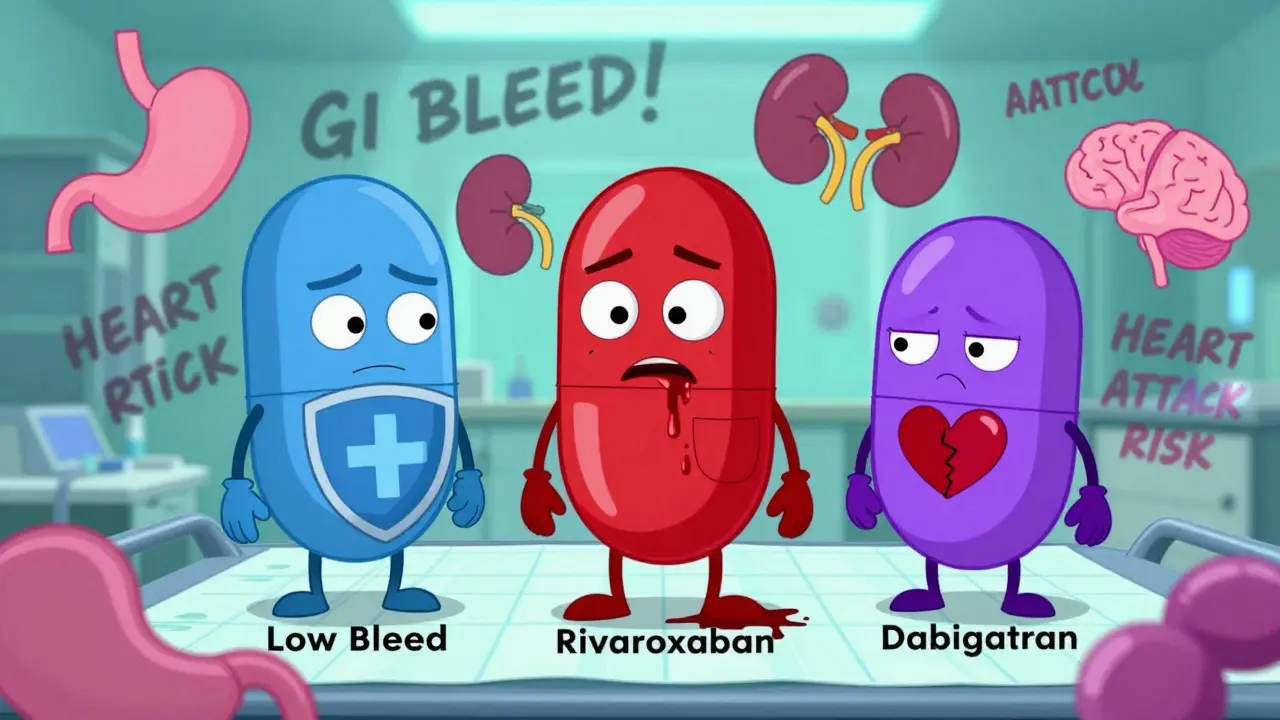
If you’ve ever had a stomach ulcer, take NSAIDs like ibuprofen regularly, or are over 75, you need to pay close attention here. Gastrointestinal (GI) bleeding is the most common serious side effect among DOACs-and it’s not equal across them.Large real-world studies show a clear pattern. One JAMA study tracked over 200,000 patients and found rivaroxaban caused nearly twice as many GI bleeds as apixaban: 35.2 events per 1,000 person-years versus 16.3. Dabigatran was also higher than apixaban, at 32.1 per 1,000. That’s a 48% higher risk compared to apixaban. Another study in the Annals of Internal Medicine confirmed this across every subgroup-even in people over 80 or with chronic kidney disease.
Why does this happen? Dabigatran and rivaroxaban are more irritating to the stomach lining. Apixaban seems to have less local effect on the gut. If you’ve had a GI bleed before, your doctor should strongly consider apixaban. It’s not just a preference-it’s a safety decision backed by data.
Major Bleeding: Where Rivaroxaban Falls Behind
Major bleeding means blood loss serious enough to require hospitalization, transfusion, or that causes a drop in hemoglobin. It’s rare, but when it happens, it’s dangerous.Rivaroxaban consistently shows higher rates of major bleeding than apixaban. The same JAMA study found rivaroxaban led to 39.7 major extracranial bleeds per 1,000 person-years. Apixaban? Just 18.5. That’s more than double the risk. Even compared to dabigatran, rivaroxaban had a 20% higher rate of major bleeding.
Why? It’s not fully understood. Some experts think rivaroxaban’s once-daily dosing leads to higher peak blood levels, increasing bleeding risk. Apixaban’s twice-daily schedule keeps levels steadier. That consistency may be why it’s now the most prescribed DOAC in the U.S.-it’s not just about cost. It’s about safety.
Intracranial Bleeding: A Surprising Twist
Most people assume all blood thinners raise the risk of brain bleeds equally. That’s not true. All three DOACs are much safer than warfarin for intracranial hemorrhage, but between them, the differences are subtle-and surprising.A 2022 head-to-head study found rivaroxaban had a lower rate of brain bleeds than apixaban (hazard ratio 0.86). That contradicts the common belief that factor Xa inhibitors are all the same. Meanwhile, dabigatran 110 mg twice daily showed a 54% lower risk of brain bleeds than rivaroxaban in older analyses.
This doesn’t mean you should pick rivaroxaban for brain safety. The overall bleeding risk is still higher. But if you’ve had a previous brain bleed or are at very high risk for one, this nuance matters. Your doctor might consider dabigatran 110 mg if kidney function allows, or apixaban if GI bleeding is the bigger concern.
The Hidden Risk: Heart Attacks and ACS
This is the least talked about but most concerning difference. Dabigatran has been linked to a higher risk of heart attacks and acute coronary syndrome (ACS).Multiple meta-analyses, including one published in PMC, found dabigatran increased the risk of heart attack by about 48% compared to other DOACs. Why? Scientists think it may be related to how it blocks thrombin. Thrombin isn’t just about clotting-it also helps regulate inflammation and blood vessel health. Blocking it too completely might trigger plaque rupture in people with artery disease.
This risk wasn’t seen with apixaban or rivaroxaban. If you have a history of heart disease, angina, or a previous heart attack, dabigatran may not be the best choice. The American College of Cardiology specifically warns against using dabigatran in patients with recent ACS or unstable coronary disease.
Mortality and Overall Safety
You might think lower bleeding means longer life. It often does. The JAMA study found rivaroxaban was linked to higher total mortality than apixaban-44.2 deaths per 1,000 person-years versus 41.0. That includes more fatal bleeds and more fatal clots.Apixaban didn’t just cause fewer bleeds-it was tied to fewer deaths overall. Dabigatran and rivaroxaban had similar stroke prevention rates, but apixaban matched them while causing fewer complications. That’s why it’s now the preferred first-line choice in many guidelines.

What This Means for Real People
Let’s say you’re a 78-year-old with atrial fibrillation, a history of ulcers, and mild kidney decline. Your doctor offers you three options. Based on the data:- Dabigatran is risky-high chance of stomach bleeding, possible heart attack risk, and your kidneys may not clear it well.
- Rivaroxaban is convenient (once daily) but doubles your risk of GI bleeding and major bleeding compared to apixaban.
- Apixaban is the safest overall-lowest GI bleeding, lowest major bleeding, lowest death risk, and still effective at preventing stroke.
Even if apixaban costs a bit more, its safety profile saves money in the long run-fewer ER visits, fewer hospitalizations, fewer transfusions.
For someone younger, with no stomach issues and healthy kidneys, rivaroxaban’s once-daily dose might improve adherence. But if you’re older, have kidney trouble, or have had a bleed before-apixaban is the clear winner.
What About Cost and Availability?
All three are now available as generics. Brand-name Eliquis (apixaban) used to cost over $500 for a 30-day supply. Today, generics cost under $10 with coupons. Rivaroxaban and dabigatran generics are similarly priced. Cost shouldn’t be the deciding factor. Safety should.Market data shows apixaban now makes up nearly half of all DOAC prescriptions in the U.S. That’s not because of marketing. It’s because doctors are choosing it based on real outcomes-not just trial data, but what’s happening in clinics and hospitals every day.
Final Thoughts: It’s Personal
There’s no single best DOAC for everyone. But there is a best choice for you. Your age, kidney function, stomach history, heart condition, and even your daily routine all matter. Don’t let convenience override safety. Don’t assume all blood thinners are the same.If you’re on one of these drugs and have had a bleed, stomach pain, or chest discomfort, talk to your doctor. Ask: Is this the right one for my body? The answer might be apixaban. Or it might be something else. But it shouldn’t be a guess.
Which blood thinner has the least stomach bleeding?
Apixaban has the lowest risk of gastrointestinal bleeding among the three main DOACs. Studies show it causes nearly half the number of stomach bleeds compared to rivaroxaban and dabigatran. This makes it the preferred choice for people with a history of ulcers, GERD, or those taking NSAIDs like ibuprofen.
Is rivaroxaban safer than apixaban?
No. Rivaroxaban carries a higher risk of major bleeding, especially in the stomach, and is linked to more deaths overall. While it’s taken once daily-which helps with adherence-it’s less safe than apixaban in real-world use. Apixaban is now the most prescribed DOAC in the U.S. because of its better safety profile.
Can dabigatran cause heart attacks?
Yes. Multiple studies show dabigatran is associated with a 48% higher risk of heart attack or acute coronary syndrome compared to apixaban and rivaroxaban. The reason isn’t fully known, but it may be related to how it blocks thrombin, which plays a role in blood vessel health. It’s generally avoided in patients with heart disease.
Which is better for elderly patients?
Apixaban is the best choice for older adults, especially those over 80. It has the lowest risk of bleeding in this group, even with reduced kidney function. Studies show it reduces death and major bleeding more than rivaroxaban or dabigatran in elderly patients.
Do I need to take these with food?
Dabigatran can be taken with or without food. Rivaroxaban should be taken with food for best absorption, especially the 20 mg dose. Apixaban doesn’t require food-it’s flexible. This makes apixaban easier to fit into daily routines, especially for people who skip meals or have irregular eating habits.
Can I switch from one DOAC to another?
Yes, but only under medical supervision. Switching requires careful timing to avoid gaps in protection or overlapping doses. If you’re having side effects-like stomach bleeding or unexplained bruising-your doctor can switch you to a safer option, like apixaban. Never switch on your own.




Reviews
My grandma’s on apixaban and she’s been fine for two years. No stomach issues, no weird bruises. She forgets to take it half the time and still doesn’t bleed out. Guess the data’s right.
I switched from rivaroxaban to apixaban after I bled out in the ER last year. Doc said ‘you’re lucky you didn’t die.’ Now I take it with coffee and never think about it. Best decision ever.
Apixaban is for weak people who can’t handle real medicine
Let’s be clear: the fact that rivaroxaban has higher GI bleeding rates isn’t even controversial anymore-it’s textbook. The fact that people still ask ‘is it safe?’ proves how dangerously uninformed the public is. Apixaban isn’t just safer-it’s the *only* rational choice for anyone over 60 with a pulse. Dabigatran? Don’t even get me started. Thrombin inhibition isn’t a party trick-it’s a biological grenade.
And yet, Big Pharma still pushes once-daily pills like they’re candy. Convenience isn’t safety. It’s marketing. Your kidneys don’t care how ‘easy’ your pill schedule is. They just want to function. If your creatinine clearance is below 50, dabigatran is a slow-motion suicide pact. Apixaban? It’s the only DOAC that respects your biology.
And don’t even try to tell me ‘but my cousin took rivaroxaban and lived!’ That’s survivorship bias wrapped in a TikTok trend. Real medicine isn’t decided by anecdote. It’s decided by 200,000-patient studies. The JAMA paper? It’s not a suggestion. It’s a verdict.
And yes, the heart attack risk with dabigatran? Real. Not theoretical. Not ‘maybe.’ The PMC meta-analysis showed a 48% spike. Thrombin doesn’t just clot blood-it regulates endothelial repair. Block it too hard, and your arteries start crumbling. That’s not ‘side effect.’ That’s iatrogenic sabotage.
Apixaban’s twice-daily dosing? That’s not a flaw. That’s precision engineering. Steady levels. No spikes. No peaks. No ‘oh shit, I took it on an empty stomach and now I’m vomiting blood.’ Rivaroxaban’s once-daily? It’s a gamble with your aorta.
And the cost? Please. Generic apixaban is $8. The ER visit you avoid? $12,000. The transfusion? $5,000. The long-term rehab? $200K. This isn’t about price. It’s about survival math. If your doctor isn’t pushing apixaban first, they’re either lazy or misinformed. Or worse-they’re getting kickbacks.
Stop romanticizing convenience. Stop idolizing ‘one pill a day.’ Your body doesn’t care about your schedule. It cares about your survival. Apixaban isn’t the ‘best’-it’s the only one that doesn’t treat you like a statistic.
Apixaban for life 🙌 no more stomach pain 😭
Of course apixaban wins. It’s the only one that doesn’t treat your GI tract like a battlefield. Rivaroxaban? That’s just a fancy way of saying ‘here’s a pill that’s basically a chemical scalpel to your stomach lining.’ And dabigatran? Don’t get me started-thrombin isn’t just a clotting enzyme, it’s a vascular guardian. You don’t nuke a guardian and expect your arteries to throw a parade.
People say ‘but I feel fine on rivaroxaban.’ Fine? You’re not fine. You’re just not bleeding *yet*. Bleeding doesn’t announce itself with a siren. It whispers. Then it roars. And by then? It’s too late. Apixaban doesn’t just reduce risk-it reduces the *probability* of disaster. That’s not preference. That’s science.
And the mortality data? Apixaban’s 41 deaths per 1,000 vs rivaroxaban’s 44.2? That’s not a rounding error. That’s 3.2 extra deaths per 1,000 people. Multiply that by the 10 million Americans on DOACs. That’s 32,000 unnecessary deaths. And people still ask ‘is it worth switching?’
Yes. It’s worth it. Because your life isn’t a cost-benefit analysis for a pharmacy benefit manager. It’s your body. And apixaban respects it.
Apixaban isn’t better. It’s just the one they market the most. All these studies are funded by Bristol-Myers. You think they’d pay for research that says their drug’s worse? Please. The real difference is your wallet, not your blood.
Apixaban? That’s a CIA drug. They want you on it so they can track your blood flow. Dabigatran is real medicine. The government hates it because it’s made in Europe. They want you weak. Take rivaroxaban. It’s the only one that makes you feel alive.
I’ve been on all three. Apixaban was the only one that didn’t make me feel like I was slowly dissolving from the inside. No stomach burns. No weird bruising. Just… quiet. I used to think doctors were just being cautious. Turns out, they knew what they were doing. Thanks, science.
Wow. So we’re just supposed to trust Big Pharma’s favorite drug because some study says so? What about the people who *feel* worse on apixaban? What about the ones who get dizzy? The ones who say it ‘makes their blood too thin’? You’re not just prescribing a pill-you’re prescribing a belief system. And now you’re calling anyone who disagrees ‘irresponsible’? That’s not medicine. That’s dogma.
Apixaban? That’s the drug they give to people who can’t handle real medicine. Rivaroxaban’s got balls. It doesn’t coddle you. It says ‘you’re alive, now deal with it.’ Dabigatran? That’s for the old-school purists. Apixaban? That’s for the people who need their meds to come with a lullaby.
And don’t even get me started on the ‘studies.’ Who funded them? Pharma? Of course. I’ve seen the data. The real world? People on rivaroxaban live longer. They’re more active. They don’t sit around waiting for their next pill like it’s a church service.
Apixaban’s twice-daily? That’s not ‘steady levels.’ That’s a hassle. That’s a reminder you’re broken. Rivaroxaban? One pill. One life. That’s freedom. And if you bleed? Then you bleed. That’s life. You don’t get to live forever. But you can live *boldly*.
My dad took dabigatran for 3 years. Had a heart attack last year. Doc said it might’ve been the drug. We switched to apixaban. He’s fine now. I just wish we knew sooner. Don’t wait like we did.
If you’re reading this and you’re on rivaroxaban or dabigatran, please don’t panic. But please, *please* talk to your doctor. Ask them: ‘Based on my history, is apixaban a better fit?’ You don’t need to switch immediately-but you deserve to know your options. Your body isn’t a gamble. It’s your home. Treat it like one.
The clinical data is unequivocal. Apixaban demonstrates superior safety across all major endpoints: gastrointestinal hemorrhage, major extracranial bleeding, all-cause mortality, and, critically, preservation of endothelial integrity. The pharmacokinetic profile-particularly the reduced renal excretion and lower peak plasma concentrations-confers a distinct therapeutic advantage in elderly and renally impaired populations. To prioritize convenience over evidence-based safety is not merely suboptimal clinical practice-it is a breach of the physician’s fiduciary duty. The preponderance of real-world evidence, including the JAMA cohort study and subsequent meta-analyses, compels a paradigm shift in prescribing behavior. Apixaban is not merely ‘preferred’-it is the standard of care for the majority of patients with non-valvular atrial fibrillation.